

7 Numerical Simulation of Generation, Distribution, and Impact …
93
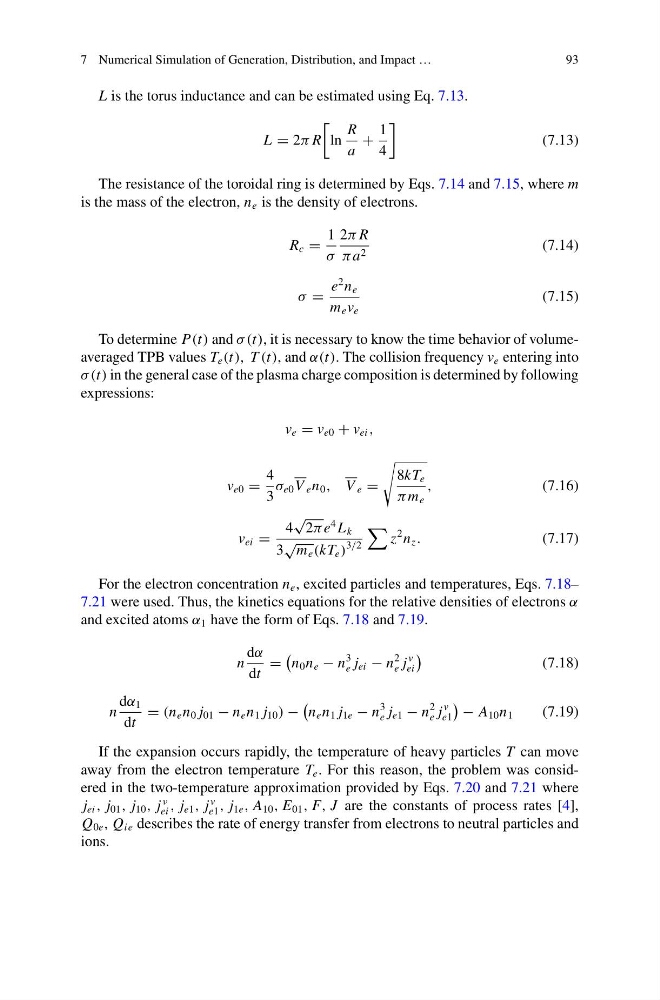
L is the torus inductance and can be estimated using Eq. 7.13.
L = 2π R
ln
R
a
+
1
4
(7.13)
The resistance of the toroidal ring is determined by Eqs. 7.14 and 7.15, where m
is the mass of the electron, n e is the density of electrons.
R c =
1
σ
2π R
πa 2
(7.14)
σ =
e
2 n e
m e v e
(7.15)
To determine P(t) and σ (t), it is necessary to know the time behavior of volumeaveraged TPB values T e (t), T (t), and α(t). The collision frequency v e entering into
σ (t) in the general case of the plasma charge composition is determined by following
expressions:
v e = v e0 + v ei ,
v e0 =
4
3
σ e0 V e n 0 , V e =
8kT e
π m e
,
(7.16)
v ei =
4
√
2πe
4 L k
3
√ m e (kT e )
3/2
z
2 n z .
(7.17)
For the electron concentration n e , excited particles and temperatures, Eqs. 7.18–
7.21 were used. Thus, the kinetics equations for the relative densities of electrons α
and excited atoms α 1 have the form of Eqs. 7.18 and 7.19.
n
dα
dt
=
n 0 n e − n
3
e j ei − n
2
e j
v
ei
(7.18)
n
dα 1
dt
= (n e n 0 j 01 − n e n 1 j 10 ) −
n e n 1 j 1e − n
3
e j e1 − n
2
e j
v
e1
− A 10 n 1
(7.19)
If the expansion occurs rapidly, the temperature of heavy particles T can move
away from the electron temperature T e . For this reason, the problem was considered in the two-temperature approximation provided by Eqs. 7.20 and 7.21 where
j ei , j 01 , j 10 , j
ν
ei , j e1 , j
v
e1 , j 1e , A 10 , E 01 , F, J are the constants of process rates [4],
Q 0e , Q ie describes the rate of energy transfer from electrons to neutral particles and
ions.
93
L is the torus inductance and can be estimated using Eq. 7.13.
L = 2π R
ln
R
a
+
1
4
(7.13)
The resistance of the toroidal ring is determined by Eqs. 7.14 and 7.15, where m
is the mass of the electron, n e is the density of electrons.
R c =
1
σ
2π R
πa 2
(7.14)
σ =
e
2 n e
m e v e
(7.15)
To determine P(t) and σ (t), it is necessary to know the time behavior of volumeaveraged TPB values T e (t), T (t), and α(t). The collision frequency v e entering into
σ (t) in the general case of the plasma charge composition is determined by following
expressions:
v e = v e0 + v ei ,
v e0 =
4
3
σ e0 V e n 0 , V e =
8kT e
π m e
,
(7.16)
v ei =
4
√
2πe
4 L k
3
√ m e (kT e )
3/2
z
2 n z .
(7.17)
For the electron concentration n e , excited particles and temperatures, Eqs. 7.18–
7.21 were used. Thus, the kinetics equations for the relative densities of electrons α
and excited atoms α 1 have the form of Eqs. 7.18 and 7.19.
n
dα
dt
=
n 0 n e − n
3
e j ei − n
2
e j
v
ei
(7.18)
n
dα 1
dt
= (n e n 0 j 01 − n e n 1 j 10 ) −
n e n 1 j 1e − n
3
e j e1 − n
2
e j
v
e1
− A 10 n 1
(7.19)
If the expansion occurs rapidly, the temperature of heavy particles T can move
away from the electron temperature T e . For this reason, the problem was considered in the two-temperature approximation provided by Eqs. 7.20 and 7.21 where
j ei , j 01 , j 10 , j
ν
ei , j e1 , j
v
e1 , j 1e , A 10 , E 01 , F, J are the constants of process rates [4],
Q 0e , Q ie describes the rate of energy transfer from electrons to neutral particles and
ions.