

92
E. L. Stupitsky et al.
U (r, t) = r
˙
a(t)
a(t)
.
(7.4)
From Maxwell’s equations, we have:
− →
j =
c
4π
rot(
− →
B ).
(7.5)
Given that the magnetic force is associated only with the presence of a poloidal
field B θ = B, j z = j, it follows from Eq. 7.2 [5]:
4πρr
3 ¨
a
a
= −4πr
2 ∂ P
∂r
− B r
∂ B r
∂r
.
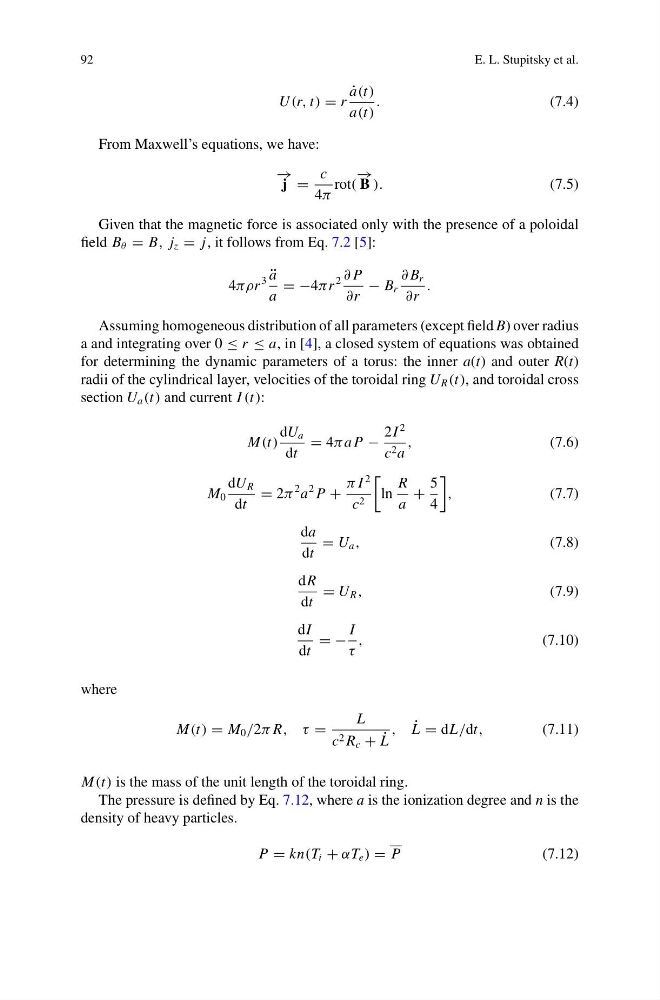
Assuming homogeneous distribution of all parameters (except field B) over radius
a and integrating over 0 ≤ r ≤ a, in [4], a closed system of equations was obtained
for determining the dynamic parameters of a torus: the inner a(t) and outer R(t)
radii of the cylindrical layer, velocities of the toroidal ring U R (t), and toroidal cross
section U a (t) and current I (t):
M(t)
dU a
dt
= 4πa P −
2I
2
c 2 a
,
(7.6)
M 0
dU R
dt
= 2π
2 a
2 P +
π I
2
c 2
ln
R
a
+
5
4
,
(7.7)
da
dt
= U a ,
(7.8)
dR
dt
= U R ,
(7.9)
dI
dt
= −
I
τ
,
(7.10)
where
M(t) = M 0 /2π R, τ =
L
c 2 R c + ˙
L
, ˙
L = dL/dt,
(7.11)
M(t) is the mass of the unit length of the toroidal ring.
The pressure is defined by Eq. 7.12, where a is the ionization degree and n is the
density of heavy particles.
P = kn(T i + αT e ) = P
(7.12)
E. L. Stupitsky et al.
U (r, t) = r
˙
a(t)
a(t)
.
(7.4)
From Maxwell’s equations, we have:
− →
j =
c
4π
rot(
− →
B ).
(7.5)
Given that the magnetic force is associated only with the presence of a poloidal
field B θ = B, j z = j, it follows from Eq. 7.2 [5]:
4πρr
3 ¨
a
a
= −4πr
2 ∂ P
∂r
− B r
∂ B r
∂r
.
Assuming homogeneous distribution of all parameters (except field B) over radius
a and integrating over 0 ≤ r ≤ a, in [4], a closed system of equations was obtained
for determining the dynamic parameters of a torus: the inner a(t) and outer R(t)
radii of the cylindrical layer, velocities of the toroidal ring U R (t), and toroidal cross
section U a (t) and current I (t):
M(t)
dU a
dt
= 4πa P −
2I
2
c 2 a
,
(7.6)
M 0
dU R
dt
= 2π
2 a
2 P +
π I
2
c 2
ln
R
a
+
5
4
,
(7.7)
da
dt
= U a ,
(7.8)
dR
dt
= U R ,
(7.9)
dI
dt
= −
I
τ
,
(7.10)
where
M(t) = M 0 /2π R, τ =
L
c 2 R c + ˙
L
, ˙
L = dL/dt,
(7.11)
M(t) is the mass of the unit length of the toroidal ring.
The pressure is defined by Eq. 7.12, where a is the ionization degree and n is the
density of heavy particles.
P = kn(T i + αT e ) = P
(7.12)