

5 Numerical Simulation of Taylor Vortex Flows …
59
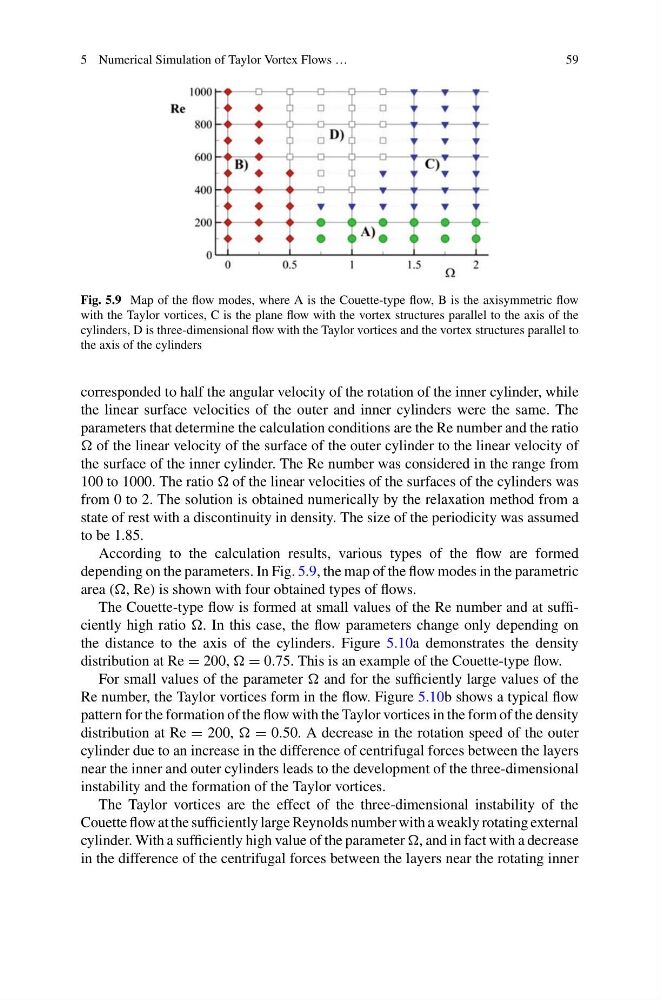
Fig. 5.9 Map of the flow modes, where A is the Couette-type flow, B is the axisymmetric flow
with the Taylor vortices, C is the plane flow with the vortex structures parallel to the axis of the
cylinders, D is three-dimensional flow with the Taylor vortices and the vortex structures parallel to
the axis of the cylinders
corresponded to half the angular velocity of the rotation of the inner cylinder, while
the linear surface velocities of the outer and inner cylinders were the same. The
parameters that determine the calculation conditions are the Re number and the ratio
of the linear velocity of the surface of the outer cylinder to the linear velocity of
the surface of the inner cylinder. The Re number was considered in the range from
100 to 1000. The ratio of the linear velocities of the surfaces of the cylinders was
from 0 to 2. The solution is obtained numerically by the relaxation method from a
state of rest with a discontinuity in density. The size of the periodicity was assumed
to be 1.85.
According to the calculation results, various types of the flow are formed
depending on the parameters. In Fig. 5.9, the map of the flow modes in the parametric
area (, Re) is shown with four obtained types of flows.
The Couette-type flow is formed at small values of the Re number and at sufficiently high ratio . In this case, the flow parameters change only depending on
the distance to the axis of the cylinders. Figure 5.10a demonstrates the density
distribution at Re = 200, = 0.75. This is an example of the Couette-type flow.
For small values of the parameter and for the sufficiently large values of the
Re number, the Taylor vortices form in the flow. Figure 5.10b shows a typical flow
pattern for the formation of the flow with the Taylor vortices in the form of the density
distribution at Re = 200, = 0.50. A decrease in the rotation speed of the outer
cylinder due to an increase in the difference of centrifugal forces between the layers
near the inner and outer cylinders leads to the development of the three-dimensional
instability and the formation of the Taylor vortices.
The Taylor vortices are the effect of the three-dimensional instability of the
Couette flow at the sufficiently large Reynolds number with a weakly rotating external
cylinder. With a sufficiently high value of the parameter , and in fact with a decrease
in the difference of the centrifugal forces between the layers near the rotating inner
59
Fig. 5.9 Map of the flow modes, where A is the Couette-type flow, B is the axisymmetric flow
with the Taylor vortices, C is the plane flow with the vortex structures parallel to the axis of the
cylinders, D is three-dimensional flow with the Taylor vortices and the vortex structures parallel to
the axis of the cylinders
corresponded to half the angular velocity of the rotation of the inner cylinder, while
the linear surface velocities of the outer and inner cylinders were the same. The
parameters that determine the calculation conditions are the Re number and the ratio
of the linear velocity of the surface of the outer cylinder to the linear velocity of
the surface of the inner cylinder. The Re number was considered in the range from
100 to 1000. The ratio of the linear velocities of the surfaces of the cylinders was
from 0 to 2. The solution is obtained numerically by the relaxation method from a
state of rest with a discontinuity in density. The size of the periodicity was assumed
to be 1.85.
According to the calculation results, various types of the flow are formed
depending on the parameters. In Fig. 5.9, the map of the flow modes in the parametric
area (, Re) is shown with four obtained types of flows.
The Couette-type flow is formed at small values of the Re number and at sufficiently high ratio . In this case, the flow parameters change only depending on
the distance to the axis of the cylinders. Figure 5.10a demonstrates the density
distribution at Re = 200, = 0.75. This is an example of the Couette-type flow.
For small values of the parameter and for the sufficiently large values of the
Re number, the Taylor vortices form in the flow. Figure 5.10b shows a typical flow
pattern for the formation of the flow with the Taylor vortices in the form of the density
distribution at Re = 200, = 0.50. A decrease in the rotation speed of the outer
cylinder due to an increase in the difference of centrifugal forces between the layers
near the inner and outer cylinders leads to the development of the three-dimensional
instability and the formation of the Taylor vortices.
The Taylor vortices are the effect of the three-dimensional instability of the
Couette flow at the sufficiently large Reynolds number with a weakly rotating external
cylinder. With a sufficiently high value of the parameter , and in fact with a decrease
in the difference of the centrifugal forces between the layers near the rotating inner