

4 Mathematical Modeling of Wave Motions of Fluids
39
p =
−
y
Fr
if (x, y) ∈ A
−
y−y
2 /2C
Fr
if (x, y) ∈ R
2
\A
(4.9)
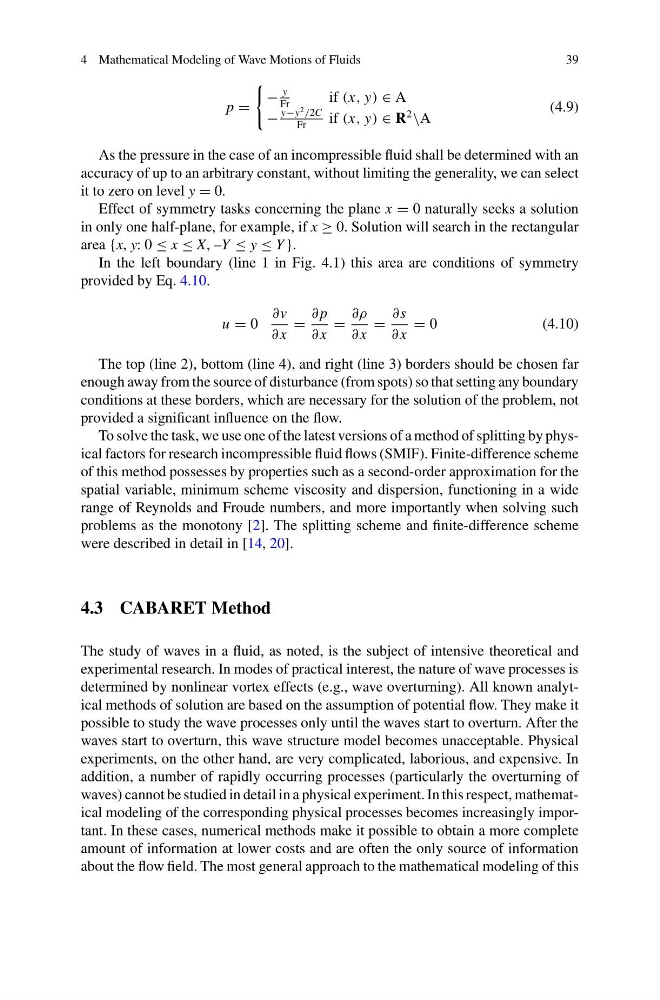
As the pressure in the case of an incompressible fluid shall be determined with an
accuracy of up to an arbitrary constant, without limiting the generality, we can select
it to zero on level y = 0.
Effect of symmetry tasks concerning the plane x = 0 naturally seeks a solution
in only one half-plane, for example, if x ≥ 0. Solution will search in the rectangular
area {x, y: 0 ≤ x ≤ X, –Y ≤ y ≤ Y }.
In the left boundary (line 1 in Fig. 4.1) this area are conditions of symmetry
provided by Eq. 4.10.
u = 0
∂v
∂ x
=
∂ p
∂ x
=
∂ρ
∂ x
=
∂s
∂ x
= 0
(4.10)
The top (line 2), bottom (line 4), and right (line 3) borders should be chosen far
enough away from the source of disturbance (from spots) so that setting any boundary
conditions at these borders, which are necessary for the solution of the problem, not
provided a significant influence on the flow.
To solve the task, we use one of the latest versions of a method of splitting by physical factors for research incompressible fluid flows (SMIF). Finite-difference scheme
of this method possesses by properties such as a second-order approximation for the
spatial variable, minimum scheme viscosity and dispersion, functioning in a wide
range of Reynolds and Froude numbers, and more importantly when solving such
problems as the monotony [2]. The splitting scheme and finite-difference scheme
were described in detail in [14, 20].
4.3 CABARET Method
The study of waves in a fluid, as noted, is the subject of intensive theoretical and
experimental research. In modes of practical interest, the nature of wave processes is
determined by nonlinear vortex effects (e.g., wave overturning). All known analytical methods of solution are based on the assumption of potential flow. They make it
possible to study the wave processes only until the waves start to overturn. After the
waves start to overturn, this wave structure model becomes unacceptable. Physical
experiments, on the other hand, are very complicated, laborious, and expensive. In
addition, a number of rapidly occurring processes (particularly the overturning of
waves) cannot be studied in detail in a physical experiment. In this respect, mathematical modeling of the corresponding physical processes becomes increasingly important. In these cases, numerical methods make it possible to obtain a more complete
amount of information at lower costs and are often the only source of information
about the flow field. The most general approach to the mathematical modeling of this
39
p =
−
y
Fr
if (x, y) ∈ A
−
y−y
2 /2C
Fr
if (x, y) ∈ R
2
\A
(4.9)
As the pressure in the case of an incompressible fluid shall be determined with an
accuracy of up to an arbitrary constant, without limiting the generality, we can select
it to zero on level y = 0.
Effect of symmetry tasks concerning the plane x = 0 naturally seeks a solution
in only one half-plane, for example, if x ≥ 0. Solution will search in the rectangular
area {x, y: 0 ≤ x ≤ X, –Y ≤ y ≤ Y }.
In the left boundary (line 1 in Fig. 4.1) this area are conditions of symmetry
provided by Eq. 4.10.
u = 0
∂v
∂ x
=
∂ p
∂ x
=
∂ρ
∂ x
=
∂s
∂ x
= 0
(4.10)
The top (line 2), bottom (line 4), and right (line 3) borders should be chosen far
enough away from the source of disturbance (from spots) so that setting any boundary
conditions at these borders, which are necessary for the solution of the problem, not
provided a significant influence on the flow.
To solve the task, we use one of the latest versions of a method of splitting by physical factors for research incompressible fluid flows (SMIF). Finite-difference scheme
of this method possesses by properties such as a second-order approximation for the
spatial variable, minimum scheme viscosity and dispersion, functioning in a wide
range of Reynolds and Froude numbers, and more importantly when solving such
problems as the monotony [2]. The splitting scheme and finite-difference scheme
were described in detail in [14, 20].
4.3 CABARET Method
The study of waves in a fluid, as noted, is the subject of intensive theoretical and
experimental research. In modes of practical interest, the nature of wave processes is
determined by nonlinear vortex effects (e.g., wave overturning). All known analytical methods of solution are based on the assumption of potential flow. They make it
possible to study the wave processes only until the waves start to overturn. After the
waves start to overturn, this wave structure model becomes unacceptable. Physical
experiments, on the other hand, are very complicated, laborious, and expensive. In
addition, a number of rapidly occurring processes (particularly the overturning of
waves) cannot be studied in detail in a physical experiment. In this respect, mathematical modeling of the corresponding physical processes becomes increasingly important. In these cases, numerical methods make it possible to obtain a more complete
amount of information at lower costs and are often the only source of information
about the flow field. The most general approach to the mathematical modeling of this