

24 3D Object Classification, Visual Search …
357
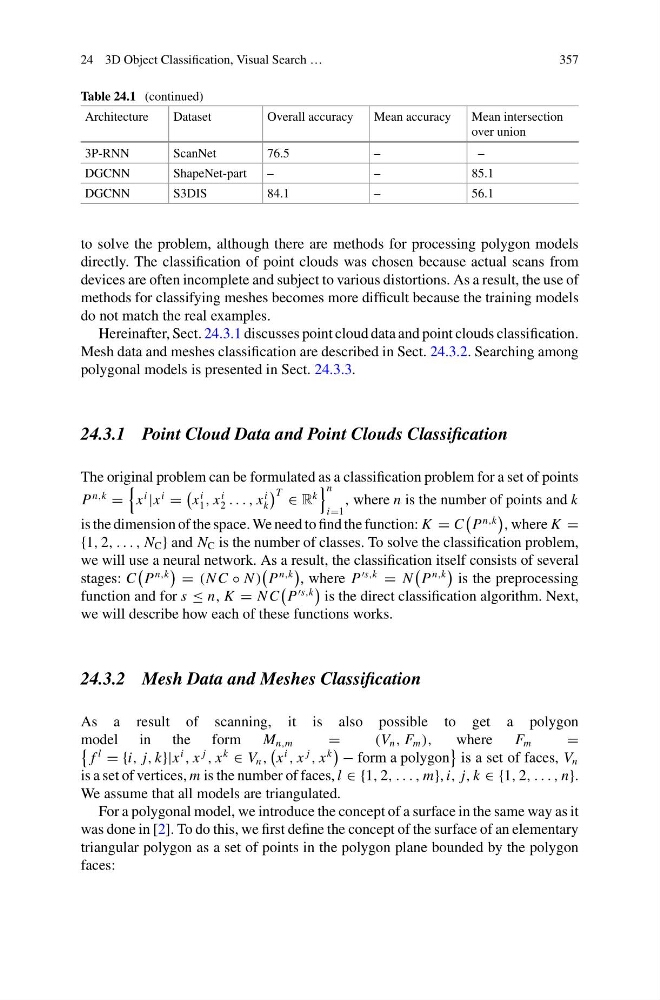
Table 24.1 (continued)
Architecture
Dataset
Overall accuracy
Mean accuracy
Mean intersection
over union
3P-RNN
ScanNet
76.5
–
–
DGCNN
ShapeNet-part
–
–
85.1
DGCNN
S3DIS
84.1
–
56.1
to solve the problem, although there are methods for processing polygon models
directly. The classification of point clouds was chosen because actual scans from
devices are often incomplete and subject to various distortions. As a result, the use of
methods for classifying meshes becomes more difficult because the training models
do not match the real examples.
Hereinafter, Sect. 24.3.1 discusses point cloud data and point clouds classification.
Mesh data and meshes classification are described in Sect. 24.3.2. Searching among
polygonal models is presented in Sect. 24.3.3.
24.3.1 Point Cloud Data and Point Clouds Classification
The original problem can be formulated as a classification problem for a set of points
P
n,k
=
x
i
|x
i
=
x
i
1 , x
i
2 . . . , x
i
k
T ∈ R
k
n
i=1
, where n is the number of points and k
is the dimension of the space. We need to find the function: K = C
P
n,k
, where K =
{1, 2, . . . , N C } and N C is the number of classes. To solve the classification problem,
we will use a neural network. As a result, the classification itself consists of several
stages: C
P
n,k
= (N C ◦ N )
P
n,k
, where P
s,k
= N
P
n,k
is the preprocessing
function and for s ≤ n, K = N C
P
s,k
is the direct classification algorithm. Next,
we will describe how each of these functions works.
24.3.2 Mesh Data and Meshes Classification
As a result of scanning, it is also possible to get a polygon
model in the form M n,m
=
(V n , F m ),
where F m
=
f
l
= {i, j, k}|x
i
, x
j
, x
k
∈ V n ,
x
i
, x
j
, x
k
− form a polygon
is a set of faces, V n
is a set of vertices, m is the number of faces, l ∈ {1, 2, . . . , m}, i, j, k ∈ {1, 2, . . . , n}.
We assume that all models are triangulated.
For a polygonal model, we introduce the concept of a surface in the same way as it
was done in [2]. To do this, we first define the concept of the surface of an elementary
triangular polygon as a set of points in the polygon plane bounded by the polygon
faces:
357
Table 24.1 (continued)
Architecture
Dataset
Overall accuracy
Mean accuracy
Mean intersection
over union
3P-RNN
ScanNet
76.5
–
–
DGCNN
ShapeNet-part
–
–
85.1
DGCNN
S3DIS
84.1
–
56.1
to solve the problem, although there are methods for processing polygon models
directly. The classification of point clouds was chosen because actual scans from
devices are often incomplete and subject to various distortions. As a result, the use of
methods for classifying meshes becomes more difficult because the training models
do not match the real examples.
Hereinafter, Sect. 24.3.1 discusses point cloud data and point clouds classification.
Mesh data and meshes classification are described in Sect. 24.3.2. Searching among
polygonal models is presented in Sect. 24.3.3.
24.3.1 Point Cloud Data and Point Clouds Classification
The original problem can be formulated as a classification problem for a set of points
P
n,k
=
x
i
|x
i
=
x
i
1 , x
i
2 . . . , x
i
k
T ∈ R
k
n
i=1
, where n is the number of points and k
is the dimension of the space. We need to find the function: K = C
P
n,k
, where K =
{1, 2, . . . , N C } and N C is the number of classes. To solve the classification problem,
we will use a neural network. As a result, the classification itself consists of several
stages: C
P
n,k
= (N C ◦ N )
P
n,k
, where P
s,k
= N
P
n,k
is the preprocessing
function and for s ≤ n, K = N C
P
s,k
is the direct classification algorithm. Next,
we will describe how each of these functions works.
24.3.2 Mesh Data and Meshes Classification
As a result of scanning, it is also possible to get a polygon
model in the form M n,m
=
(V n , F m ),
where F m
=
f
l
= {i, j, k}|x
i
, x
j
, x
k
∈ V n ,
x
i
, x
j
, x
k
− form a polygon
is a set of faces, V n
is a set of vertices, m is the number of faces, l ∈ {1, 2, . . . , m}, i, j, k ∈ {1, 2, . . . , n}.
We assume that all models are triangulated.
For a polygonal model, we introduce the concept of a surface in the same way as it
was done in [2]. To do this, we first define the concept of the surface of an elementary
triangular polygon as a set of points in the polygon plane bounded by the polygon
faces: