

3 Numerical Simulation of Flow Structure Near Descent …
27
3.3 Problem Statement
Numerical simulation of the flow around the descent module at hypersonic regime is
considered. Numerical modeling is carried out on the basis of a model of viscous heatconducting compressible gas (the Navier-Stokes model). The simulation is carried
out in a three-dimensional non-stationary formulation using the gas-dynamic model
of a perfect gas.
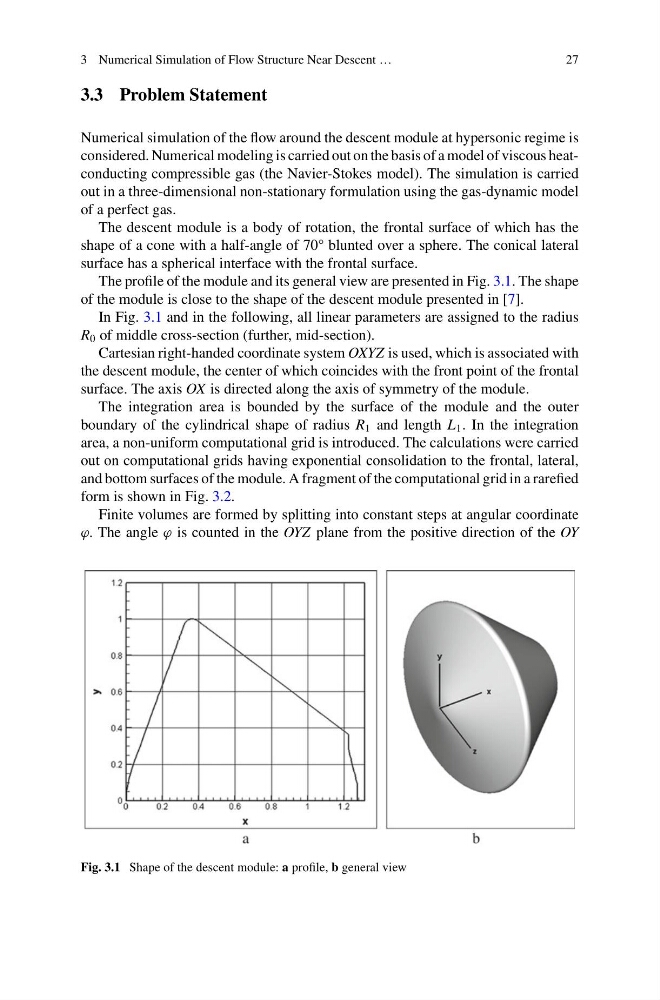
The descent module is a body of rotation, the frontal surface of which has the
shape of a cone with a half-angle of 70° blunted over a sphere. The conical lateral
surface has a spherical interface with the frontal surface.
The profile of the module and its general view are presented in Fig. 3.1. The shape
of the module is close to the shape of the descent module presented in [7].
In Fig. 3.1 and in the following, all linear parameters are assigned to the radius
R 0 of middle cross-section (further, mid-section).
Cartesian right-handed coordinate system OXYZ is used, which is associated with
the descent module, the center of which coincides with the front point of the frontal
surface. The axis OX is directed along the axis of symmetry of the module.
The integration area is bounded by the surface of the module and the outer
boundary of the cylindrical shape of radius R 1 and length L 1 . In the integration
area, a non-uniform computational grid is introduced. The calculations were carried
out on computational grids having exponential consolidation to the frontal, lateral,
and bottom surfaces of the module. A fragment of the computational grid in a rarefied
form is shown in Fig. 3.2.
Finite volumes are formed by splitting into constant steps at angular coordinate
ϕ. The angle ϕ is counted in the OYZ plane from the positive direction of the OY
Fig. 3.1 Shape of the descent module: a profile, b general view
27
3.3 Problem Statement
Numerical simulation of the flow around the descent module at hypersonic regime is
considered. Numerical modeling is carried out on the basis of a model of viscous heatconducting compressible gas (the Navier-Stokes model). The simulation is carried
out in a three-dimensional non-stationary formulation using the gas-dynamic model
of a perfect gas.
The descent module is a body of rotation, the frontal surface of which has the
shape of a cone with a half-angle of 70° blunted over a sphere. The conical lateral
surface has a spherical interface with the frontal surface.
The profile of the module and its general view are presented in Fig. 3.1. The shape
of the module is close to the shape of the descent module presented in [7].
In Fig. 3.1 and in the following, all linear parameters are assigned to the radius
R 0 of middle cross-section (further, mid-section).
Cartesian right-handed coordinate system OXYZ is used, which is associated with
the descent module, the center of which coincides with the front point of the frontal
surface. The axis OX is directed along the axis of symmetry of the module.
The integration area is bounded by the surface of the module and the outer
boundary of the cylindrical shape of radius R 1 and length L 1 . In the integration
area, a non-uniform computational grid is introduced. The calculations were carried
out on computational grids having exponential consolidation to the frontal, lateral,
and bottom surfaces of the module. A fragment of the computational grid in a rarefied
form is shown in Fig. 3.2.
Finite volumes are formed by splitting into constant steps at angular coordinate
ϕ. The angle ϕ is counted in the OYZ plane from the positive direction of the OY
Fig. 3.1 Shape of the descent module: a profile, b general view