

324
V. N. Lukin and L. N. Chernyshov
Within the semester, such a model can be considered as continuous if the “temperature” of the occupations is regularly monitored, and if noticeable deviations (ε(t))
from what the teacher considers the norm (y(t)), make appropriate adjustments.
Here, the output is the current training of the student. If we consider the output as the
readiness of the graduate, the model becomes discrete. The quality of the graduate is
compared with the desirable quality, and at ε(t) > 0 conclusions about some correction
of the course are drawn. In the case where a graduate specializes in information technology, a regulatory error is always there because the natural lag in the curriculum
from real needs. This amount can be reduced, moreover, made insignificant if the
teacher has the time and desire to constantly modernize the course. Otherwise, the
feedback breaks, and we return to the old model, releasing specialists whom the
employer will have to train in the workplace.
Thus, we conclude that the model from one-dimensional becomes at least twodimensional: y = (y 1 , y 2 ), where the components are the qualifications of the student
(y 1 ) and the teacher (y 2 ). If y 1 stabilizes, then y 2 is an increasing value. If the regulator
detects an insufficient growth (a decrease compared to the increasing requirements
of the employer), it should stimulate the teacher’s further training.
What could be the consequences of a regulator error in this case? If the gain ε 2 (t) =
g 2 (t) – y 2 (t) is excessive, that is, the feedback will be positive, the teacher will spend
his/her resources to the detriment of the educational process without a significant
positive result. Otherwise, the course degrades, it will not become modern, and the
graduate will cease to be interesting for the employer.
We considered the student as a management object that does not affect the course of
the educational process. In fact, in reality this is not the case. The student (reasonable)
strives to be interesting for the employer and makes efforts for this purpose. If from
his/her point of view, the teacher satisfies this requirement, he/her tries to get to
win him/her for a diploma, otherwise he/her ceases to be an object of management
(walking, working on the side), and the university cannot provide his/her full-fledged
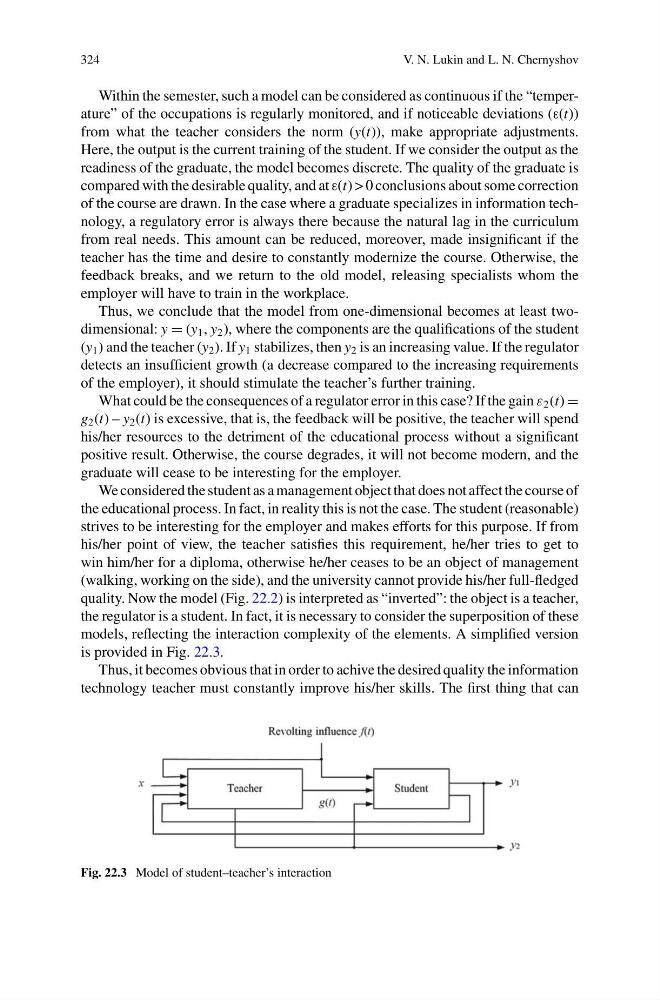
quality. Now the model (Fig. 22.2) is interpreted as “inverted”: the object is a teacher,
the regulator is a student. In fact, it is necessary to consider the superposition of these
models, reflecting the interaction complexity of the elements. A simplified version
is provided in Fig. 22.3.
Thus, it becomes obvious that in order to achive the desired quality the information
technology teacher must constantly improve his/her skills. The first thing that can
Fig. 22.3 Model of student–teacher’s interaction
V. N. Lukin and L. N. Chernyshov
Within the semester, such a model can be considered as continuous if the “temperature” of the occupations is regularly monitored, and if noticeable deviations (ε(t))
from what the teacher considers the norm (y(t)), make appropriate adjustments.
Here, the output is the current training of the student. If we consider the output as the
readiness of the graduate, the model becomes discrete. The quality of the graduate is
compared with the desirable quality, and at ε(t) > 0 conclusions about some correction
of the course are drawn. In the case where a graduate specializes in information technology, a regulatory error is always there because the natural lag in the curriculum
from real needs. This amount can be reduced, moreover, made insignificant if the
teacher has the time and desire to constantly modernize the course. Otherwise, the
feedback breaks, and we return to the old model, releasing specialists whom the
employer will have to train in the workplace.
Thus, we conclude that the model from one-dimensional becomes at least twodimensional: y = (y 1 , y 2 ), where the components are the qualifications of the student
(y 1 ) and the teacher (y 2 ). If y 1 stabilizes, then y 2 is an increasing value. If the regulator
detects an insufficient growth (a decrease compared to the increasing requirements
of the employer), it should stimulate the teacher’s further training.
What could be the consequences of a regulator error in this case? If the gain ε 2 (t) =
g 2 (t) – y 2 (t) is excessive, that is, the feedback will be positive, the teacher will spend
his/her resources to the detriment of the educational process without a significant
positive result. Otherwise, the course degrades, it will not become modern, and the
graduate will cease to be interesting for the employer.
We considered the student as a management object that does not affect the course of
the educational process. In fact, in reality this is not the case. The student (reasonable)
strives to be interesting for the employer and makes efforts for this purpose. If from
his/her point of view, the teacher satisfies this requirement, he/her tries to get to
win him/her for a diploma, otherwise he/her ceases to be an object of management
(walking, working on the side), and the university cannot provide his/her full-fledged
quality. Now the model (Fig. 22.2) is interpreted as “inverted”: the object is a teacher,
the regulator is a student. In fact, it is necessary to consider the superposition of these
models, reflecting the interaction complexity of the elements. A simplified version
is provided in Fig. 22.3.
Thus, it becomes obvious that in order to achive the desired quality the information
technology teacher must constantly improve his/her skills. The first thing that can
Fig. 22.3 Model of student–teacher’s interaction