

22 On the Modeling of the University Education …
323
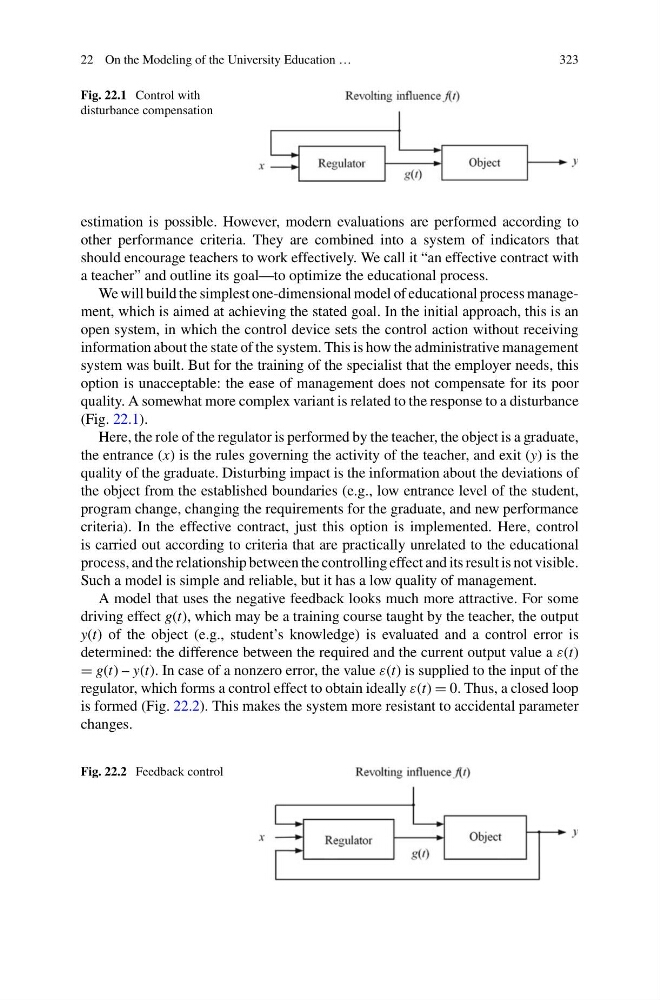
Fig. 22.1 Control with
disturbance compensation
estimation is possible. However, modern evaluations are performed according to
other performance criteria. They are combined into a system of indicators that
should encourage teachers to work effectively. We call it “an effective contract with
a teacher” and outline its goal—to optimize the educational process.
We will build the simplest one-dimensional model of educational process management, which is aimed at achieving the stated goal. In the initial approach, this is an
open system, in which the control device sets the control action without receiving
information about the state of the system. This is how the administrative management
system was built. But for the training of the specialist that the employer needs, this
option is unacceptable: the ease of management does not compensate for its poor
quality. A somewhat more complex variant is related to the response to a disturbance
(Fig. 22.1).
Here, the role of the regulator is performed by the teacher, the object is a graduate,
the entrance (x) is the rules governing the activity of the teacher, and exit (y) is the
quality of the graduate. Disturbing impact is the information about the deviations of
the object from the established boundaries (e.g., low entrance level of the student,
program change, changing the requirements for the graduate, and new performance
criteria). In the effective contract, just this option is implemented. Here, control
is carried out according to criteria that are practically unrelated to the educational
process, and the relationship between the controlling effect and its result is not visible.
Such a model is simple and reliable, but it has a low quality of management.
A model that uses the negative feedback looks much more attractive. For some
driving effect g(t), which may be a training course taught by the teacher, the output
y(t) of the object (e.g., student’s knowledge) is evaluated and a control error is
determined: the difference between the required and the current output value a ε(t)
= g(t) – y(t). In case of a nonzero error, the value ε(t) is supplied to the input of the
regulator, which forms a control effect to obtain ideally ε(t) = 0. Thus, a closed loop
is formed (Fig. 22.2). This makes the system more resistant to accidental parameter
changes.
Fig. 22.2 Feedback control
323
Fig. 22.1 Control with
disturbance compensation
estimation is possible. However, modern evaluations are performed according to
other performance criteria. They are combined into a system of indicators that
should encourage teachers to work effectively. We call it “an effective contract with
a teacher” and outline its goal—to optimize the educational process.
We will build the simplest one-dimensional model of educational process management, which is aimed at achieving the stated goal. In the initial approach, this is an
open system, in which the control device sets the control action without receiving
information about the state of the system. This is how the administrative management
system was built. But for the training of the specialist that the employer needs, this
option is unacceptable: the ease of management does not compensate for its poor
quality. A somewhat more complex variant is related to the response to a disturbance
(Fig. 22.1).
Here, the role of the regulator is performed by the teacher, the object is a graduate,
the entrance (x) is the rules governing the activity of the teacher, and exit (y) is the
quality of the graduate. Disturbing impact is the information about the deviations of
the object from the established boundaries (e.g., low entrance level of the student,
program change, changing the requirements for the graduate, and new performance
criteria). In the effective contract, just this option is implemented. Here, control
is carried out according to criteria that are practically unrelated to the educational
process, and the relationship between the controlling effect and its result is not visible.
Such a model is simple and reliable, but it has a low quality of management.
A model that uses the negative feedback looks much more attractive. For some
driving effect g(t), which may be a training course taught by the teacher, the output
y(t) of the object (e.g., student’s knowledge) is evaluated and a control error is
determined: the difference between the required and the current output value a ε(t)
= g(t) – y(t). In case of a nonzero error, the value ε(t) is supplied to the input of the
regulator, which forms a control effect to obtain ideally ε(t) = 0. Thus, a closed loop
is formed (Fig. 22.2). This makes the system more resistant to accidental parameter
changes.
Fig. 22.2 Feedback control