

316
A. S. Semenov
Equality between Eqs. 21.6 and 21.7 is held by Eq. 21.8.
u[m] =
N
n+1
− 1
N − 1
(21.8)
Then a number of steps k of the elastic model is calculated by Eq. 21.9.
k =
log N ((N − 1) · u[m] + 1)
(21.9)
CCM for the pattern 1/r = 3, N = 2 (see Fig. 21.3a) is defined by Eq. 21.10.
f
n
(E
0
= {e 0 }
S
,
R
{c}
S
,
[n + +, ∀{e}
S
∈ E
n−1
{e}
S
↓ (E
n
= ≡ (3, 2){e}
S
)|0 < n ≤ k] ,
[n − −, ∀{e}
S
∈ E
n−1
{e}
S
↓ (E
n
= ≡
−1
(3, 2){e}
S
)|0 < n ≥ k] ) (21.10)
21.4 The Fractal Analysis of the Distributed Gradient
Ascent Algorithm
In this section, the analysis based on integrated CCM of gradient ascent algorithm
is presented. At the beginning, a gradient ascent algorithm [23] is considered in
Sect. 21.4.1, and after that, its distributed version based on integrated CCM is
introduced in Sect. 21.4.2.
21.4.1 Gradient Ascent for Big Data Ordered in Time
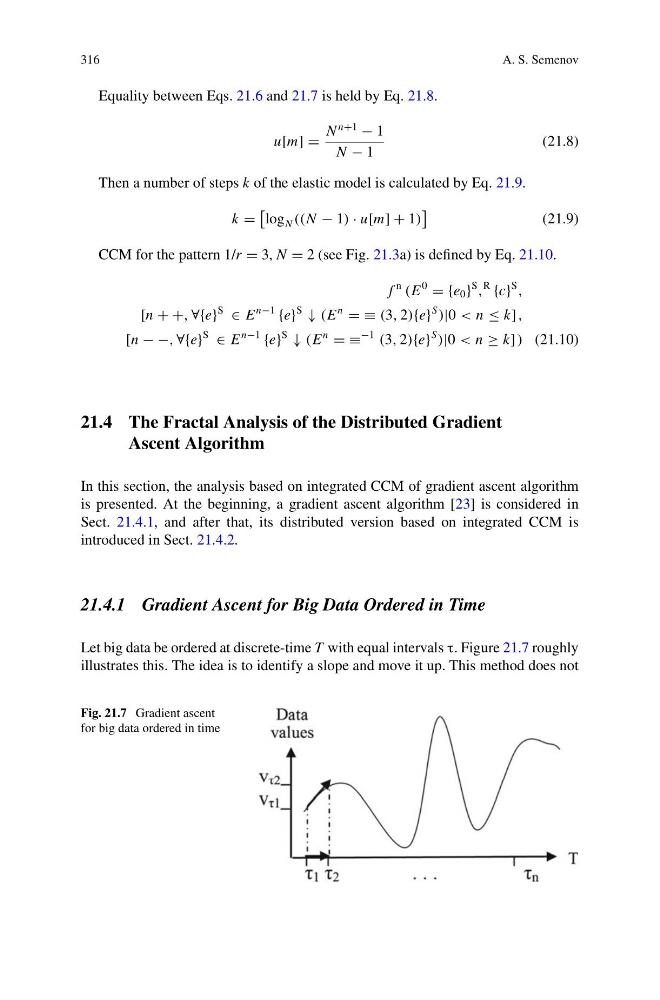
Let big data be ordered at discrete-time T with equal intervals τ. Figure 21.7 roughly
illustrates this. The idea is to identify a slope and move it up. This method does not
Fig. 21.7 Gradient ascent
for big data ordered in time
A. S. Semenov
Equality between Eqs. 21.6 and 21.7 is held by Eq. 21.8.
u[m] =
N
n+1
− 1
N − 1
(21.8)
Then a number of steps k of the elastic model is calculated by Eq. 21.9.
k =
log N ((N − 1) · u[m] + 1)
(21.9)
CCM for the pattern 1/r = 3, N = 2 (see Fig. 21.3a) is defined by Eq. 21.10.
f
n
(E
0
= {e 0 }
S
,
R
{c}
S
,
[n + +, ∀{e}
S
∈ E
n−1
{e}
S
↓ (E
n
= ≡ (3, 2){e}
S
)|0 < n ≤ k] ,
[n − −, ∀{e}
S
∈ E
n−1
{e}
S
↓ (E
n
= ≡
−1
(3, 2){e}
S
)|0 < n ≥ k] ) (21.10)
21.4 The Fractal Analysis of the Distributed Gradient
Ascent Algorithm
In this section, the analysis based on integrated CCM of gradient ascent algorithm
is presented. At the beginning, a gradient ascent algorithm [23] is considered in
Sect. 21.4.1, and after that, its distributed version based on integrated CCM is
introduced in Sect. 21.4.2.
21.4.1 Gradient Ascent for Big Data Ordered in Time
Let big data be ordered at discrete-time T with equal intervals τ. Figure 21.7 roughly
illustrates this. The idea is to identify a slope and move it up. This method does not
Fig. 21.7 Gradient ascent
for big data ordered in time