

21 Fractal Analysis and Programming of Elastic Systems …
311
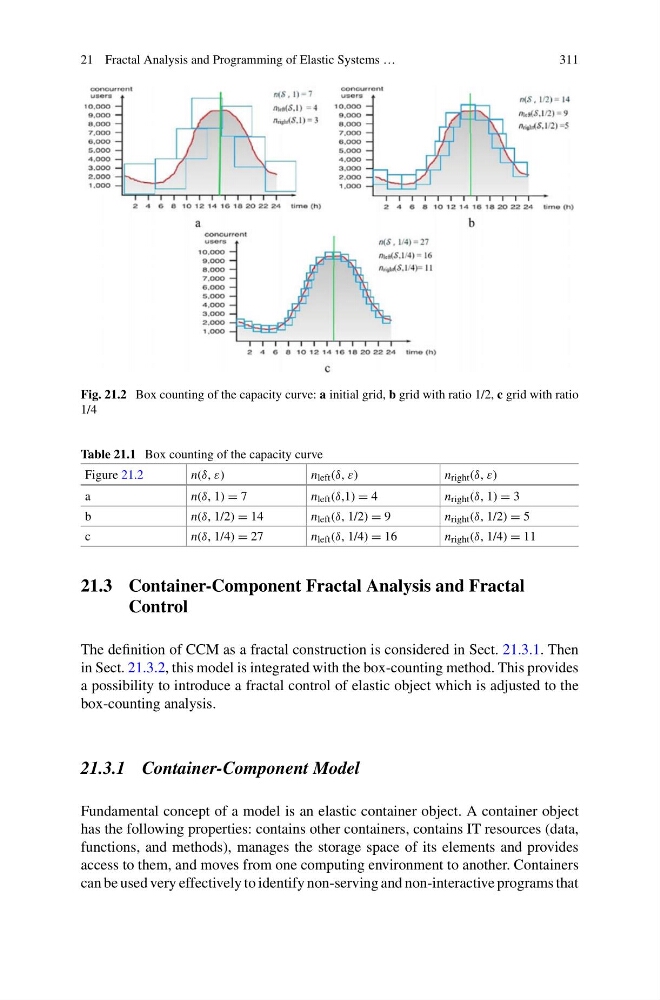
Fig. 21.2 Box counting of the capacity curve: a initial grid, b grid with ratio 1/2, c grid with ratio
1/4
Table 21.1 Box counting of the capacity curve
Figure 21.2
n(δ, ε)
n left (δ, ε)
n right (δ, ε)
a
n(δ, 1) = 7
n left (δ,1) = 4
n right (δ, 1) = 3
b
n(δ, 1/2) = 14
n left (δ, 1/2) = 9
n right (δ, 1/2) = 5
c
n(δ, 1/4) = 27
n left (δ, 1/4) = 16
n right (δ, 1/4) = 11
21.3 Container-Component Fractal Analysis and Fractal
Control
The definition of CCM as a fractal construction is considered in Sect. 21.3.1. Then
in Sect. 21.3.2, this model is integrated with the box-counting method. This provides
a possibility to introduce a fractal control of elastic object which is adjusted to the
box-counting analysis.
21.3.1 Container-Component Model
Fundamental concept of a model is an elastic container object. A container object
has the following properties: contains other containers, contains IT resources (data,
functions, and methods), manages the storage space of its elements and provides
access to them, and moves from one computing environment to another. Containers
can be used very effectively to identify non-serving and non-interactive programs that
311
Fig. 21.2 Box counting of the capacity curve: a initial grid, b grid with ratio 1/2, c grid with ratio
1/4
Table 21.1 Box counting of the capacity curve
Figure 21.2
n(δ, ε)
n left (δ, ε)
n right (δ, ε)
a
n(δ, 1) = 7
n left (δ,1) = 4
n right (δ, 1) = 3
b
n(δ, 1/2) = 14
n left (δ, 1/2) = 9
n right (δ, 1/2) = 5
c
n(δ, 1/4) = 27
n left (δ, 1/4) = 16
n right (δ, 1/4) = 11
21.3 Container-Component Fractal Analysis and Fractal
Control
The definition of CCM as a fractal construction is considered in Sect. 21.3.1. Then
in Sect. 21.3.2, this model is integrated with the box-counting method. This provides
a possibility to introduce a fractal control of elastic object which is adjusted to the
box-counting analysis.
21.3.1 Container-Component Model
Fundamental concept of a model is an elastic container object. A container object
has the following properties: contains other containers, contains IT resources (data,
functions, and methods), manages the storage space of its elements and provides
access to them, and moves from one computing environment to another. Containers
can be used very effectively to identify non-serving and non-interactive programs that