

20 Using Spectral Form of Mathematical Description …
289
where h > 0 and w 1 (t), w 2 (t), …, w s (t) are F t -adapted independent standard Wiener
processes. The integral of multiplicity k = 1 is a centered Gaussian random variable
I
∗( j 1 )
h
=
h
0
dw j 1 (τ ) = w j 1 (h), j 1 = 1, 2, . . . , s,
with the second-order moment h. In this context, h is an integration step in numerical
methods for stochastic differential equations [2–4, 12, 13, 15].
Note that for the case of pairwise distinct values j 1 , j 2 , . . . , j k the iterated
Stratonovich stochastic integral defined by Eq. 20.1 coincides with the corresponding
iterated Itô stochastic integral
I
( j 1 j 2 ... j k )
h
=
h
0
. . .
τ 3
0
τ 2
0
dw j 1 (τ 1 )dw j 2 (τ 2 ) . . . dw j k (τ k ),
and in the general case the relationship between the Itô and iterated Stratonovich
stochastic integrals is described in [13, 15].
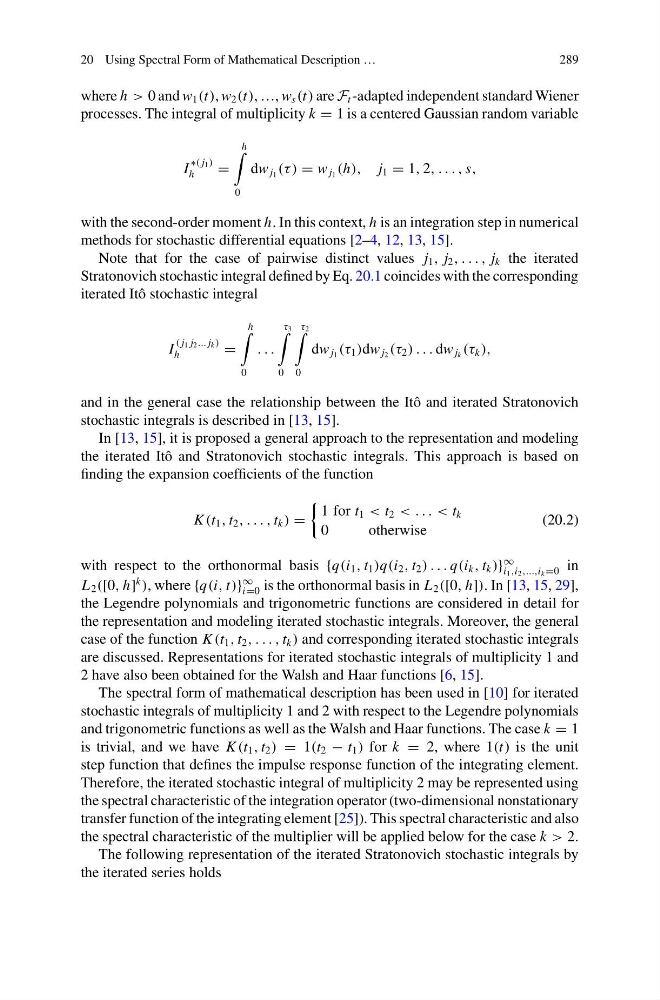
In [13, 15], it is proposed a general approach to the representation and modeling
the iterated Itô and Stratonovich stochastic integrals. This approach is based on
finding the expansion coefficients of the function
K (t 1 , t 2 , . . . , t k ) =
1 for t 1 < t 2 < . . . < t k
0
otherwise
(20.2)
with respect to the orthonormal basis {q(i 1 , t 1 )q(i 2 , t 2 ) . . . q(i k , t k )}
∞
i 1 ,i 2 ,...,i k =0 in
L 2 ([0, h]
k
), where {q(i, t)}
∞
i=0 is the orthonormal basis in L 2 ([0, h]). In [13, 15, 29],
the Legendre polynomials and trigonometric functions are considered in detail for
the representation and modeling iterated stochastic integrals. Moreover, the general
case of the function K (t 1 , t 2 , . . . , t k ) and corresponding iterated stochastic integrals
are discussed. Representations for iterated stochastic integrals of multiplicity 1 and
2 have also been obtained for the Walsh and Haar functions [6, 15].
The spectral form of mathematical description has been used in [10] for iterated
stochastic integrals of multiplicity 1 and 2 with respect to the Legendre polynomials
and trigonometric functions as well as the Walsh and Haar functions. The case k = 1
is trivial, and we have K (t 1 , t 2 ) = 1(t 2 − t 1 ) for k = 2, where 1(t) is the unit
step function that defines the impulse response function of the integrating element.
Therefore, the iterated stochastic integral of multiplicity 2 may be represented using
the spectral characteristic of the integration operator (two-dimensional nonstationary
transfer function of the integrating element [25]). This spectral characteristic and also
the spectral characteristic of the multiplier will be applied below for the case k > 2.
The following representation of the iterated Stratonovich stochastic integrals by
the iterated series holds
289
where h > 0 and w 1 (t), w 2 (t), …, w s (t) are F t -adapted independent standard Wiener
processes. The integral of multiplicity k = 1 is a centered Gaussian random variable
I
∗( j 1 )
h
=
h
0
dw j 1 (τ ) = w j 1 (h), j 1 = 1, 2, . . . , s,
with the second-order moment h. In this context, h is an integration step in numerical
methods for stochastic differential equations [2–4, 12, 13, 15].
Note that for the case of pairwise distinct values j 1 , j 2 , . . . , j k the iterated
Stratonovich stochastic integral defined by Eq. 20.1 coincides with the corresponding
iterated Itô stochastic integral
I
( j 1 j 2 ... j k )
h
=
h
0
. . .
τ 3
0
τ 2
0
dw j 1 (τ 1 )dw j 2 (τ 2 ) . . . dw j k (τ k ),
and in the general case the relationship between the Itô and iterated Stratonovich
stochastic integrals is described in [13, 15].
In [13, 15], it is proposed a general approach to the representation and modeling
the iterated Itô and Stratonovich stochastic integrals. This approach is based on
finding the expansion coefficients of the function
K (t 1 , t 2 , . . . , t k ) =
1 for t 1 < t 2 < . . . < t k
0
otherwise
(20.2)
with respect to the orthonormal basis {q(i 1 , t 1 )q(i 2 , t 2 ) . . . q(i k , t k )}
∞
i 1 ,i 2 ,...,i k =0 in
L 2 ([0, h]
k
), where {q(i, t)}
∞
i=0 is the orthonormal basis in L 2 ([0, h]). In [13, 15, 29],
the Legendre polynomials and trigonometric functions are considered in detail for
the representation and modeling iterated stochastic integrals. Moreover, the general
case of the function K (t 1 , t 2 , . . . , t k ) and corresponding iterated stochastic integrals
are discussed. Representations for iterated stochastic integrals of multiplicity 1 and
2 have also been obtained for the Walsh and Haar functions [6, 15].
The spectral form of mathematical description has been used in [10] for iterated
stochastic integrals of multiplicity 1 and 2 with respect to the Legendre polynomials
and trigonometric functions as well as the Walsh and Haar functions. The case k = 1
is trivial, and we have K (t 1 , t 2 ) = 1(t 2 − t 1 ) for k = 2, where 1(t) is the unit
step function that defines the impulse response function of the integrating element.
Therefore, the iterated stochastic integral of multiplicity 2 may be represented using
the spectral characteristic of the integration operator (two-dimensional nonstationary
transfer function of the integrating element [25]). This spectral characteristic and also
the spectral characteristic of the multiplier will be applied below for the case k > 2.
The following representation of the iterated Stratonovich stochastic integrals by
the iterated series holds