

19 Adaptive Interpolation, TT-Decomposition and Sparse …
285
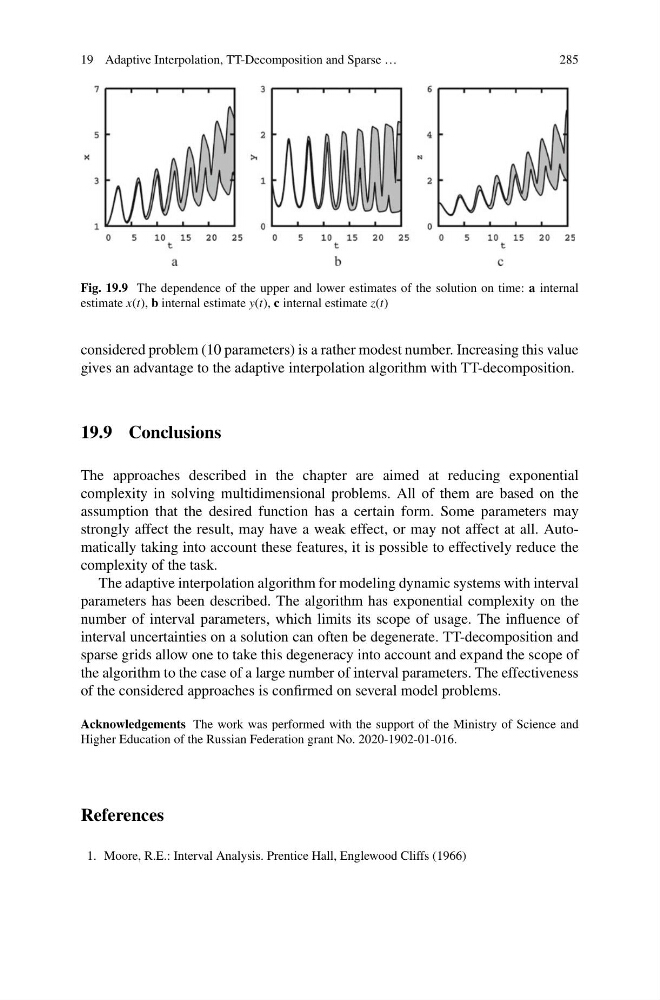
Fig. 19.9 The dependence of the upper and lower estimates of the solution on time: a internal
estimate x(t), b internal estimate y(t), c internal estimate z(t)
considered problem (10 parameters) is a rather modest number. Increasing this value
gives an advantage to the adaptive interpolation algorithm with TT-decomposition.
19.9 Conclusions
The approaches described in the chapter are aimed at reducing exponential
complexity in solving multidimensional problems. All of them are based on the
assumption that the desired function has a certain form. Some parameters may
strongly affect the result, may have a weak effect, or may not affect at all. Automatically taking into account these features, it is possible to effectively reduce the
complexity of the task.
The adaptive interpolation algorithm for modeling dynamic systems with interval
parameters has been described. The algorithm has exponential complexity on the
number of interval parameters, which limits its scope of usage. The influence of
interval uncertainties on a solution can often be degenerate. TT-decomposition and
sparse grids allow one to take this degeneracy into account and expand the scope of
the algorithm to the case of a large number of interval parameters. The effectiveness
of the considered approaches is confirmed on several model problems.
Acknowledgements The work was performed with the support of the Ministry of Science and
Higher Education of the Russian Federation grant No. 2020-1902-01-016.
References
1. Moore, R.E.: Interval Analysis. Prentice Hall, Englewood Cliffs (1966)
285
Fig. 19.9 The dependence of the upper and lower estimates of the solution on time: a internal
estimate x(t), b internal estimate y(t), c internal estimate z(t)
considered problem (10 parameters) is a rather modest number. Increasing this value
gives an advantage to the adaptive interpolation algorithm with TT-decomposition.
19.9 Conclusions
The approaches described in the chapter are aimed at reducing exponential
complexity in solving multidimensional problems. All of them are based on the
assumption that the desired function has a certain form. Some parameters may
strongly affect the result, may have a weak effect, or may not affect at all. Automatically taking into account these features, it is possible to effectively reduce the
complexity of the task.
The adaptive interpolation algorithm for modeling dynamic systems with interval
parameters has been described. The algorithm has exponential complexity on the
number of interval parameters, which limits its scope of usage. The influence of
interval uncertainties on a solution can often be degenerate. TT-decomposition and
sparse grids allow one to take this degeneracy into account and expand the scope of
the algorithm to the case of a large number of interval parameters. The effectiveness
of the considered approaches is confirmed on several model problems.
Acknowledgements The work was performed with the support of the Ministry of Science and
Higher Education of the Russian Federation grant No. 2020-1902-01-016.
References
1. Moore, R.E.: Interval Analysis. Prentice Hall, Englewood Cliffs (1966)