

2 Aspects of Meteoroids Flight in the Earth’s Atmosphere
19
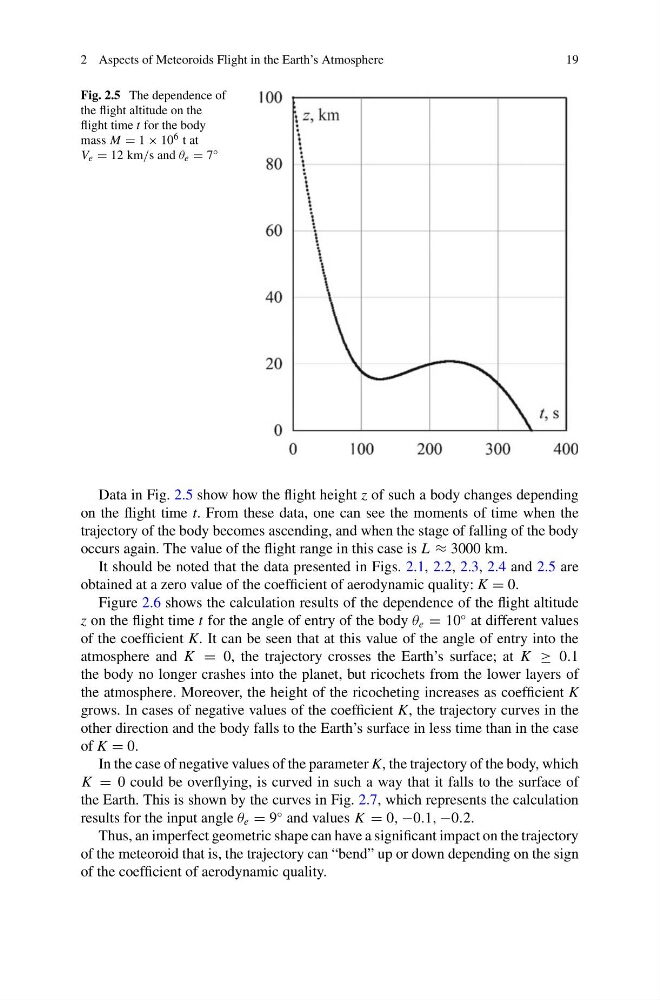
Fig. 2.5 The dependence of
the flight altitude on the
flight time t for the body
mass M = 1 × 10 6 t at
V e = 12 km/s and θ e = 7 ◦
Data in Fig. 2.5 show how the flight height z of such a body changes depending
on the flight time t. From these data, one can see the moments of time when the
trajectory of the body becomes ascending, and when the stage of falling of the body
occurs again. The value of the flight range in this case is L ≈ 3000 km.
It should be noted that the data presented in Figs. 2.1, 2.2, 2.3, 2.4 and 2.5 are
obtained at a zero value of the coefficient of aerodynamic quality: K = 0.
Figure 2.6 shows the calculation results of the dependence of the flight altitude
z on the flight time t for the angle of entry of the body θ e = 10
◦ at different values
of the coefficient K. It can be seen that at this value of the angle of entry into the
atmosphere and K = 0, the trajectory crosses the Earth’s surface; at K ≥ 0.1
the body no longer crashes into the planet, but ricochets from the lower layers of
the atmosphere. Moreover, the height of the ricocheting increases as coefficient K
grows. In cases of negative values of the coefficient K, the trajectory curves in the
other direction and the body falls to the Earth’s surface in less time than in the case
of K = 0.
In the case of negative values of the parameter K, the trajectory of the body, which
K = 0 could be overflying, is curved in such a way that it falls to the surface of
the Earth. This is shown by the curves in Fig. 2.7, which represents the calculation
results for the input angle θ e = 9
◦ and values K = 0, −0.1, −0.2.
Thus, an imperfect geometric shape can have a significant impact on the trajectory
of the meteoroid that is, the trajectory can “bend” up or down depending on the sign
of the coefficient of aerodynamic quality.
19
Fig. 2.5 The dependence of
the flight altitude on the
flight time t for the body
mass M = 1 × 10 6 t at
V e = 12 km/s and θ e = 7 ◦
Data in Fig. 2.5 show how the flight height z of such a body changes depending
on the flight time t. From these data, one can see the moments of time when the
trajectory of the body becomes ascending, and when the stage of falling of the body
occurs again. The value of the flight range in this case is L ≈ 3000 km.
It should be noted that the data presented in Figs. 2.1, 2.2, 2.3, 2.4 and 2.5 are
obtained at a zero value of the coefficient of aerodynamic quality: K = 0.
Figure 2.6 shows the calculation results of the dependence of the flight altitude
z on the flight time t for the angle of entry of the body θ e = 10
◦ at different values
of the coefficient K. It can be seen that at this value of the angle of entry into the
atmosphere and K = 0, the trajectory crosses the Earth’s surface; at K ≥ 0.1
the body no longer crashes into the planet, but ricochets from the lower layers of
the atmosphere. Moreover, the height of the ricocheting increases as coefficient K
grows. In cases of negative values of the coefficient K, the trajectory curves in the
other direction and the body falls to the Earth’s surface in less time than in the case
of K = 0.
In the case of negative values of the parameter K, the trajectory of the body, which
K = 0 could be overflying, is curved in such a way that it falls to the surface of
the Earth. This is shown by the curves in Fig. 2.7, which represents the calculation
results for the input angle θ e = 9
◦ and values K = 0, −0.1, −0.2.
Thus, an imperfect geometric shape can have a significant impact on the trajectory
of the meteoroid that is, the trajectory can “bend” up or down depending on the sign
of the coefficient of aerodynamic quality.