

2 Aspects of Meteoroids Flight in the Earth’s Atmosphere
17
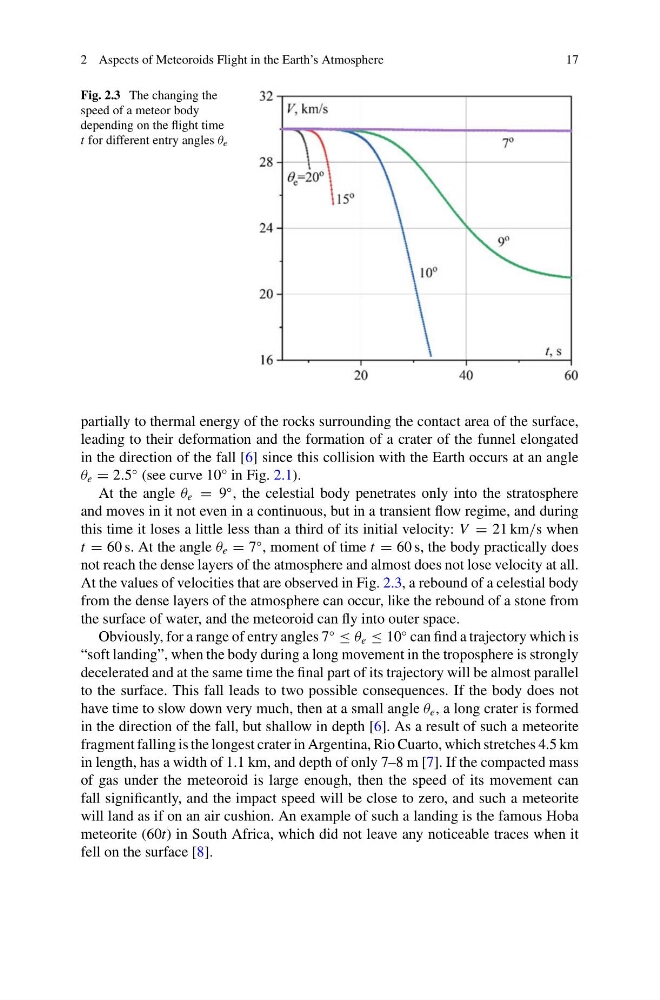
Fig. 2.3 The changing the
speed of a meteor body
depending on the flight time
t for different entry angles θ e
partially to thermal energy of the rocks surrounding the contact area of the surface,
leading to their deformation and the formation of a crater of the funnel elongated
in the direction of the fall [6] since this collision with the Earth occurs at an angle
θ e = 2.5
◦ (see curve 10° in Fig. 2.1).
At the angle θ e = 9
◦ , the celestial body penetrates only into the stratosphere
and moves in it not even in a continuous, but in a transient flow regime, and during
this time it loses a little less than a third of its initial velocity: V = 21 km/s when
t = 60 s. At the angle θ e = 7
◦ , moment of time t = 60 s, the body practically does
not reach the dense layers of the atmosphere and almost does not lose velocity at all.
At the values of velocities that are observed in Fig. 2.3, a rebound of a celestial body
from the dense layers of the atmosphere can occur, like the rebound of a stone from
the surface of water, and the meteoroid can fly into outer space.
Obviously, for a range of entry angles 7
◦
≤ θ e ≤ 10
◦ can find a trajectory which is
“soft landing”, when the body during a long movement in the troposphere is strongly
decelerated and at the same time the final part of its trajectory will be almost parallel
to the surface. This fall leads to two possible consequences. If the body does not
have time to slow down very much, then at a small angle θ e , a long crater is formed
in the direction of the fall, but shallow in depth [6]. As a result of such a meteorite
fragment falling is the longest crater in Argentina, Rio Cuarto, which stretches 4.5 km
in length, has a width of 1.1 km, and depth of only 7–8 m [7]. If the compacted mass
of gas under the meteoroid is large enough, then the speed of its movement can
fall significantly, and the impact speed will be close to zero, and such a meteorite
will land as if on an air cushion. An example of such a landing is the famous Hoba
meteorite (60t) in South Africa, which did not leave any noticeable traces when it
fell on the surface [8].
17
Fig. 2.3 The changing the
speed of a meteor body
depending on the flight time
t for different entry angles θ e
partially to thermal energy of the rocks surrounding the contact area of the surface,
leading to their deformation and the formation of a crater of the funnel elongated
in the direction of the fall [6] since this collision with the Earth occurs at an angle
θ e = 2.5
◦ (see curve 10° in Fig. 2.1).
At the angle θ e = 9
◦ , the celestial body penetrates only into the stratosphere
and moves in it not even in a continuous, but in a transient flow regime, and during
this time it loses a little less than a third of its initial velocity: V = 21 km/s when
t = 60 s. At the angle θ e = 7
◦ , moment of time t = 60 s, the body practically does
not reach the dense layers of the atmosphere and almost does not lose velocity at all.
At the values of velocities that are observed in Fig. 2.3, a rebound of a celestial body
from the dense layers of the atmosphere can occur, like the rebound of a stone from
the surface of water, and the meteoroid can fly into outer space.
Obviously, for a range of entry angles 7
◦
≤ θ e ≤ 10
◦ can find a trajectory which is
“soft landing”, when the body during a long movement in the troposphere is strongly
decelerated and at the same time the final part of its trajectory will be almost parallel
to the surface. This fall leads to two possible consequences. If the body does not
have time to slow down very much, then at a small angle θ e , a long crater is formed
in the direction of the fall, but shallow in depth [6]. As a result of such a meteorite
fragment falling is the longest crater in Argentina, Rio Cuarto, which stretches 4.5 km
in length, has a width of 1.1 km, and depth of only 7–8 m [7]. If the compacted mass
of gas under the meteoroid is large enough, then the speed of its movement can
fall significantly, and the impact speed will be close to zero, and such a meteorite
will land as if on an air cushion. An example of such a landing is the famous Hoba
meteorite (60t) in South Africa, which did not leave any noticeable traces when it
fell on the surface [8].