

16 Application of Multi-agent Optimization Methods …
233
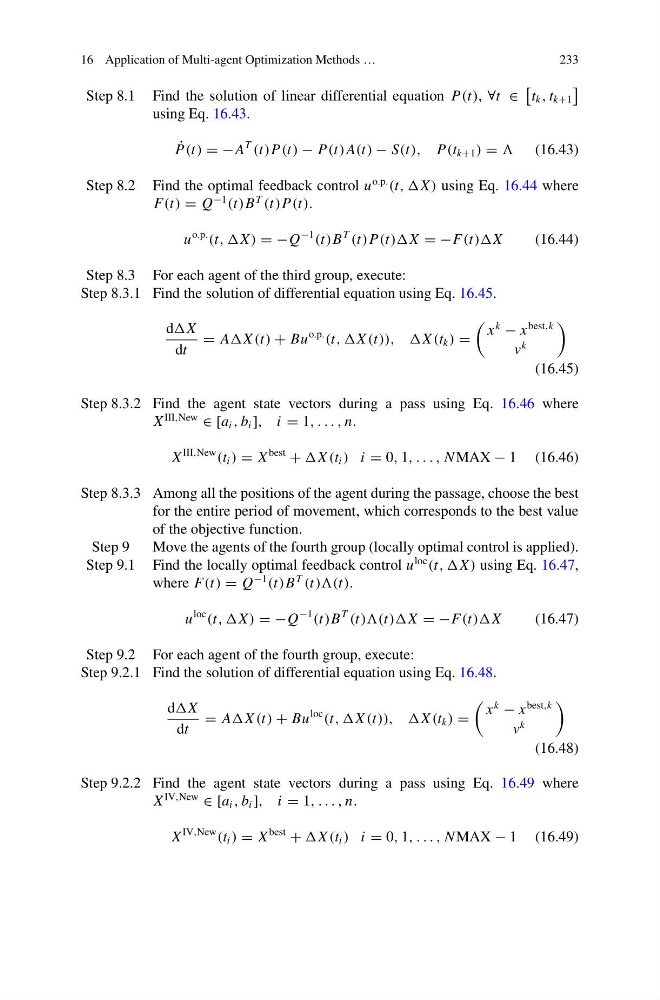
Step 8.1 Find the solution of linear differential equation P(t), ∀t ∈
t k , t k+1
using Eq. 16.43.
˙
P(t) = −A
T
(t)P(t) − P(t)A(t) − S(t), P(t k+1 ) = (16.43)
Step 8.2 Find the optimal feedback control u
o.p.
(t, ,X ) using Eq. 16.44 where
F(t) = Q
−1
(t)B
T
(t)P(t).
u
o.p.
(t, ,X ) = −Q
−1
(t)B
T
(t)P(t))X = −F(t))X
(16.44)
Step 8.3 For each agent of the third group, execute:
Step 8.3.1 Find the solution of differential equation using Eq. 16.45.
dX
dt
= AX (t) + Bu
o.p.
(t, ,X (t)), ,X (t k ) =
x
k
− x
best,k
v
k
(16.45)
Step 8.3.2 Find the agent state vectors during a pass using Eq. 16.46 where
X
III,New
∈ [a i , b i ], i = 1, . . . , n.
X
III,New
(t i ) = X
best
+ X (t i ) i = 0, 1, . . . , N MAX − 1 (16.46)
Step 8.3.3 Among all the positions of the agent during the passage, choose the best
for the entire period of movement, which corresponds to the best value
of the objective function.
Step 9
Move the agents of the fourth group (locally optimal control is applied).
Step 9.1 Find the locally optimal feedback control u
loc
(t, ,X ) using Eq. 16.47,
where F(t) = Q
−1
(t)B
T
(t))(t).
u
loc
(t, ,X ) = −Q
−1
(t)B
T
(t))(t))X = −F(t))X
(16.47)
Step 9.2 For each agent of the fourth group, execute:
Step 9.2.1 Find the solution of differential equation using Eq. 16.48.
dX
dt
= AX (t) + Bu
loc
(t, ,X (t)), ,X (t k ) =
x
k
− x
best,k
v
k
(16.48)
Step 9.2.2 Find the agent state vectors during a pass using Eq. 16.49 where
X
IV,New
∈ [a i , b i ], i = 1, . . . , n.
X
IV,New
(t i ) = X
best
+ X (t i ) i = 0, 1, . . . , N MAX − 1 (16.49)
233
Step 8.1 Find the solution of linear differential equation P(t), ∀t ∈
t k , t k+1
using Eq. 16.43.
˙
P(t) = −A
T
(t)P(t) − P(t)A(t) − S(t), P(t k+1 ) = (16.43)
Step 8.2 Find the optimal feedback control u
o.p.
(t, ,X ) using Eq. 16.44 where
F(t) = Q
−1
(t)B
T
(t)P(t).
u
o.p.
(t, ,X ) = −Q
−1
(t)B
T
(t)P(t))X = −F(t))X
(16.44)
Step 8.3 For each agent of the third group, execute:
Step 8.3.1 Find the solution of differential equation using Eq. 16.45.
dX
dt
= AX (t) + Bu
o.p.
(t, ,X (t)), ,X (t k ) =
x
k
− x
best,k
v
k
(16.45)
Step 8.3.2 Find the agent state vectors during a pass using Eq. 16.46 where
X
III,New
∈ [a i , b i ], i = 1, . . . , n.
X
III,New
(t i ) = X
best
+ X (t i ) i = 0, 1, . . . , N MAX − 1 (16.46)
Step 8.3.3 Among all the positions of the agent during the passage, choose the best
for the entire period of movement, which corresponds to the best value
of the objective function.
Step 9
Move the agents of the fourth group (locally optimal control is applied).
Step 9.1 Find the locally optimal feedback control u
loc
(t, ,X ) using Eq. 16.47,
where F(t) = Q
−1
(t)B
T
(t))(t).
u
loc
(t, ,X ) = −Q
−1
(t)B
T
(t))(t))X = −F(t))X
(16.47)
Step 9.2 For each agent of the fourth group, execute:
Step 9.2.1 Find the solution of differential equation using Eq. 16.48.
dX
dt
= AX (t) + Bu
loc
(t, ,X (t)), ,X (t k ) =
x
k
− x
best,k
v
k
(16.48)
Step 9.2.2 Find the agent state vectors during a pass using Eq. 16.49 where
X
IV,New
∈ [a i , b i ], i = 1, . . . , n.
X
IV,New
(t i ) = X
best
+ X (t i ) i = 0, 1, . . . , N MAX − 1 (16.49)