

232
A. V. Panteleev and M. M. S. Karane
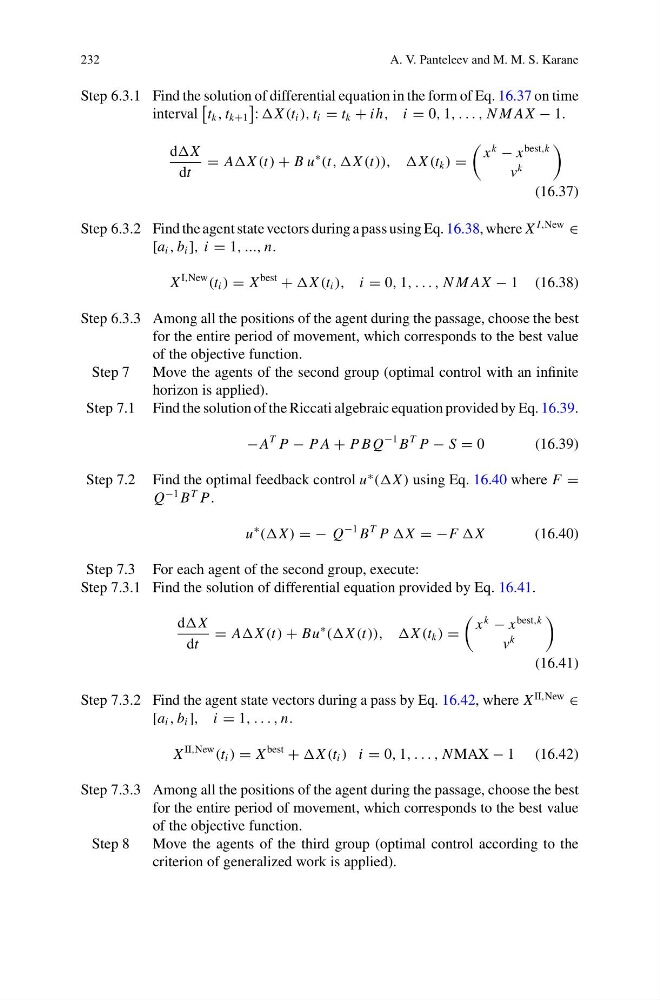
Step 6.3.1 Find the solution of differential equation in the form of Eq. 16.37 on time
interval
t k , t k+1
: X (t i ), t i = t k + ih, i = 0, 1, . . . , N M AX − 1.
dX
dt
= AX (t) + B u
∗
(t, ,X (t)), ,X (t k ) =
x
k
− x
best,k
v
k
(16.37)
Step 6.3.2 Find the agent state vectors during a pass using Eq. 16.38, where X
I,New
∈
[a i , b i ], i = 1, ..., n.
X
I,New
(t i ) = X
best
+ X (t i ), i = 0, 1, . . . , N M AX − 1 (16.38)
Step 6.3.3 Among all the positions of the agent during the passage, choose the best
for the entire period of movement, which corresponds to the best value
of the objective function.
Step 7
Move the agents of the second group (optimal control with an infinite
horizon is applied).
Step 7.1 Find the solution of the Riccati algebraic equation provided by Eq. 16.39.
−A
T P − P A + P B Q
−1 B
T P − S = 0
(16.39)
Step 7.2 Find the optimal feedback control u
∗
((X ) using Eq. 16.40 where F =
Q
−1 B
T P.
u
∗
((X ) = − Q
−1 B
T P X = −F X
(16.40)
Step 7.3 For each agent of the second group, execute:
Step 7.3.1 Find the solution of differential equation provided by Eq. 16.41.
dX
dt
= AX (t) + Bu
∗
((X (t)), ,X (t k ) =
x
k
− x
best,k
v
k
(16.41)
Step 7.3.2 Find the agent state vectors during a pass by Eq. 16.42, where X
II,New
∈
[a i , b i ], i = 1, . . . , n.
X
II,New
(t i ) = X
best
+ X (t i ) i = 0, 1, . . . , N MAX − 1 (16.42)
Step 7.3.3 Among all the positions of the agent during the passage, choose the best
for the entire period of movement, which corresponds to the best value
of the objective function.
Step 8
Move the agents of the third group (optimal control according to the
criterion of generalized work is applied).
A. V. Panteleev and M. M. S. Karane
Step 6.3.1 Find the solution of differential equation in the form of Eq. 16.37 on time
interval
t k , t k+1
: X (t i ), t i = t k + ih, i = 0, 1, . . . , N M AX − 1.
dX
dt
= AX (t) + B u
∗
(t, ,X (t)), ,X (t k ) =
x
k
− x
best,k
v
k
(16.37)
Step 6.3.2 Find the agent state vectors during a pass using Eq. 16.38, where X
I,New
∈
[a i , b i ], i = 1, ..., n.
X
I,New
(t i ) = X
best
+ X (t i ), i = 0, 1, . . . , N M AX − 1 (16.38)
Step 6.3.3 Among all the positions of the agent during the passage, choose the best
for the entire period of movement, which corresponds to the best value
of the objective function.
Step 7
Move the agents of the second group (optimal control with an infinite
horizon is applied).
Step 7.1 Find the solution of the Riccati algebraic equation provided by Eq. 16.39.
−A
T P − P A + P B Q
−1 B
T P − S = 0
(16.39)
Step 7.2 Find the optimal feedback control u
∗
((X ) using Eq. 16.40 where F =
Q
−1 B
T P.
u
∗
((X ) = − Q
−1 B
T P X = −F X
(16.40)
Step 7.3 For each agent of the second group, execute:
Step 7.3.1 Find the solution of differential equation provided by Eq. 16.41.
dX
dt
= AX (t) + Bu
∗
((X (t)), ,X (t k ) =
x
k
− x
best,k
v
k
(16.41)
Step 7.3.2 Find the agent state vectors during a pass by Eq. 16.42, where X
II,New
∈
[a i , b i ], i = 1, . . . , n.
X
II,New
(t i ) = X
best
+ X (t i ) i = 0, 1, . . . , N MAX − 1 (16.42)
Step 7.3.3 Among all the positions of the agent during the passage, choose the best
for the entire period of movement, which corresponds to the best value
of the objective function.
Step 8
Move the agents of the third group (optimal control according to the
criterion of generalized work is applied).