

230
A. V. Panteleev and M. M. S. Karane
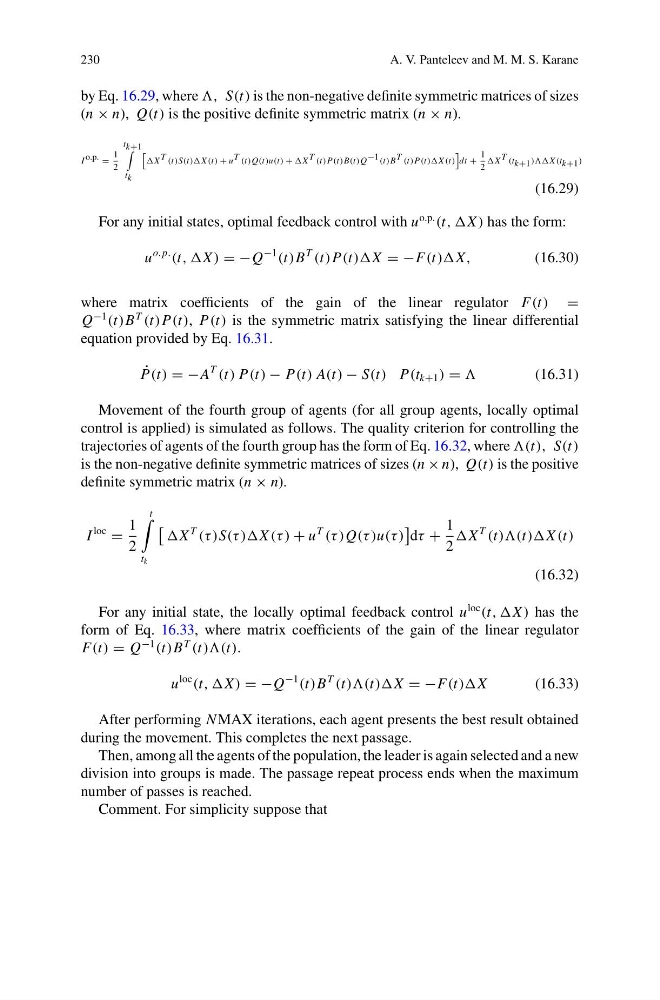
by Eq. 16.29, where , S(t) is the non-negative definite symmetric matrices of sizes
(n × n), Q(t) is the positive definite symmetric matrix (n × n).
I o.p. =
1
2
t k+1
t k
X T (t)S(t))X (t) + u T (t)Q(t)u(t) + X T (t)P(t)B(t)Q −1 (t)B T (t)P(t))X (t)
dt +
1
2
X T (t k+1 )))X (t k+1 )
(16.29)
For any initial states, optimal feedback control with u
o.p.
(t, ,X ) has the form:
u
o. p.
(t, ,X ) = −Q
−1
(t)B
T
(t)P(t))X = −F(t))X,
(16.30)
where matrix coefficients of the gain of the linear regulator F(t) =
Q
−1
(t)B
T
(t)P(t), P(t) is the symmetric matrix satisfying the linear differential
equation provided by Eq. 16.31.
˙
P(t) = −A
T
(t) P(t) − P(t) A(t) − S(t) P(t k+1 ) =
(16.31)
Movement of the fourth group of agents (for all group agents, locally optimal
control is applied) is simulated as follows. The quality criterion for controlling the
trajectories of agents of the fourth group has the form of Eq. 16.32, where (t), S(t)
is the non-negative definite symmetric matrices of sizes (n × n), Q(t) is the positive
definite symmetric matrix (n × n).
I
loc
=
1
2
t
t k
X
T
(τ )S(τ ))X (τ ) + u
T
(τ )Q(τ )u(τ )
dτ +
1
2
X
T
(t))(t))X (t)
(16.32)
For any initial state, the locally optimal feedback control u
loc
(t, ,X ) has the
form of Eq. 16.33, where matrix coefficients of the gain of the linear regulator
F(t) = Q
−1
(t)B
T
(t))(t).
u
loc
(t, ,X ) = −Q
−1
(t)B
T
(t))(t))X = −F(t))X
(16.33)
After performing N MAX iterations, each agent presents the best result obtained
during the movement. This completes the next passage.
Then, among all the agents of the population, the leader is again selected and a new
division into groups is made. The passage repeat process ends when the maximum
number of passes is reached.
Comment. For simplicity suppose that
A. V. Panteleev and M. M. S. Karane
by Eq. 16.29, where , S(t) is the non-negative definite symmetric matrices of sizes
(n × n), Q(t) is the positive definite symmetric matrix (n × n).
I o.p. =
1
2
t k+1
t k
X T (t)S(t))X (t) + u T (t)Q(t)u(t) + X T (t)P(t)B(t)Q −1 (t)B T (t)P(t))X (t)
dt +
1
2
X T (t k+1 )))X (t k+1 )
(16.29)
For any initial states, optimal feedback control with u
o.p.
(t, ,X ) has the form:
u
o. p.
(t, ,X ) = −Q
−1
(t)B
T
(t)P(t))X = −F(t))X,
(16.30)
where matrix coefficients of the gain of the linear regulator F(t) =
Q
−1
(t)B
T
(t)P(t), P(t) is the symmetric matrix satisfying the linear differential
equation provided by Eq. 16.31.
˙
P(t) = −A
T
(t) P(t) − P(t) A(t) − S(t) P(t k+1 ) =
(16.31)
Movement of the fourth group of agents (for all group agents, locally optimal
control is applied) is simulated as follows. The quality criterion for controlling the
trajectories of agents of the fourth group has the form of Eq. 16.32, where (t), S(t)
is the non-negative definite symmetric matrices of sizes (n × n), Q(t) is the positive
definite symmetric matrix (n × n).
I
loc
=
1
2
t
t k
X
T
(τ )S(τ ))X (τ ) + u
T
(τ )Q(τ )u(τ )
dτ +
1
2
X
T
(t))(t))X (t)
(16.32)
For any initial state, the locally optimal feedback control u
loc
(t, ,X ) has the
form of Eq. 16.33, where matrix coefficients of the gain of the linear regulator
F(t) = Q
−1
(t)B
T
(t))(t).
u
loc
(t, ,X ) = −Q
−1
(t)B
T
(t))(t))X = −F(t))X
(16.33)
After performing N MAX iterations, each agent presents the best result obtained
during the movement. This completes the next passage.
Then, among all the agents of the population, the leader is again selected and a new
division into groups is made. The passage repeat process ends when the maximum
number of passes is reached.
Comment. For simplicity suppose that