

224
A. V. Panteleev and M. M. S. Karane
P RT V ector
( j)
i =
1 if rand i < P RT
0 else
rand i = U [0, 1] (16.11)
Step 5.1.2 Consistently find the probable positions of population members using
Eq. 16.12, where ⊗ is the component product of vectors (by Hadamard).
x
( j),m
= x
( j)
+
x
(1)
− x
( j)
nstep
2
m ⊗ P RT V ector
( j)
i
m = 0, 1, . . . , nstep
(16.12)
Step 5.1.3 Find the best position of population members during migration using
Eq. 16.13.
x
( j),new
= arg
max
m=0,1,...,nstep
f (x
( j),m
) j = 2, . . . , N P x
(1),new
= x
(1)
(16.13)
Step 5.2 Place new members of the population after migration in ascending order
of fitness function value.
Step 6
Execute frontal search.
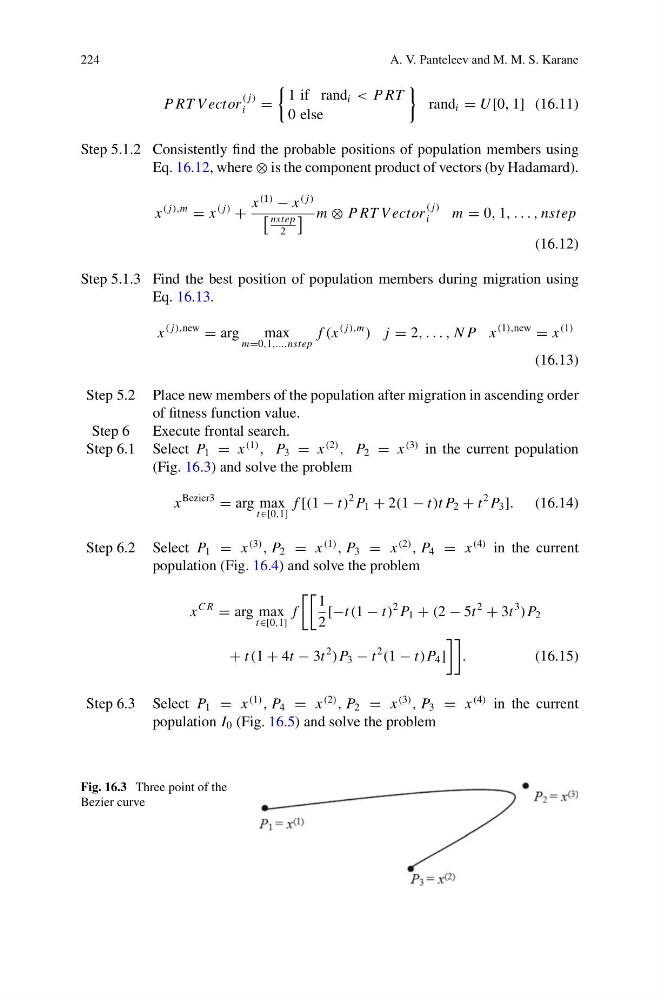
Step 6.1 Select P 1 = x
(1)
, P 3 = x
(2)
, P 2 = x
(3) in the current population
(Fig. 16.3) and solve the problem
x
Bezier3
= arg max
t∈[0,1]
f [(1 − t)
2 P 1 + 2(1 − t)t P 2 + t
2 P 3 ]. (16.14)
Step 6.2 Select P 1 = x
(3)
, P 2 = x
(1)
, P 3 = x
(2)
, P 4 = x
(4) in the current
population (Fig. 16.4) and solve the problem
x
C R
= arg max
t∈[0,1]
f
1
2
[−t (1 − t)
2 P 1 + (2 − 5t
2
+ 3t
3
)P 2
+ t (1 + 4t − 3t
2
)P 3 − t
2
(1 − t)P 4 ]
.
(16.15)
Step 6.3 Select P 1 = x
(1)
, P 4 = x
(2)
, P 2 = x
(3)
, P 3 = x
(4) in the current
population I 0 (Fig. 16.5) and solve the problem
Fig. 16.3 Three point of the
Bezier curve
A. V. Panteleev and M. M. S. Karane
P RT V ector
( j)
i =
1 if rand i < P RT
0 else
rand i = U [0, 1] (16.11)
Step 5.1.2 Consistently find the probable positions of population members using
Eq. 16.12, where ⊗ is the component product of vectors (by Hadamard).
x
( j),m
= x
( j)
+
x
(1)
− x
( j)
nstep
2
m ⊗ P RT V ector
( j)
i
m = 0, 1, . . . , nstep
(16.12)
Step 5.1.3 Find the best position of population members during migration using
Eq. 16.13.
x
( j),new
= arg
max
m=0,1,...,nstep
f (x
( j),m
) j = 2, . . . , N P x
(1),new
= x
(1)
(16.13)
Step 5.2 Place new members of the population after migration in ascending order
of fitness function value.
Step 6
Execute frontal search.
Step 6.1 Select P 1 = x
(1)
, P 3 = x
(2)
, P 2 = x
(3) in the current population
(Fig. 16.3) and solve the problem
x
Bezier3
= arg max
t∈[0,1]
f [(1 − t)
2 P 1 + 2(1 − t)t P 2 + t
2 P 3 ]. (16.14)
Step 6.2 Select P 1 = x
(3)
, P 2 = x
(1)
, P 3 = x
(2)
, P 4 = x
(4) in the current
population (Fig. 16.4) and solve the problem
x
C R
= arg max
t∈[0,1]
f
1
2
[−t (1 − t)
2 P 1 + (2 − 5t
2
+ 3t
3
)P 2
+ t (1 + 4t − 3t
2
)P 3 − t
2
(1 − t)P 4 ]
.
(16.15)
Step 6.3 Select P 1 = x
(1)
, P 4 = x
(2)
, P 2 = x
(3)
, P 3 = x
(4) in the current
population I 0 (Fig. 16.5) and solve the problem
Fig. 16.3 Three point of the
Bezier curve