

16 Application of Multi-agent Optimization Methods …
223
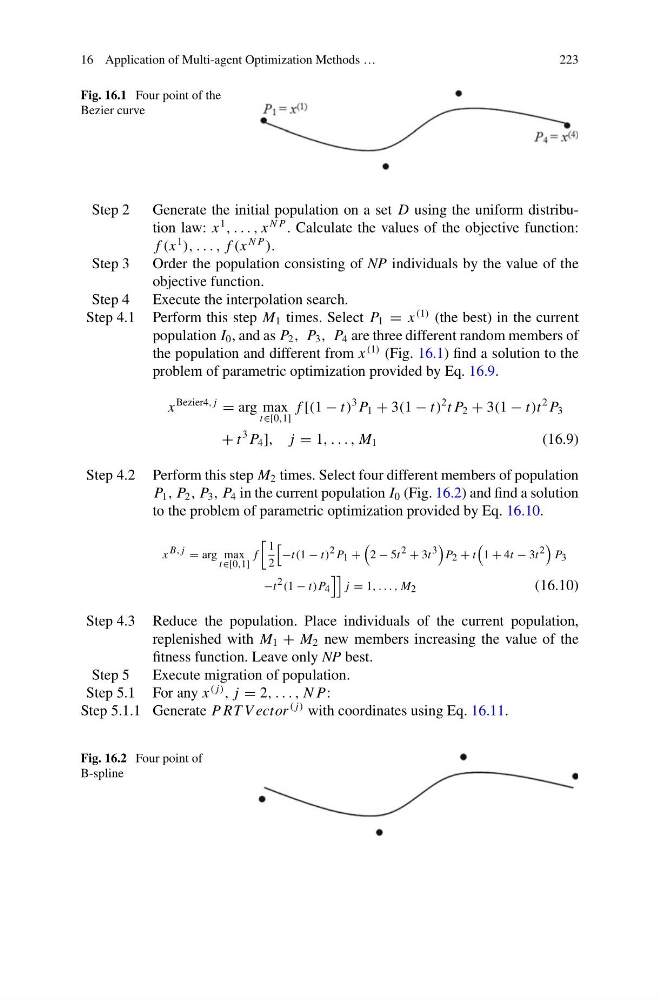
Fig. 16.1 Four point of the
Bezier curve
Step 2
Generate the initial population on a set D using the uniform distribution law: x
1
, . . . , x
N P . Calculate the values of the objective function:
f (x
1
), . . . , f (x
N P
).
Step 3
Order the population consisting of NP individuals by the value of the
objective function.
Step 4
Execute the interpolation search.
Step 4.1 Perform this step M 1 times. Select P 1 = x
(1) (the best) in the current
population I 0 , and as P 2 , P 3 , P 4 are three different random members of
the population and different from x
(1) (Fig. 16.1) find a solution to the
problem of parametric optimization provided by Eq. 16.9.
x
Bezier4, j
= arg max
t∈[0,1]
f [(1 − t)
3 P 1 + 3(1 − t)
2 t P 2 + 3(1 − t)t
2 P 3
+ t
3 P 4 ], j = 1, . . . , M 1
(16.9)
Step 4.2 Perform this step M 2 times. Select four different members of population
P 1 , P 2 , P 3 , P 4 in the current population I 0 (Fig. 16.2) and find a solution
to the problem of parametric optimization provided by Eq. 16.10.
x B, j = arg max
t∈[0,1]
f
1
2
−t(1 − t) 2 P 1 +
2 − 5t 2 + 3t 3
P 2 + t
1 + 4t − 3t 2
P 3
−t 2 (1 − t)P 4
j = 1, . . . , M 2
(16.10)
Step 4.3 Reduce the population. Place individuals of the current population,
replenished with M 1 + M 2 new members increasing the value of the
fitness function. Leave only NP best.
Step 5
Execute migration of population.
Step 5.1 For any x
( j)
, j = 2, . . . , N P:
Step 5.1.1 Generate P RT V ector
( j) with coordinates using Eq. 16.11.
Fig. 16.2 Four point of
B-spline
223
Fig. 16.1 Four point of the
Bezier curve
Step 2
Generate the initial population on a set D using the uniform distribution law: x
1
, . . . , x
N P . Calculate the values of the objective function:
f (x
1
), . . . , f (x
N P
).
Step 3
Order the population consisting of NP individuals by the value of the
objective function.
Step 4
Execute the interpolation search.
Step 4.1 Perform this step M 1 times. Select P 1 = x
(1) (the best) in the current
population I 0 , and as P 2 , P 3 , P 4 are three different random members of
the population and different from x
(1) (Fig. 16.1) find a solution to the
problem of parametric optimization provided by Eq. 16.9.
x
Bezier4, j
= arg max
t∈[0,1]
f [(1 − t)
3 P 1 + 3(1 − t)
2 t P 2 + 3(1 − t)t
2 P 3
+ t
3 P 4 ], j = 1, . . . , M 1
(16.9)
Step 4.2 Perform this step M 2 times. Select four different members of population
P 1 , P 2 , P 3 , P 4 in the current population I 0 (Fig. 16.2) and find a solution
to the problem of parametric optimization provided by Eq. 16.10.
x B, j = arg max
t∈[0,1]
f
1
2
−t(1 − t) 2 P 1 +
2 − 5t 2 + 3t 3
P 2 + t
1 + 4t − 3t 2
P 3
−t 2 (1 − t)P 4
j = 1, . . . , M 2
(16.10)
Step 4.3 Reduce the population. Place individuals of the current population,
replenished with M 1 + M 2 new members increasing the value of the
fitness function. Leave only NP best.
Step 5
Execute migration of population.
Step 5.1 For any x
( j)
, j = 2, . . . , N P:
Step 5.1.1 Generate P RT V ector
( j) with coordinates using Eq. 16.11.
Fig. 16.2 Four point of
B-spline