

212
S. S. Krylov et al.
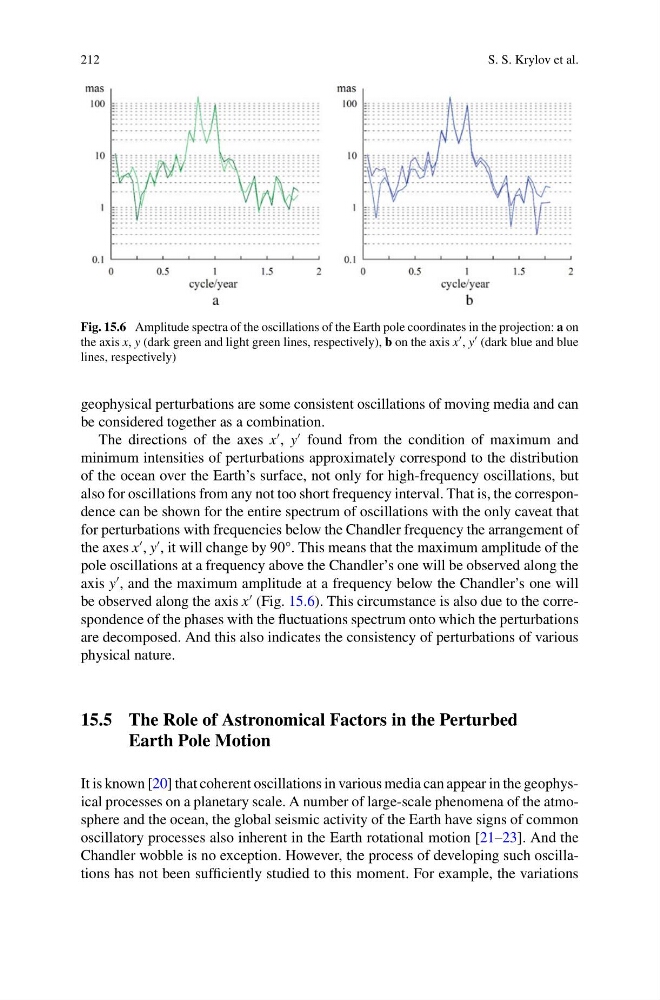
Fig. 15.6 Amplitude spectra of the oscillations of the Earth pole coordinates in the projection: a on
the axis x, y (dark green and light green lines, respectively), b on the axis x , y (dark blue and blue
lines, respectively)
geophysical perturbations are some consistent oscillations of moving media and can
be considered together as a combination.
The directions of the axes x
, y
found from the condition of maximum and
minimum intensities of perturbations approximately correspond to the distribution
of the ocean over the Earth’s surface, not only for high-frequency oscillations, but
also for oscillations from any not too short frequency interval. That is, the correspondence can be shown for the entire spectrum of oscillations with the only caveat that
for perturbations with frequencies below the Chandler frequency the arrangement of
the axes x
, y
, it will change by 90°. This means that the maximum amplitude of the
pole oscillations at a frequency above the Chandler’s one will be observed along the
axis y
, and the maximum amplitude at a frequency below the Chandler’s one will
be observed along the axis x
(Fig. 15.6). This circumstance is also due to the correspondence of the phases with the fluctuations spectrum onto which the perturbations
are decomposed. And this also indicates the consistency of perturbations of various
physical nature.
15.5 The Role of Astronomical Factors in the Perturbed
Earth Pole Motion
It is known [20] that coherent oscillations in various media can appear in the geophysical processes on a planetary scale. A number of large-scale phenomena of the atmosphere and the ocean, the global seismic activity of the Earth have signs of common
oscillatory processes also inherent in the Earth rotational motion [21–23]. And the
Chandler wobble is no exception. However, the process of developing such oscillations has not been sufficiently studied to this moment. For example, the variations
S. S. Krylov et al.
Fig. 15.6 Amplitude spectra of the oscillations of the Earth pole coordinates in the projection: a on
the axis x, y (dark green and light green lines, respectively), b on the axis x , y (dark blue and blue
lines, respectively)
geophysical perturbations are some consistent oscillations of moving media and can
be considered together as a combination.
The directions of the axes x
, y
found from the condition of maximum and
minimum intensities of perturbations approximately correspond to the distribution
of the ocean over the Earth’s surface, not only for high-frequency oscillations, but
also for oscillations from any not too short frequency interval. That is, the correspondence can be shown for the entire spectrum of oscillations with the only caveat that
for perturbations with frequencies below the Chandler frequency the arrangement of
the axes x
, y
, it will change by 90°. This means that the maximum amplitude of the
pole oscillations at a frequency above the Chandler’s one will be observed along the
axis y
, and the maximum amplitude at a frequency below the Chandler’s one will
be observed along the axis x
(Fig. 15.6). This circumstance is also due to the correspondence of the phases with the fluctuations spectrum onto which the perturbations
are decomposed. And this also indicates the consistency of perturbations of various
physical nature.
15.5 The Role of Astronomical Factors in the Perturbed
Earth Pole Motion
It is known [20] that coherent oscillations in various media can appear in the geophysical processes on a planetary scale. A number of large-scale phenomena of the atmosphere and the ocean, the global seismic activity of the Earth have signs of common
oscillatory processes also inherent in the Earth rotational motion [21–23]. And the
Chandler wobble is no exception. However, the process of developing such oscillations has not been sufficiently studied to this moment. For example, the variations