

11 Application of Low-Power Pulse Plasma Thrusters in Thrust Units …
149
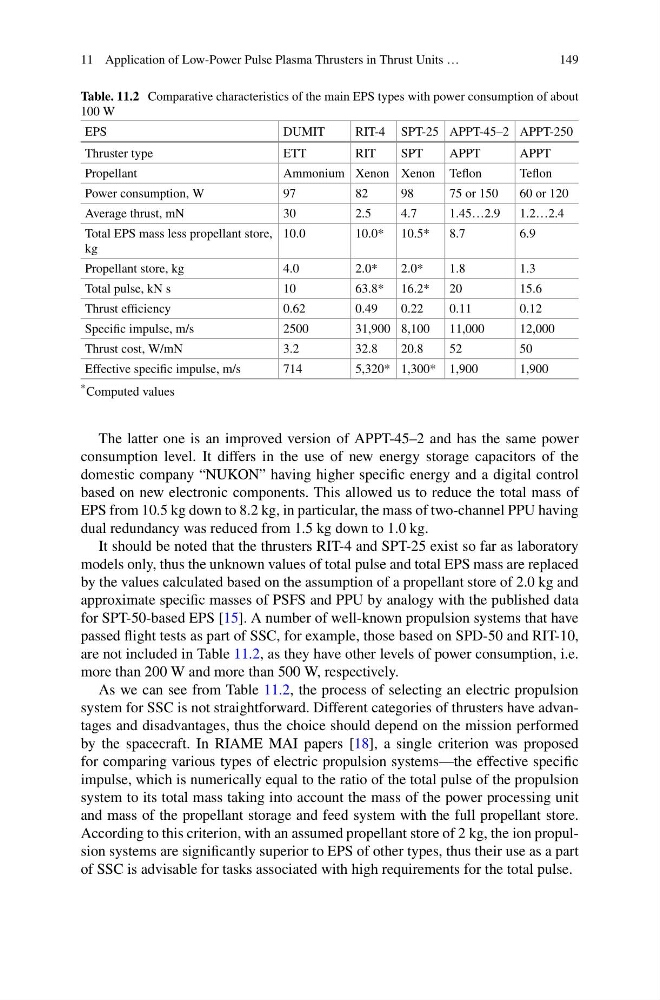
Table. 11.2 Comparative characteristics of the main EPS types with power consumption of about
100 W
EPS
DUMIT
RIT-4 SPT-25 APPT-45–2 APPT-250
Thruster type
ETT
RIT
SPT
APPT
APPT
Propellant
Ammonium Xenon Xenon Teflon
Teflon
Power consumption, W
97
82
98
75 or 150
60 or 120
Average thrust, mN
30
2.5
4.7
1.45…2.9
1.2…2.4
Total EPS mass less propellant store,
kg
10.0
10.0* 10.5*
8.7
6.9
Propellant store, kg
4.0
2.0*
2.0*
1.8
1.3
Total pulse, kN s
10
63.8* 16.2*
20
15.6
Thrust efficiency
0.62
0.49
0.22
0.11
0.12
Specific impulse, m/s
2500
31,900 8,100
11,000
12,000
Thrust cost, W/mN
3.2
32.8
20.8
52
50
Effective specific impulse, m/s
714
5,320* 1,300* 1,900
1,900
* Computed values
The latter one is an improved version of APPT-45–2 and has the same power
consumption level. It differs in the use of new energy storage capacitors of the
domestic company “NUKON” having higher specific energy and a digital control
based on new electronic components. This allowed us to reduce the total mass of
EPS from 10.5 kg down to 8.2 kg, in particular, the mass of two-channel PPU having
dual redundancy was reduced from 1.5 kg down to 1.0 kg.
It should be noted that the thrusters RIT-4 and SPT-25 exist so far as laboratory
models only, thus the unknown values of total pulse and total EPS mass are replaced
by the values calculated based on the assumption of a propellant store of 2.0 kg and
approximate specific masses of PSFS and PPU by analogy with the published data
for SPT-50-based EPS [15]. A number of well-known propulsion systems that have
passed flight tests as part of SSC, for example, those based on SPD-50 and RIT-10,
are not included in Table 11.2, as they have other levels of power consumption, i.e.
more than 200 W and more than 500 W, respectively.
As we can see from Table 11.2, the process of selecting an electric propulsion
system for SSC is not straightforward. Different categories of thrusters have advantages and disadvantages, thus the choice should depend on the mission performed
by the spacecraft. In RIAME MAI papers [18], a single criterion was proposed
for comparing various types of electric propulsion systems—the effective specific
impulse, which is numerically equal to the ratio of the total pulse of the propulsion
system to its total mass taking into account the mass of the power processing unit
and mass of the propellant storage and feed system with the full propellant store.
According to this criterion, with an assumed propellant store of 2 kg, the ion propulsion systems are significantly superior to EPS of other types, thus their use as a part
of SSC is advisable for tasks associated with high requirements for the total pulse.
149
Table. 11.2 Comparative characteristics of the main EPS types with power consumption of about
100 W
EPS
DUMIT
RIT-4 SPT-25 APPT-45–2 APPT-250
Thruster type
ETT
RIT
SPT
APPT
APPT
Propellant
Ammonium Xenon Xenon Teflon
Teflon
Power consumption, W
97
82
98
75 or 150
60 or 120
Average thrust, mN
30
2.5
4.7
1.45…2.9
1.2…2.4
Total EPS mass less propellant store,
kg
10.0
10.0* 10.5*
8.7
6.9
Propellant store, kg
4.0
2.0*
2.0*
1.8
1.3
Total pulse, kN s
10
63.8* 16.2*
20
15.6
Thrust efficiency
0.62
0.49
0.22
0.11
0.12
Specific impulse, m/s
2500
31,900 8,100
11,000
12,000
Thrust cost, W/mN
3.2
32.8
20.8
52
50
Effective specific impulse, m/s
714
5,320* 1,300* 1,900
1,900
* Computed values
The latter one is an improved version of APPT-45–2 and has the same power
consumption level. It differs in the use of new energy storage capacitors of the
domestic company “NUKON” having higher specific energy and a digital control
based on new electronic components. This allowed us to reduce the total mass of
EPS from 10.5 kg down to 8.2 kg, in particular, the mass of two-channel PPU having
dual redundancy was reduced from 1.5 kg down to 1.0 kg.
It should be noted that the thrusters RIT-4 and SPT-25 exist so far as laboratory
models only, thus the unknown values of total pulse and total EPS mass are replaced
by the values calculated based on the assumption of a propellant store of 2.0 kg and
approximate specific masses of PSFS and PPU by analogy with the published data
for SPT-50-based EPS [15]. A number of well-known propulsion systems that have
passed flight tests as part of SSC, for example, those based on SPD-50 and RIT-10,
are not included in Table 11.2, as they have other levels of power consumption, i.e.
more than 200 W and more than 500 W, respectively.
As we can see from Table 11.2, the process of selecting an electric propulsion
system for SSC is not straightforward. Different categories of thrusters have advantages and disadvantages, thus the choice should depend on the mission performed
by the spacecraft. In RIAME MAI papers [18], a single criterion was proposed
for comparing various types of electric propulsion systems—the effective specific
impulse, which is numerically equal to the ratio of the total pulse of the propulsion
system to its total mass taking into account the mass of the power processing unit
and mass of the propellant storage and feed system with the full propellant store.
According to this criterion, with an assumed propellant store of 2 kg, the ion propulsion systems are significantly superior to EPS of other types, thus their use as a part
of SSC is advisable for tasks associated with high requirements for the total pulse.