

146
A. V. Bogatiy et al.
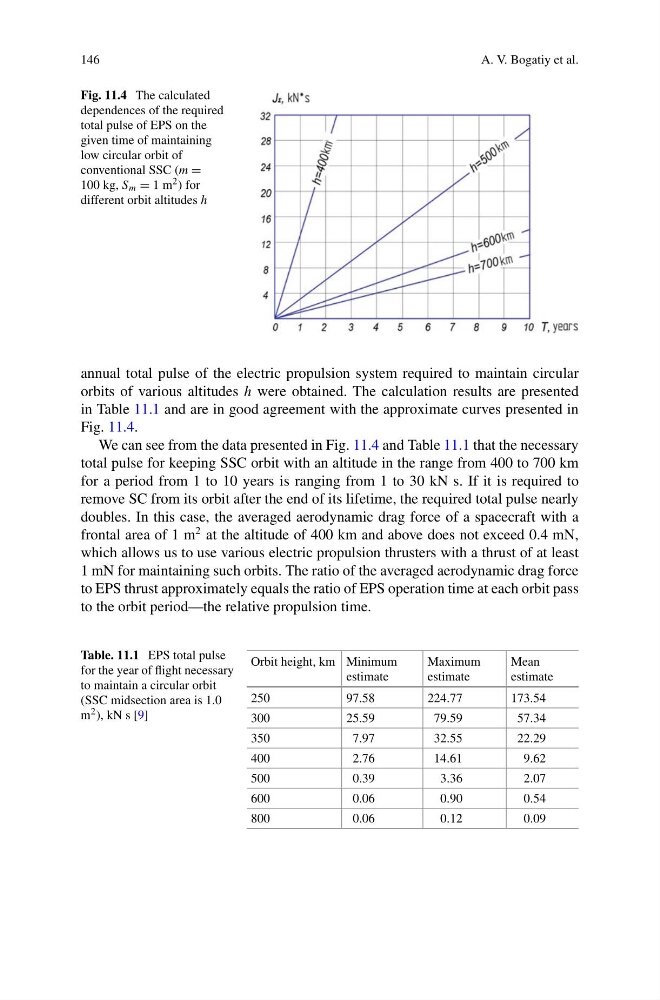
Fig. 11.4 The calculated
dependences of the required
total pulse of EPS on the
given time of maintaining
low circular orbit of
conventional SSC (m =
100 kg, S m = 1 m 2 ) for
different orbit altitudes h
annual total pulse of the electric propulsion system required to maintain circular
orbits of various altitudes h were obtained. The calculation results are presented
in Table 11.1 and are in good agreement with the approximate curves presented in
Fig. 11.4.
We can see from the data presented in Fig. 11.4 and Table 11.1 that the necessary
total pulse for keeping SSC orbit with an altitude in the range from 400 to 700 km
for a period from 1 to 10 years is ranging from 1 to 30 kN s. If it is required to
remove SC from its orbit after the end of its lifetime, the required total pulse nearly
doubles. In this case, the averaged aerodynamic drag force of a spacecraft with a
frontal area of 1 m
2 at the altitude of 400 km and above does not exceed 0.4 mN,
which allows us to use various electric propulsion thrusters with a thrust of at least
1 mN for maintaining such orbits. The ratio of the averaged aerodynamic drag force
to EPS thrust approximately equals the ratio of EPS operation time at each orbit pass
to the orbit period—the relative propulsion time.
Table. 11.1 EPS total pulse
for the year of flight necessary
to maintain a circular orbit
(SSC midsection area is 1.0
m 2 ), kN s [9]
Orbit height, km Minimum
estimate
Maximum
estimate
Mean
estimate
250
97.58
224.77
173.54
300
25.59
79.59
57.34
350
7.97
32.55
22.29
400
2.76
14.61
9.62
500
0.39
3.36
2.07
600
0.06
0.90
0.54
800
0.06
0.12
0.09
A. V. Bogatiy et al.
Fig. 11.4 The calculated
dependences of the required
total pulse of EPS on the
given time of maintaining
low circular orbit of
conventional SSC (m =
100 kg, S m = 1 m 2 ) for
different orbit altitudes h
annual total pulse of the electric propulsion system required to maintain circular
orbits of various altitudes h were obtained. The calculation results are presented
in Table 11.1 and are in good agreement with the approximate curves presented in
Fig. 11.4.
We can see from the data presented in Fig. 11.4 and Table 11.1 that the necessary
total pulse for keeping SSC orbit with an altitude in the range from 400 to 700 km
for a period from 1 to 10 years is ranging from 1 to 30 kN s. If it is required to
remove SC from its orbit after the end of its lifetime, the required total pulse nearly
doubles. In this case, the averaged aerodynamic drag force of a spacecraft with a
frontal area of 1 m
2 at the altitude of 400 km and above does not exceed 0.4 mN,
which allows us to use various electric propulsion thrusters with a thrust of at least
1 mN for maintaining such orbits. The ratio of the averaged aerodynamic drag force
to EPS thrust approximately equals the ratio of EPS operation time at each orbit pass
to the orbit period—the relative propulsion time.
Table. 11.1 EPS total pulse
for the year of flight necessary
to maintain a circular orbit
(SSC midsection area is 1.0
m 2 ), kN s [9]
Orbit height, km Minimum
estimate
Maximum
estimate
Mean
estimate
250
97.58
224.77
173.54
300
25.59
79.59
57.34
350
7.97
32.55
22.29
400
2.76
14.61
9.62
500
0.39
3.36
2.07
600
0.06
0.90
0.54
800
0.06
0.12
0.09