

11 Application of Low-Power Pulse Plasma Thrusters in Thrust Units …
145
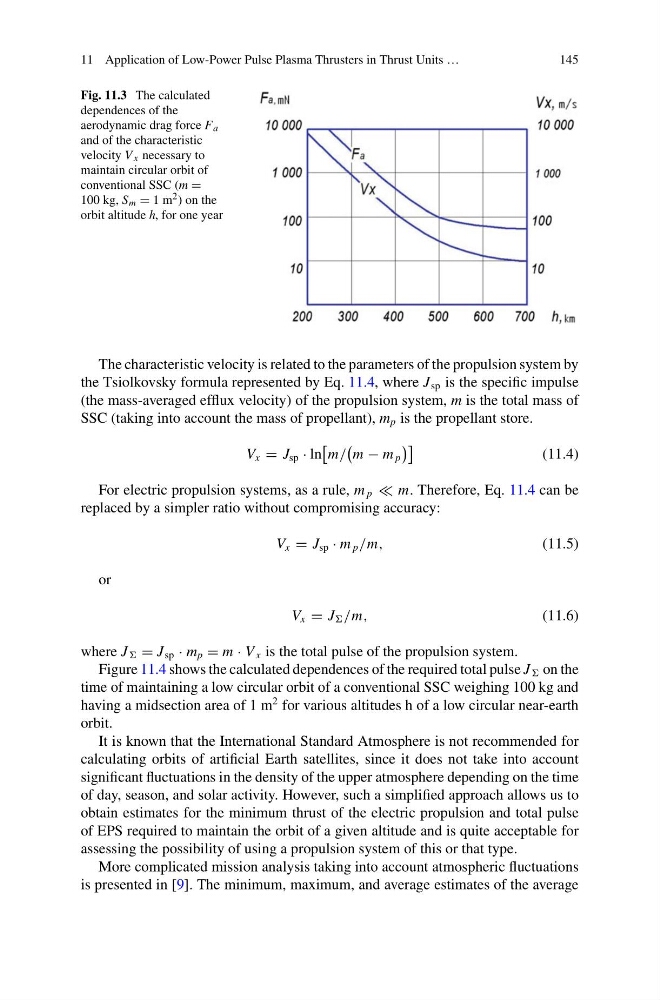
Fig. 11.3 The calculated
dependences of the
aerodynamic drag force F a
and of the characteristic
velocity V x necessary to
maintain circular orbit of
conventional SSC (m =
100 kg, S m = 1 m 2 ) on the
orbit altitude h, for one year
The characteristic velocity is related to the parameters of the propulsion system by
the Tsiolkovsky formula represented by Eq. 11.4, where J sp is the specific impulse
(the mass-averaged efflux velocity) of the propulsion system, m is the total mass of
SSC (taking into account the mass of propellant), m p is the propellant store.
V x = J sp · ln
m/
m − m p
(11.4)
For electric propulsion systems, as a rule, m p m. Therefore, Eq. 11.4 can be
replaced by a simpler ratio without compromising accuracy:
V x = J sp · m p /m,
(11.5)
or
V x = J /m,
(11.6)
where J = J sp · m p = m · V x is the total pulse of the propulsion system.
Figure 11.4 shows the calculated dependences of the required total pulse J on the
time of maintaining a low circular orbit of a conventional SSC weighing 100 kg and
having a midsection area of 1 m
2 for various altitudes h of a low circular near-earth
orbit.
It is known that the International Standard Atmosphere is not recommended for
calculating orbits of artificial Earth satellites, since it does not take into account
significant fluctuations in the density of the upper atmosphere depending on the time
of day, season, and solar activity. However, such a simplified approach allows us to
obtain estimates for the minimum thrust of the electric propulsion and total pulse
of EPS required to maintain the orbit of a given altitude and is quite acceptable for
assessing the possibility of using a propulsion system of this or that type.
More complicated mission analysis taking into account atmospheric fluctuations
is presented in [9]. The minimum, maximum, and average estimates of the average
145
Fig. 11.3 The calculated
dependences of the
aerodynamic drag force F a
and of the characteristic
velocity V x necessary to
maintain circular orbit of
conventional SSC (m =
100 kg, S m = 1 m 2 ) on the
orbit altitude h, for one year
The characteristic velocity is related to the parameters of the propulsion system by
the Tsiolkovsky formula represented by Eq. 11.4, where J sp is the specific impulse
(the mass-averaged efflux velocity) of the propulsion system, m is the total mass of
SSC (taking into account the mass of propellant), m p is the propellant store.
V x = J sp · ln
m/
m − m p
(11.4)
For electric propulsion systems, as a rule, m p m. Therefore, Eq. 11.4 can be
replaced by a simpler ratio without compromising accuracy:
V x = J sp · m p /m,
(11.5)
or
V x = J /m,
(11.6)
where J = J sp · m p = m · V x is the total pulse of the propulsion system.
Figure 11.4 shows the calculated dependences of the required total pulse J on the
time of maintaining a low circular orbit of a conventional SSC weighing 100 kg and
having a midsection area of 1 m
2 for various altitudes h of a low circular near-earth
orbit.
It is known that the International Standard Atmosphere is not recommended for
calculating orbits of artificial Earth satellites, since it does not take into account
significant fluctuations in the density of the upper atmosphere depending on the time
of day, season, and solar activity. However, such a simplified approach allows us to
obtain estimates for the minimum thrust of the electric propulsion and total pulse
of EPS required to maintain the orbit of a given altitude and is quite acceptable for
assessing the possibility of using a propulsion system of this or that type.
More complicated mission analysis taking into account atmospheric fluctuations
is presented in [9]. The minimum, maximum, and average estimates of the average