

11 Application of Low-Power Pulse Plasma Thrusters in Thrust Units …
143
thermo-catalytic, electrothermal, and arcjet thrusters. Hall thrusters (HT) with closed
electron drift have two varieties: Stationary Plasma Thruster (SPT) and Thruster with
Anode Layer (TAL) [3, 4]. Thrusters with electromagnetic acceleration are usually
divided into two subclasses: magneto-plasma-dynamic thrusters with self-induced
and applied magnetic field. Electrostatic thrusters include ion thrusters (IT) and
colloid thrusters with various mechanisms of propellant ionization [5, 6]. Pulsed
Plasma Thrusters (PPT) are usually considered as a separate class [7] due to the
pronounced specificity of operating processes. It should be noted that in Ablative
PPT (APPT) both electrothermal and electromagnetic plasma acceleration can take
place. Often, the mixed mechanism of acceleration is implemented.
The main condition for the application of EPT of any type as a part of SSC electric
propulsion system is the possibility for its operation in limited power consumption
conditions. In this chapter, the power consumption of 100 … 150 W is assumed as
the boundary value. This condition can be met by the following types of electric
propulsion thrusters (only EPT that reached the stage of flight tests or purposeoriented operation in space conditions are considered), i.e. in:
• Class of electrothermal thrusters includes the hydrazine-operated thermo-catalytic
thrusters, electrothermal thrusters, and arcjet.
• Class of HT involves SPT and TAL.
• Class of electrostatic thrusters joints the ion thrusters and colloid thrusters.
• Special class of pulsed thrusters contains APPT, usually with Teflon (fluoroplast4) as a propellant, in which the acceleration physics is either electrothermal (arc)
or electromagnetic with a self magnetic field, or mixed.
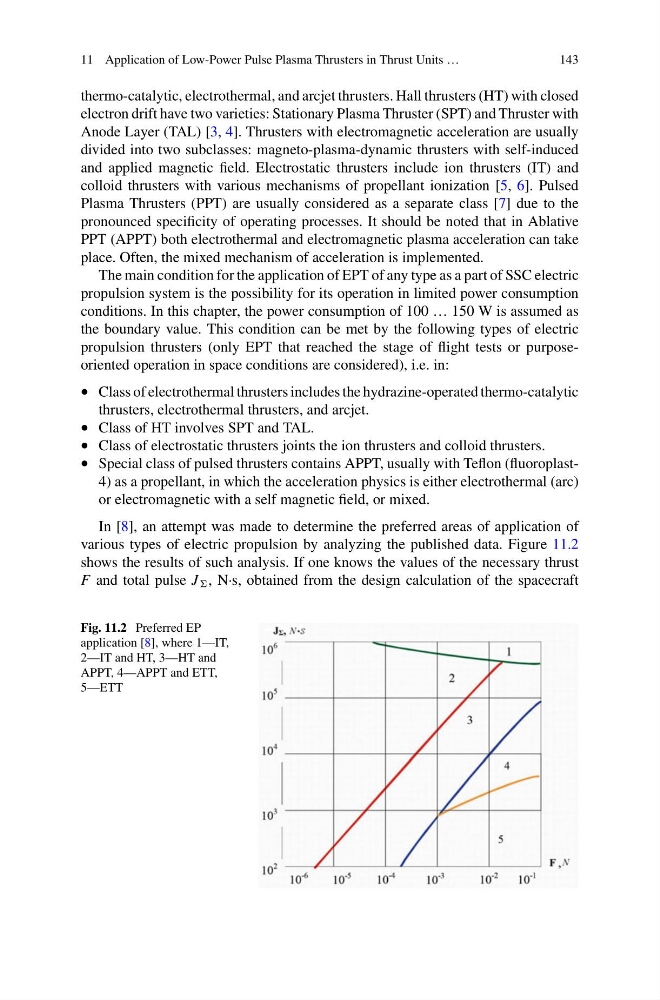
In [8], an attempt was made to determine the preferred areas of application of
various types of electric propulsion by analyzing the published data. Figure 11.2
shows the results of such analysis. If one knows the values of the necessary thrust
F and total pulse J , N·s, obtained from the design calculation of the spacecraft
Fig. 11.2 Preferred EP
application [8], where 1—IT,
2—IT and HT, 3—HT and
APPT, 4—APPT and ETT,
5—ETT
143
thermo-catalytic, electrothermal, and arcjet thrusters. Hall thrusters (HT) with closed
electron drift have two varieties: Stationary Plasma Thruster (SPT) and Thruster with
Anode Layer (TAL) [3, 4]. Thrusters with electromagnetic acceleration are usually
divided into two subclasses: magneto-plasma-dynamic thrusters with self-induced
and applied magnetic field. Electrostatic thrusters include ion thrusters (IT) and
colloid thrusters with various mechanisms of propellant ionization [5, 6]. Pulsed
Plasma Thrusters (PPT) are usually considered as a separate class [7] due to the
pronounced specificity of operating processes. It should be noted that in Ablative
PPT (APPT) both electrothermal and electromagnetic plasma acceleration can take
place. Often, the mixed mechanism of acceleration is implemented.
The main condition for the application of EPT of any type as a part of SSC electric
propulsion system is the possibility for its operation in limited power consumption
conditions. In this chapter, the power consumption of 100 … 150 W is assumed as
the boundary value. This condition can be met by the following types of electric
propulsion thrusters (only EPT that reached the stage of flight tests or purposeoriented operation in space conditions are considered), i.e. in:
• Class of electrothermal thrusters includes the hydrazine-operated thermo-catalytic
thrusters, electrothermal thrusters, and arcjet.
• Class of HT involves SPT and TAL.
• Class of electrostatic thrusters joints the ion thrusters and colloid thrusters.
• Special class of pulsed thrusters contains APPT, usually with Teflon (fluoroplast4) as a propellant, in which the acceleration physics is either electrothermal (arc)
or electromagnetic with a self magnetic field, or mixed.
In [8], an attempt was made to determine the preferred areas of application of
various types of electric propulsion by analyzing the published data. Figure 11.2
shows the results of such analysis. If one knows the values of the necessary thrust
F and total pulse J , N·s, obtained from the design calculation of the spacecraft
Fig. 11.2 Preferred EP
application [8], where 1—IT,
2—IT and HT, 3—HT and
APPT, 4—APPT and ETT,
5—ETT