

142
A. V. Bogatiy et al.
provide high resolution due to the summation of apertures of individual spacecraft
equipment [2].
The operating conditions of most of such spacecraft require the maintenance
and regular correction of their orbits, which makes it necessary to use small-sized
propulsion systems that could operate efficiently in conditions of limited power
consumption. The growing demands on the accuracy of keeping the parameters of
SSC orbits, as well as, on the thruster lifetime and total pulse, necessitate the use of
Electric Propulsion Systems (EPS) on such SSC. The current level of SSC powerweight ratio is about 1 W/kg. The limited mass of SSC and the limited power of
their onboard power plants, as well as, the restrictions imposed on the cost of their
development and operation, require the development of small, lightweight, and cheap
electric propulsion systems with high efficiency in a range of power consumption of
about 50–100 W and slightly higher.
This chapter is organized as follows. Section 11.2 reviews the types of EPS
and their applications. Section 11.3 assesses the requirements for EPS for a loworbit SSC. Section 11.4 discusses the possibility of solving the problem of SSC
orientation using EPS. Section 11.5 compares APPT-based EPS with other types of
EPS. Section 11.6 describes new development at the RIAME MAI of propulsion
system based on APPT for SSC, its calculated technical characteristics are given.
Section 11.7 concludes the chapter.
11.2 Types of Low-Power Electric Propulsion Systems
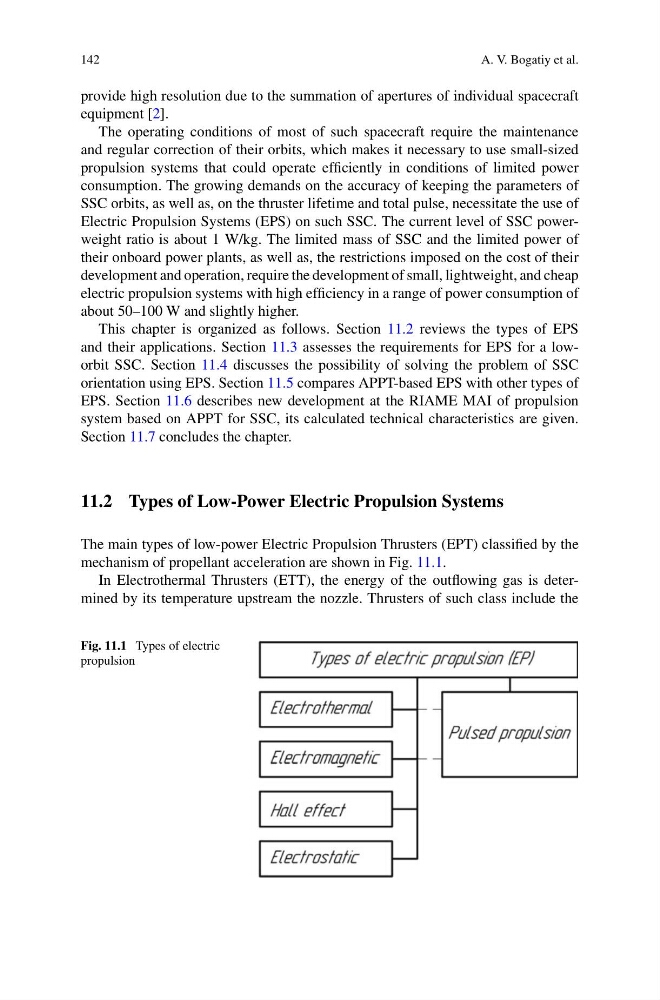
The main types of low-power Electric Propulsion Thrusters (EPT) classified by the
mechanism of propellant acceleration are shown in Fig. 11.1.
In Electrothermal Thrusters (ETT), the energy of the outflowing gas is determined by its temperature upstream the nozzle. Thrusters of such class include the
Fig. 11.1 Types of electric
propulsion
A. V. Bogatiy et al.
provide high resolution due to the summation of apertures of individual spacecraft
equipment [2].
The operating conditions of most of such spacecraft require the maintenance
and regular correction of their orbits, which makes it necessary to use small-sized
propulsion systems that could operate efficiently in conditions of limited power
consumption. The growing demands on the accuracy of keeping the parameters of
SSC orbits, as well as, on the thruster lifetime and total pulse, necessitate the use of
Electric Propulsion Systems (EPS) on such SSC. The current level of SSC powerweight ratio is about 1 W/kg. The limited mass of SSC and the limited power of
their onboard power plants, as well as, the restrictions imposed on the cost of their
development and operation, require the development of small, lightweight, and cheap
electric propulsion systems with high efficiency in a range of power consumption of
about 50–100 W and slightly higher.
This chapter is organized as follows. Section 11.2 reviews the types of EPS
and their applications. Section 11.3 assesses the requirements for EPS for a loworbit SSC. Section 11.4 discusses the possibility of solving the problem of SSC
orientation using EPS. Section 11.5 compares APPT-based EPS with other types of
EPS. Section 11.6 describes new development at the RIAME MAI of propulsion
system based on APPT for SSC, its calculated technical characteristics are given.
Section 11.7 concludes the chapter.
11.2 Types of Low-Power Electric Propulsion Systems
The main types of low-power Electric Propulsion Thrusters (EPT) classified by the
mechanism of propellant acceleration are shown in Fig. 11.1.
In Electrothermal Thrusters (ETT), the energy of the outflowing gas is determined by its temperature upstream the nozzle. Thrusters of such class include the
Fig. 11.1 Types of electric
propulsion