

9 A Godunov-Type Method for a Multi-temperature Plasma …
121
Behind SW, the gas velocity is equaled −2 × 10
7 cm s
−1 , the pressure is equaled
5.37 × 10
8 din cm
−2 , and the temperature is equaled 8.11 × 10
5 K. The density
behind SW is equaled 4.00 × 10
−6 g cm
−3 . The simplest way to define the SW
velocity D is the constant mass flux on both surfaces of SW (0− D)×10
−6 g cm
−3
=
(2 × 10
7 cm s
−1
− D) × 3.955 × 10
−6 g cm
−3 . Thus, D = −2.68 × 10
7 cm s
−1 , and
its Mach number is M = |D|/c s = 16, where c s is the sound speed, relative to the
gas at rest.
9.4 Taking into Account Radiation Effects
In the previous Sect. 9.3, some contradictory results were obtained. The obtained
pressure is equaled 5.37 × 10
8 din cm
−2 , and the temperature is equaled 8.11 × 10
5
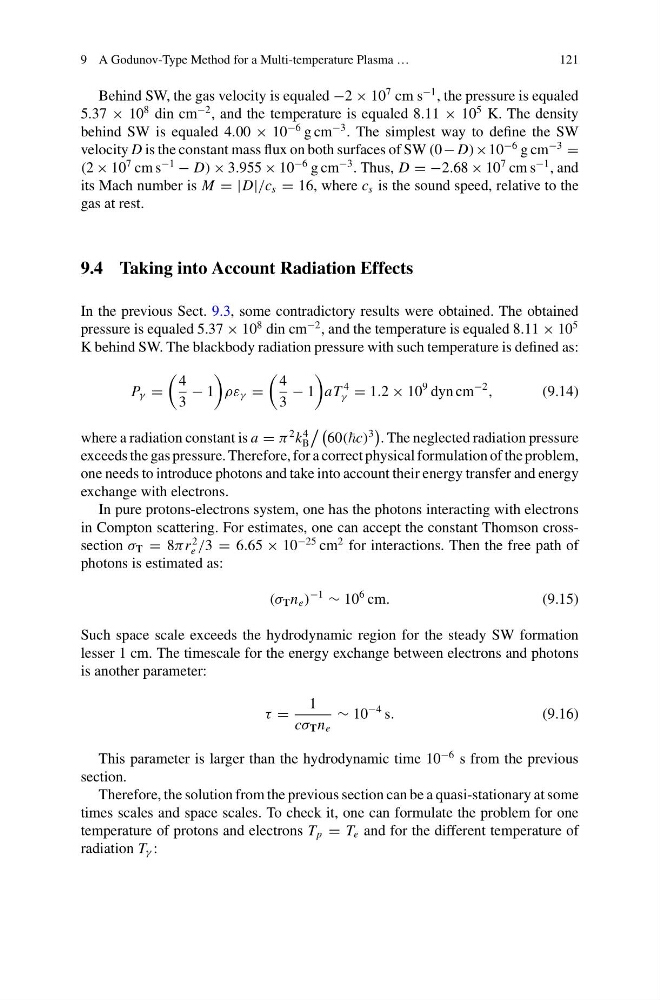
K behind SW. The blackbody radiation pressure with such temperature is defined as:
P γ =
4
3
− 1
ρε γ =
4
3
− 1
aT
4
γ = 1.2 × 10
9 dyn cm
−2
,
(9.14)
where a radiation constant is a = π
2 k
4
B
60(c)
3
. The neglected radiation pressure
exceeds the gas pressure. Therefore, for a correct physical formulation of the problem,
one needs to introduce photons and take into account their energy transfer and energy
exchange with electrons.
In pure protons-electrons system, one has the photons interacting with electrons
in Compton scattering. For estimates, one can accept the constant Thomson crosssection σ T = 8πr
2
e /3 = 6.65 × 10
−25 cm
2 for interactions. Then the free path of
photons is estimated as:
(σ T n e )
−1
∼ 10
6 cm.
(9.15)
Such space scale exceeds the hydrodynamic region for the steady SW formation
lesser 1 cm. The timescale for the energy exchange between electrons and photons
is another parameter:
τ =
1
cσ T n e
∼ 10
−4 s.
(9.16)
This parameter is larger than the hydrodynamic time 10
−6 s from the previous
section.
Therefore, the solution from the previous section can be a quasi-stationary at some
times scales and space scales. To check it, one can formulate the problem for one
temperature of protons and electrons T p = T e and for the different temperature of
radiation T γ :
121
Behind SW, the gas velocity is equaled −2 × 10
7 cm s
−1 , the pressure is equaled
5.37 × 10
8 din cm
−2 , and the temperature is equaled 8.11 × 10
5 K. The density
behind SW is equaled 4.00 × 10
−6 g cm
−3 . The simplest way to define the SW
velocity D is the constant mass flux on both surfaces of SW (0− D)×10
−6 g cm
−3
=
(2 × 10
7 cm s
−1
− D) × 3.955 × 10
−6 g cm
−3 . Thus, D = −2.68 × 10
7 cm s
−1 , and
its Mach number is M = |D|/c s = 16, where c s is the sound speed, relative to the
gas at rest.
9.4 Taking into Account Radiation Effects
In the previous Sect. 9.3, some contradictory results were obtained. The obtained
pressure is equaled 5.37 × 10
8 din cm
−2 , and the temperature is equaled 8.11 × 10
5
K behind SW. The blackbody radiation pressure with such temperature is defined as:
P γ =
4
3
− 1
ρε γ =
4
3
− 1
aT
4
γ = 1.2 × 10
9 dyn cm
−2
,
(9.14)
where a radiation constant is a = π
2 k
4
B
60(c)
3
. The neglected radiation pressure
exceeds the gas pressure. Therefore, for a correct physical formulation of the problem,
one needs to introduce photons and take into account their energy transfer and energy
exchange with electrons.
In pure protons-electrons system, one has the photons interacting with electrons
in Compton scattering. For estimates, one can accept the constant Thomson crosssection σ T = 8πr
2
e /3 = 6.65 × 10
−25 cm
2 for interactions. Then the free path of
photons is estimated as:
(σ T n e )
−1
∼ 10
6 cm.
(9.15)
Such space scale exceeds the hydrodynamic region for the steady SW formation
lesser 1 cm. The timescale for the energy exchange between electrons and photons
is another parameter:
τ =
1
cσ T n e
∼ 10
−4 s.
(9.16)
This parameter is larger than the hydrodynamic time 10
−6 s from the previous
section.
Therefore, the solution from the previous section can be a quasi-stationary at some
times scales and space scales. To check it, one can formulate the problem for one
temperature of protons and electrons T p = T e and for the different temperature of
radiation T γ :