

620
F. Abdelradi and D. Yassin
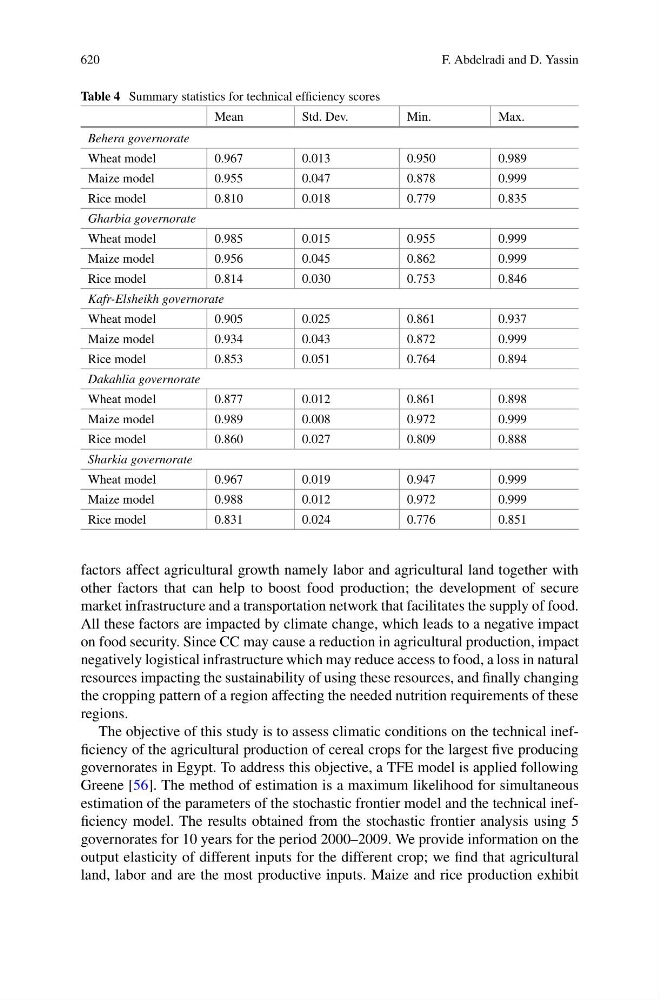
Table 4 Summary statistics for technical efficiency scores
Mean
Std. Dev.
Min.
Max.
Behera governorate
Wheat model
0.967
0.013
0.950
0.989
Maize model
0.955
0.047
0.878
0.999
Rice model
0.810
0.018
0.779
0.835
Gharbia governorate
Wheat model
0.985
0.015
0.955
0.999
Maize model
0.956
0.045
0.862
0.999
Rice model
0.814
0.030
0.753
0.846
Kafr-Elsheikh governorate
Wheat model
0.905
0.025
0.861
0.937
Maize model
0.934
0.043
0.872
0.999
Rice model
0.853
0.051
0.764
0.894
Dakahlia governorate
Wheat model
0.877
0.012
0.861
0.898
Maize model
0.989
0.008
0.972
0.999
Rice model
0.860
0.027
0.809
0.888
Sharkia governorate
Wheat model
0.967
0.019
0.947
0.999
Maize model
0.988
0.012
0.972
0.999
Rice model
0.831
0.024
0.776
0.851
factors affect agricultural growth namely labor and agricultural land together with
other factors that can help to boost food production; the development of secure
market infrastructure and a transportation network that facilitates the supply of food.
All these factors are impacted by climate change, which leads to a negative impact
on food security. Since CC may cause a reduction in agricultural production, impact
negatively logistical infrastructure which may reduce access to food, a loss in natural
resources impacting the sustainability of using these resources, and finally changing
the cropping pattern of a region affecting the needed nutrition requirements of these
regions.
The objective of this study is to assess climatic conditions on the technical inefficiency of the agricultural production of cereal crops for the largest five producing
governorates in Egypt. To address this objective, a TFE model is applied following
Greene [56]. The method of estimation is a maximum likelihood for simultaneous
estimation of the parameters of the stochastic frontier model and the technical inefficiency model. The results obtained from the stochastic frontier analysis using 5
governorates for 10 years for the period 2000–2009. We provide information on the
output elasticity of different inputs for the different crop; we find that agricultural
land, labor and are the most productive inputs. Maize and rice production exhibit
F. Abdelradi and D. Yassin
Table 4 Summary statistics for technical efficiency scores
Mean
Std. Dev.
Min.
Max.
Behera governorate
Wheat model
0.967
0.013
0.950
0.989
Maize model
0.955
0.047
0.878
0.999
Rice model
0.810
0.018
0.779
0.835
Gharbia governorate
Wheat model
0.985
0.015
0.955
0.999
Maize model
0.956
0.045
0.862
0.999
Rice model
0.814
0.030
0.753
0.846
Kafr-Elsheikh governorate
Wheat model
0.905
0.025
0.861
0.937
Maize model
0.934
0.043
0.872
0.999
Rice model
0.853
0.051
0.764
0.894
Dakahlia governorate
Wheat model
0.877
0.012
0.861
0.898
Maize model
0.989
0.008
0.972
0.999
Rice model
0.860
0.027
0.809
0.888
Sharkia governorate
Wheat model
0.967
0.019
0.947
0.999
Maize model
0.988
0.012
0.972
0.999
Rice model
0.831
0.024
0.776
0.851
factors affect agricultural growth namely labor and agricultural land together with
other factors that can help to boost food production; the development of secure
market infrastructure and a transportation network that facilitates the supply of food.
All these factors are impacted by climate change, which leads to a negative impact
on food security. Since CC may cause a reduction in agricultural production, impact
negatively logistical infrastructure which may reduce access to food, a loss in natural
resources impacting the sustainability of using these resources, and finally changing
the cropping pattern of a region affecting the needed nutrition requirements of these
regions.
The objective of this study is to assess climatic conditions on the technical inefficiency of the agricultural production of cereal crops for the largest five producing
governorates in Egypt. To address this objective, a TFE model is applied following
Greene [56]. The method of estimation is a maximum likelihood for simultaneous
estimation of the parameters of the stochastic frontier model and the technical inefficiency model. The results obtained from the stochastic frontier analysis using 5
governorates for 10 years for the period 2000–2009. We provide information on the
output elasticity of different inputs for the different crop; we find that agricultural
land, labor and are the most productive inputs. Maize and rice production exhibit