

Climate Impact on Egyptian Agriculture: An Efficiency …
619
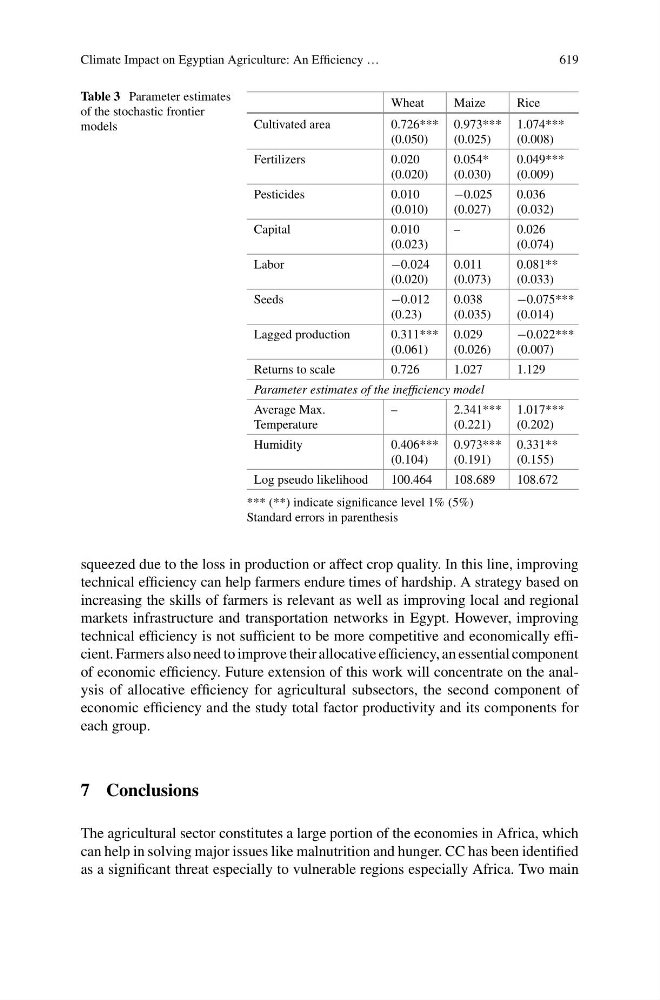
Table 3 Parameter estimates
of the stochastic frontier
models
Wheat
Maize
Rice
Cultivated area
0.726***
(0.050)
0.973***
(0.025)
1.074***
(0.008)
Fertilizers
0.020
(0.020)
0.054*
(0.030)
0.049***
(0.009)
Pesticides
0.010
(0.010)
−0.025
(0.027)
0.036
(0.032)
Capital
0.010
(0.023)
–
0.026
(0.074)
Labor
−0.024
(0.020)
0.011
(0.073)
0.081**
(0.033)
Seeds
−0.012
(0.23)
0.038
(0.035)
−0.075***
(0.014)
Lagged production
0.311***
(0.061)
0.029
(0.026)
−0.022***
(0.007)
Returns to scale
0.726
1.027
1.129
Parameter estimates of the inefficiency model
Average Max.
Temperature
–
2.341***
(0.221)
1.017***
(0.202)
Humidity
0.406***
(0.104)
0.973***
(0.191)
0.331**
(0.155)
Log pseudo likelihood
100.464
108.689
108.672
*** (**) indicate significance level 1% (5%)
Standard errors in parenthesis
squeezed due to the loss in production or affect crop quality. In this line, improving
technical efficiency can help farmers endure times of hardship. A strategy based on
increasing the skills of farmers is relevant as well as improving local and regional
markets infrastructure and transportation networks in Egypt. However, improving
technical efficiency is not sufficient to be more competitive and economically efficient. Farmers also need to improve their allocative efficiency, an essential component
of economic efficiency. Future extension of this work will concentrate on the analysis of allocative efficiency for agricultural subsectors, the second component of
economic efficiency and the study total factor productivity and its components for
each group.
7 Conclusions
The agricultural sector constitutes a large portion of the economies in Africa, which
can help in solving major issues like malnutrition and hunger. CC has been identified
as a significant threat especially to vulnerable regions especially Africa. Two main
619
Table 3 Parameter estimates
of the stochastic frontier
models
Wheat
Maize
Rice
Cultivated area
0.726***
(0.050)
0.973***
(0.025)
1.074***
(0.008)
Fertilizers
0.020
(0.020)
0.054*
(0.030)
0.049***
(0.009)
Pesticides
0.010
(0.010)
−0.025
(0.027)
0.036
(0.032)
Capital
0.010
(0.023)
–
0.026
(0.074)
Labor
−0.024
(0.020)
0.011
(0.073)
0.081**
(0.033)
Seeds
−0.012
(0.23)
0.038
(0.035)
−0.075***
(0.014)
Lagged production
0.311***
(0.061)
0.029
(0.026)
−0.022***
(0.007)
Returns to scale
0.726
1.027
1.129
Parameter estimates of the inefficiency model
Average Max.
Temperature
–
2.341***
(0.221)
1.017***
(0.202)
Humidity
0.406***
(0.104)
0.973***
(0.191)
0.331**
(0.155)
Log pseudo likelihood
100.464
108.689
108.672
*** (**) indicate significance level 1% (5%)
Standard errors in parenthesis
squeezed due to the loss in production or affect crop quality. In this line, improving
technical efficiency can help farmers endure times of hardship. A strategy based on
increasing the skills of farmers is relevant as well as improving local and regional
markets infrastructure and transportation networks in Egypt. However, improving
technical efficiency is not sufficient to be more competitive and economically efficient. Farmers also need to improve their allocative efficiency, an essential component
of economic efficiency. Future extension of this work will concentrate on the analysis of allocative efficiency for agricultural subsectors, the second component of
economic efficiency and the study total factor productivity and its components for
each group.
7 Conclusions
The agricultural sector constitutes a large portion of the economies in Africa, which
can help in solving major issues like malnutrition and hunger. CC has been identified
as a significant threat especially to vulnerable regions especially Africa. Two main