

592
S. A. Zahran
Table 4 Impacts of climate change on water demands [11]
Year
2010 2025 2050 2075 2100
Population (million)
79
104
146
191
237
Mean air temperature increase (°C)
–
1.0
1.7
2.5
3.6
Evapotranspiration and irrigation water requirements
(%)
–
2
4.5
8
12
Municipal water (million m 3 /year)
9
9.6
12.55 14.75 17.2
Industrial water (million m 3 /year)
2
2.2
3.4
4
4.9
Source Practice Assessment and Recommendations Report/REC-WEE pros/WPOrt EG [13]
cutting policy. The decision maker and all stakeholders should be engaged and work
closely to fill the gaps and construct the bridge linked between all sides in the Crosse
areas to get the benefit from inter-relationship for the natural resources in terms of
water management, climate change and food security with effective way. Such way
need form the most pressing Nexus problem, that require system analysis, develop
storyline for plausible futures, and co-design polices and investment strategies based
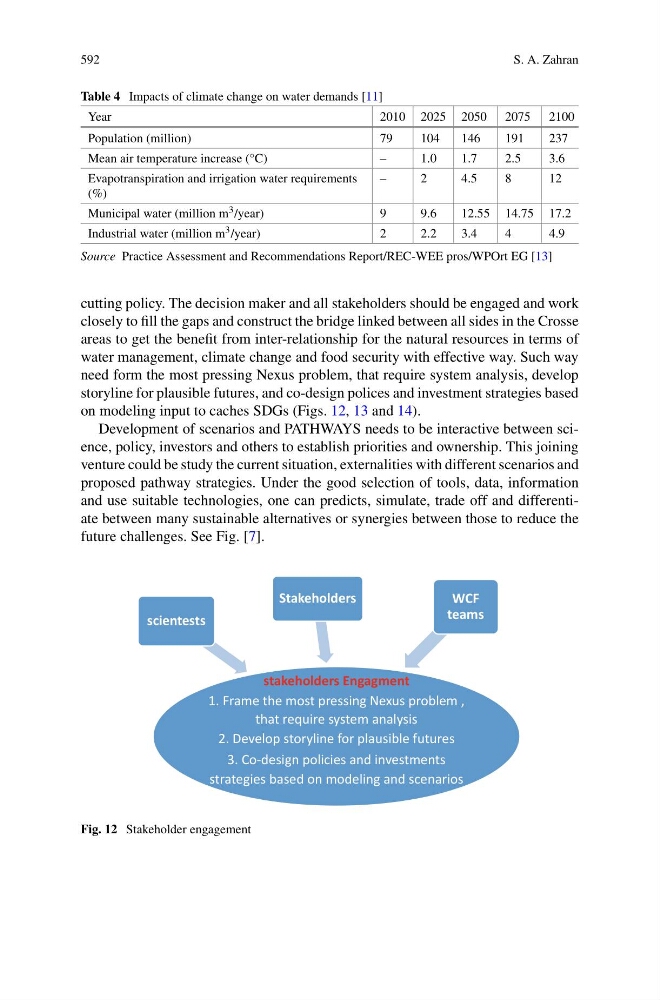
on modeling input to caches SDGs (Figs. 12, 13 and 14).
Development of scenarios and PATHWAYS needs to be interactive between science, policy, investors and others to establish priorities and ownership. This joining
venture could be study the current situation, externalities with different scenarios and
proposed pathway strategies. Under the good selection of tools, data, information
and use suitable technologies, one can predicts, simulate, trade off and differentiate between many sustainable alternatives or synergies between those to reduce the
future challenges. See Fig. [7].
stakeholders Engagment
1. Frame the most pressing Nexus problem ,
that require system analysis
2. Develop storyline for plausible futures
3. Co-design policies and investments
strategies based on modeling and scenarios
scientests
Stakeholders
WCF
teams
Fig. 12 Stakeholder engagement
S. A. Zahran
Table 4 Impacts of climate change on water demands [11]
Year
2010 2025 2050 2075 2100
Population (million)
79
104
146
191
237
Mean air temperature increase (°C)
–
1.0
1.7
2.5
3.6
Evapotranspiration and irrigation water requirements
(%)
–
2
4.5
8
12
Municipal water (million m 3 /year)
9
9.6
12.55 14.75 17.2
Industrial water (million m 3 /year)
2
2.2
3.4
4
4.9
Source Practice Assessment and Recommendations Report/REC-WEE pros/WPOrt EG [13]
cutting policy. The decision maker and all stakeholders should be engaged and work
closely to fill the gaps and construct the bridge linked between all sides in the Crosse
areas to get the benefit from inter-relationship for the natural resources in terms of
water management, climate change and food security with effective way. Such way
need form the most pressing Nexus problem, that require system analysis, develop
storyline for plausible futures, and co-design polices and investment strategies based
on modeling input to caches SDGs (Figs. 12, 13 and 14).
Development of scenarios and PATHWAYS needs to be interactive between science, policy, investors and others to establish priorities and ownership. This joining
venture could be study the current situation, externalities with different scenarios and
proposed pathway strategies. Under the good selection of tools, data, information
and use suitable technologies, one can predicts, simulate, trade off and differentiate between many sustainable alternatives or synergies between those to reduce the
future challenges. See Fig. [7].
stakeholders Engagment
1. Frame the most pressing Nexus problem ,
that require system analysis
2. Develop storyline for plausible futures
3. Co-design policies and investments
strategies based on modeling and scenarios
scientests
Stakeholders
WCF
teams
Fig. 12 Stakeholder engagement