

580
S. A. Zahran
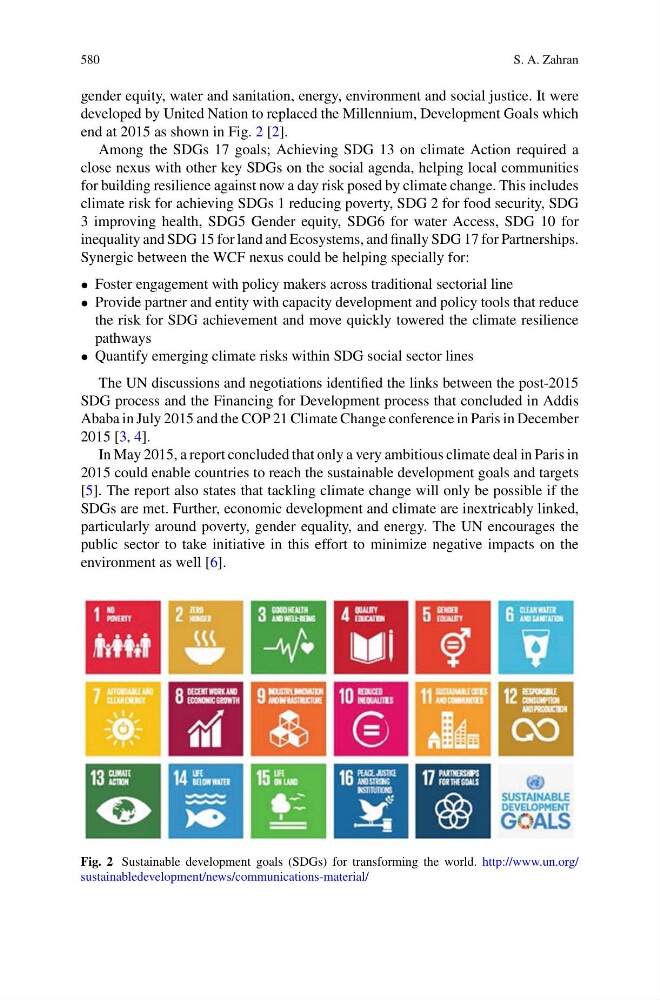
gender equity, water and sanitation, energy, environment and social justice. It were
developed by United Nation to replaced the Millennium, Development Goals which
end at 2015 as shown in Fig. 2 [2].
Among the SDGs 17 goals; Achieving SDG 13 on climate Action required a
close nexus with other key SDGs on the social agenda, helping local communities
for building resilience against now a day risk posed by climate change. This includes
climate risk for achieving SDGs 1 reducing poverty, SDG 2 for food security, SDG
3 improving health, SDG5 Gender equity, SDG6 for water Access, SDG 10 for
inequality and SDG 15 for land and Ecosystems, and finally SDG 17 for Partnerships.
Synergic between the WCF nexus could be helping specially for:
• Foster engagement with policy makers across traditional sectorial line
• Provide partner and entity with capacity development and policy tools that reduce
the risk for SDG achievement and move quickly towered the climate resilience
pathways
• Quantify emerging climate risks within SDG social sector lines
The UN discussions and negotiations identified the links between the post-2015
SDG process and the Financing for Development process that concluded in Addis
Ababa in July 2015 and the COP 21 Climate Change conference in Paris in December
2015 [3, 4].
In May 2015, a report concluded that only a very ambitious climate deal in Paris in
2015 could enable countries to reach the sustainable development goals and targets
[5]. The report also states that tackling climate change will only be possible if the
SDGs are met. Further, economic development and climate are inextricably linked,
particularly around poverty, gender equality, and energy. The UN encourages the
public sector to take initiative in this effort to minimize negative impacts on the
environment as well [6].
Fig. 2 Sustainable development goals (SDGs) for transforming the world. http://www.un.org/
sustainabledevelopment/news/communications-material/
S. A. Zahran
gender equity, water and sanitation, energy, environment and social justice. It were
developed by United Nation to replaced the Millennium, Development Goals which
end at 2015 as shown in Fig. 2 [2].
Among the SDGs 17 goals; Achieving SDG 13 on climate Action required a
close nexus with other key SDGs on the social agenda, helping local communities
for building resilience against now a day risk posed by climate change. This includes
climate risk for achieving SDGs 1 reducing poverty, SDG 2 for food security, SDG
3 improving health, SDG5 Gender equity, SDG6 for water Access, SDG 10 for
inequality and SDG 15 for land and Ecosystems, and finally SDG 17 for Partnerships.
Synergic between the WCF nexus could be helping specially for:
• Foster engagement with policy makers across traditional sectorial line
• Provide partner and entity with capacity development and policy tools that reduce
the risk for SDG achievement and move quickly towered the climate resilience
pathways
• Quantify emerging climate risks within SDG social sector lines
The UN discussions and negotiations identified the links between the post-2015
SDG process and the Financing for Development process that concluded in Addis
Ababa in July 2015 and the COP 21 Climate Change conference in Paris in December
2015 [3, 4].
In May 2015, a report concluded that only a very ambitious climate deal in Paris in
2015 could enable countries to reach the sustainable development goals and targets
[5]. The report also states that tackling climate change will only be possible if the
SDGs are met. Further, economic development and climate are inextricably linked,
particularly around poverty, gender equality, and energy. The UN encourages the
public sector to take initiative in this effort to minimize negative impacts on the
environment as well [6].
Fig. 2 Sustainable development goals (SDGs) for transforming the world. http://www.un.org/
sustainabledevelopment/news/communications-material/