

554
D. M. Gouda
on Beheira is expected to have greater impacts on local food self-sufficiency, on the
national budget, and in turn on GDP as well as on social stability.
5 Conclusions
The conclusion presents a brief comparison between the impact of urban expansion
on agricultural land and that of climate change on agriculture. The separation between
the impacts of the socio-economic challenges and that of climate change stimuli on
agriculture in 2030 is for analytical purposes; however, in reality, change in climatic
conditions and urban expansion on agricultural land, are expected to take place in
conjunction, and even reinforce one another.
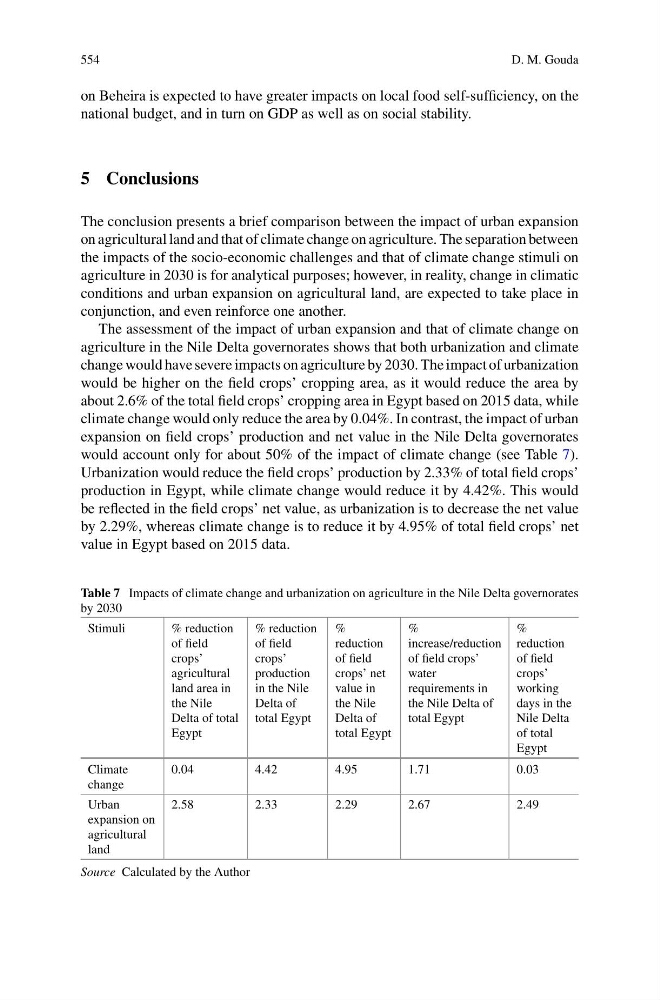
The assessment of the impact of urban expansion and that of climate change on
agriculture in the Nile Delta governorates shows that both urbanization and climate
change would have severe impacts on agriculture by 2030. The impact of urbanization
would be higher on the field crops’ cropping area, as it would reduce the area by
about 2.6% of the total field crops’ cropping area in Egypt based on 2015 data, while
climate change would only reduce the area by 0.04%. In contrast, the impact of urban
expansion on field crops’ production and net value in the Nile Delta governorates
would account only for about 50% of the impact of climate change (see Table 7).
Urbanization would reduce the field crops’ production by 2.33% of total field crops’
production in Egypt, while climate change would reduce it by 4.42%. This would
be reflected in the field crops’ net value, as urbanization is to decrease the net value
by 2.29%, whereas climate change is to reduce it by 4.95% of total field crops’ net
value in Egypt based on 2015 data.
Table 7 Impacts of climate change and urbanization on agriculture in the Nile Delta governorates
by 2030
Stimuli
% reduction
of field
crops’
agricultural
land area in
the Nile
Delta of total
Egypt
% reduction
of field
crops’
production
in the Nile
Delta of
total Egypt
%
reduction
of field
crops’ net
value in
the Nile
Delta of
total Egypt
%
increase/reduction
of field crops’
water
requirements in
the Nile Delta of
total Egypt
%
reduction
of field
crops’
working
days in the
Nile Delta
of total
Egypt
Climate
change
0.04
4.42
4.95
1.71
0.03
Urban
expansion on
agricultural
land
2.58
2.33
2.29
2.67
2.49
Source Calculated by the Author
D. M. Gouda
on Beheira is expected to have greater impacts on local food self-sufficiency, on the
national budget, and in turn on GDP as well as on social stability.
5 Conclusions
The conclusion presents a brief comparison between the impact of urban expansion
on agricultural land and that of climate change on agriculture. The separation between
the impacts of the socio-economic challenges and that of climate change stimuli on
agriculture in 2030 is for analytical purposes; however, in reality, change in climatic
conditions and urban expansion on agricultural land, are expected to take place in
conjunction, and even reinforce one another.
The assessment of the impact of urban expansion and that of climate change on
agriculture in the Nile Delta governorates shows that both urbanization and climate
change would have severe impacts on agriculture by 2030. The impact of urbanization
would be higher on the field crops’ cropping area, as it would reduce the area by
about 2.6% of the total field crops’ cropping area in Egypt based on 2015 data, while
climate change would only reduce the area by 0.04%. In contrast, the impact of urban
expansion on field crops’ production and net value in the Nile Delta governorates
would account only for about 50% of the impact of climate change (see Table 7).
Urbanization would reduce the field crops’ production by 2.33% of total field crops’
production in Egypt, while climate change would reduce it by 4.42%. This would
be reflected in the field crops’ net value, as urbanization is to decrease the net value
by 2.29%, whereas climate change is to reduce it by 4.95% of total field crops’ net
value in Egypt based on 2015 data.
Table 7 Impacts of climate change and urbanization on agriculture in the Nile Delta governorates
by 2030
Stimuli
% reduction
of field
crops’
agricultural
land area in
the Nile
Delta of total
Egypt
% reduction
of field
crops’
production
in the Nile
Delta of
total Egypt
%
reduction
of field
crops’ net
value in
the Nile
Delta of
total Egypt
%
increase/reduction
of field crops’
water
requirements in
the Nile Delta of
total Egypt
%
reduction
of field
crops’
working
days in the
Nile Delta
of total
Egypt
Climate
change
0.04
4.42
4.95
1.71
0.03
Urban
expansion on
agricultural
land
2.58
2.33
2.29
2.67
2.49
Source Calculated by the Author