

Potential Climate Change Impacts on Livestock and Food Security …
435
4 Livestock Production
In this part addresses in detail the effect of environmental change on domesticated
animals’ generation. This part involves five principle items covering the immediate
effects of environmental change on poultry and farm animal’s development, milk and
veal production, and its genetic resources in Egypt. This part additionally talks about
extravagantly on the aberrant effects of environmental change on animals, water
and forage accessibility, and other feed resources. Moreover, this part features the
significance of various inborn components by which animals adjust to the evolving
the climate variability.
4.1 Poultry Production Sector
In value terms, 26% of Egypt’s total livestock products came from poultry meat
and egg production, and Egypt’s livestock sector contributed 27% of total domestic
agricultural production in 1999 [31].
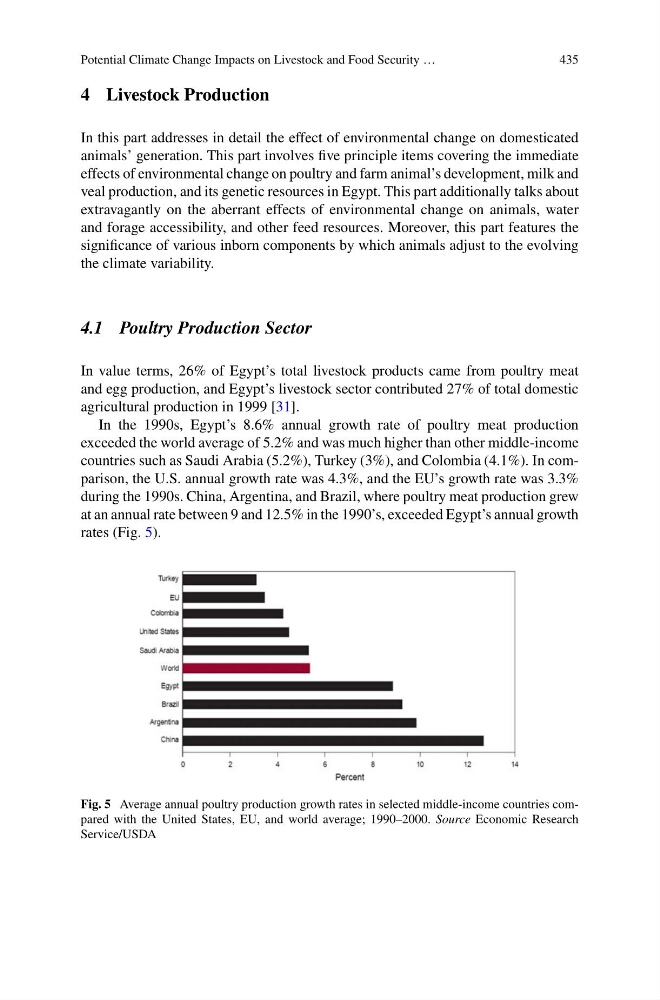
In the 1990s, Egypt’s 8.6% annual growth rate of poultry meat production
exceeded the world average of 5.2% and was much higher than other middle-income
countries such as Saudi Arabia (5.2%), Turkey (3%), and Colombia (4.1%). In comparison, the U.S. annual growth rate was 4.3%, and the EU’s growth rate was 3.3%
during the 1990s. China, Argentina, and Brazil, where poultry meat production grew
at an annual rate between 9 and 12.5% in the 1990’s, exceeded Egypt’s annual growth
rates (Fig. 5).
Fig. 5 Average annual poultry production growth rates in selected middle-income countries compared with the United States, EU, and world average; 1990–2000. Source Economic Research
Service/USDA
435
4 Livestock Production
In this part addresses in detail the effect of environmental change on domesticated
animals’ generation. This part involves five principle items covering the immediate
effects of environmental change on poultry and farm animal’s development, milk and
veal production, and its genetic resources in Egypt. This part additionally talks about
extravagantly on the aberrant effects of environmental change on animals, water
and forage accessibility, and other feed resources. Moreover, this part features the
significance of various inborn components by which animals adjust to the evolving
the climate variability.
4.1 Poultry Production Sector
In value terms, 26% of Egypt’s total livestock products came from poultry meat
and egg production, and Egypt’s livestock sector contributed 27% of total domestic
agricultural production in 1999 [31].
In the 1990s, Egypt’s 8.6% annual growth rate of poultry meat production
exceeded the world average of 5.2% and was much higher than other middle-income
countries such as Saudi Arabia (5.2%), Turkey (3%), and Colombia (4.1%). In comparison, the U.S. annual growth rate was 4.3%, and the EU’s growth rate was 3.3%
during the 1990s. China, Argentina, and Brazil, where poultry meat production grew
at an annual rate between 9 and 12.5% in the 1990’s, exceeded Egypt’s annual growth
rates (Fig. 5).
Fig. 5 Average annual poultry production growth rates in selected middle-income countries compared with the United States, EU, and world average; 1990–2000. Source Economic Research
Service/USDA