

Potential Climate Change Impacts on Livestock and Food Security …
425
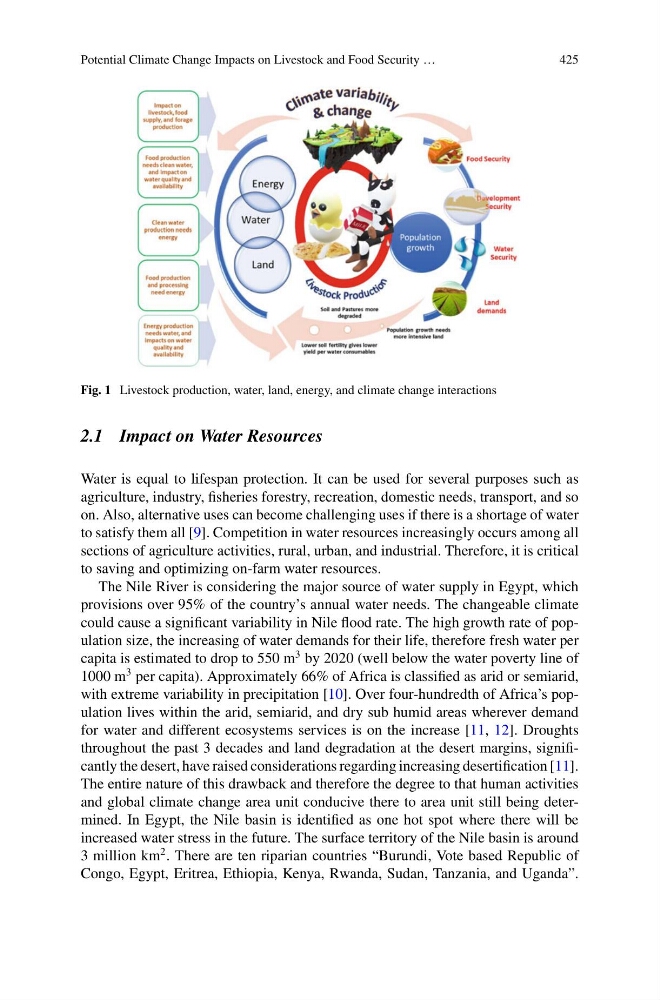
Fig. 1 Livestock production, water, land, energy, and climate change interactions
2.1 Impact on Water Resources
Water is equal to lifespan protection. It can be used for several purposes such as
agriculture, industry, fisheries forestry, recreation, domestic needs, transport, and so
on. Also, alternative uses can become challenging uses if there is a shortage of water
to satisfy them all [9]. Competition in water resources increasingly occurs among all
sections of agriculture activities, rural, urban, and industrial. Therefore, it is critical
to saving and optimizing on-farm water resources.
The Nile River is considering the major source of water supply in Egypt, which
provisions over 95% of the country’s annual water needs. The changeable climate
could cause a significant variability in Nile flood rate. The high growth rate of population size, the increasing of water demands for their life, therefore fresh water per
capita is estimated to drop to 550 m
3 by 2020 (well below the water poverty line of
1000 m
3 per capita). Approximately 66% of Africa is classified as arid or semiarid,
with extreme variability in precipitation [10]. Over four-hundredth of Africa’s population lives within the arid, semiarid, and dry sub humid areas wherever demand
for water and different ecosystems services is on the increase [11, 12]. Droughts
throughout the past 3 decades and land degradation at the desert margins, significantly the desert, have raised considerations regarding increasing desertification [11].
The entire nature of this drawback and therefore the degree to that human activities
and global climate change area unit conducive there to area unit still being determined. In Egypt, the Nile basin is identified as one hot spot where there will be
increased water stress in the future. The surface territory of the Nile basin is around
3 million km
2 . There are ten riparian countries “Burundi, Vote based Republic of
Congo, Egypt, Eritrea, Ethiopia, Kenya, Rwanda, Sudan, Tanzania, and Uganda”.
425
Fig. 1 Livestock production, water, land, energy, and climate change interactions
2.1 Impact on Water Resources
Water is equal to lifespan protection. It can be used for several purposes such as
agriculture, industry, fisheries forestry, recreation, domestic needs, transport, and so
on. Also, alternative uses can become challenging uses if there is a shortage of water
to satisfy them all [9]. Competition in water resources increasingly occurs among all
sections of agriculture activities, rural, urban, and industrial. Therefore, it is critical
to saving and optimizing on-farm water resources.
The Nile River is considering the major source of water supply in Egypt, which
provisions over 95% of the country’s annual water needs. The changeable climate
could cause a significant variability in Nile flood rate. The high growth rate of population size, the increasing of water demands for their life, therefore fresh water per
capita is estimated to drop to 550 m
3 by 2020 (well below the water poverty line of
1000 m
3 per capita). Approximately 66% of Africa is classified as arid or semiarid,
with extreme variability in precipitation [10]. Over four-hundredth of Africa’s population lives within the arid, semiarid, and dry sub humid areas wherever demand
for water and different ecosystems services is on the increase [11, 12]. Droughts
throughout the past 3 decades and land degradation at the desert margins, significantly the desert, have raised considerations regarding increasing desertification [11].
The entire nature of this drawback and therefore the degree to that human activities
and global climate change area unit conducive there to area unit still being determined. In Egypt, the Nile basin is identified as one hot spot where there will be
increased water stress in the future. The surface territory of the Nile basin is around
3 million km
2 . There are ten riparian countries “Burundi, Vote based Republic of
Congo, Egypt, Eritrea, Ethiopia, Kenya, Rwanda, Sudan, Tanzania, and Uganda”.