

Facing Climate Change: Urban Gardening and Sustainable …
393
3. Third, lower the greenhouse gas emissions that cause climate change [25].
The average temperature of the built-up areas is higher than the surrounding rural
areas and may be more than 5 °C. This is known as the Urban Heat Island (UHI)
phenomenon, which causes a loss of thermal comfort for users and a significant loss
of energy used for air conditioning. The use of façade and roofing works to reduce
the temperature caused by solar brightness and thermal reflections, thus reducing
the phenomenon of thermal islands within the existing building, leading to better
temperatures within the architectural spaces [156].
12.9 Purify Air and Reduce Dust
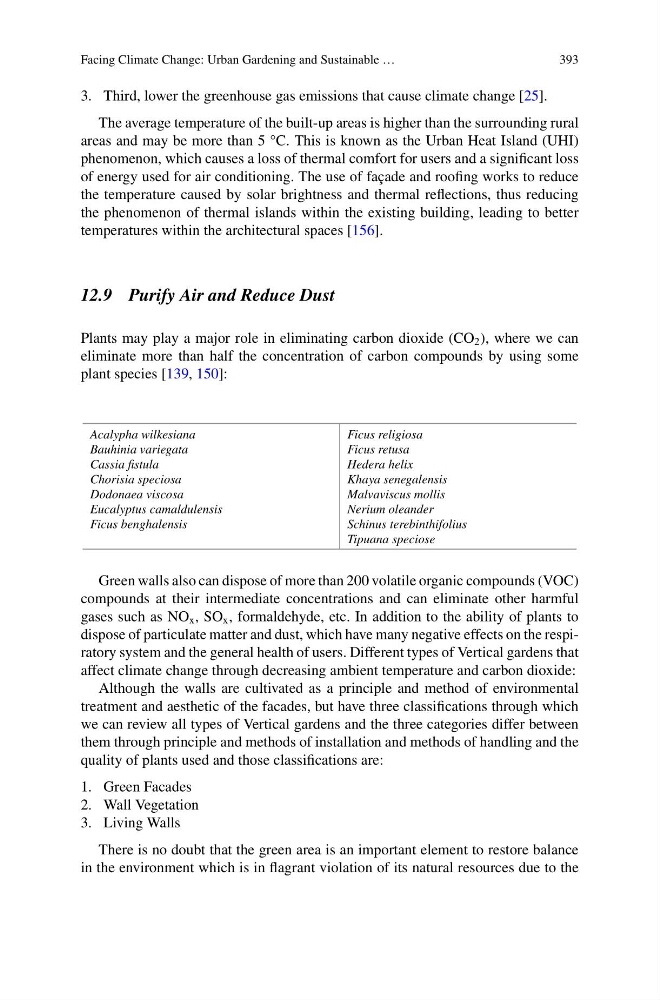
Plants may play a major role in eliminating carbon dioxide (CO 2 ), where we can
eliminate more than half the concentration of carbon compounds by using some
plant species [139, 150]:
Acalypha wilkesiana
Bauhinia variegata
Cassia fistula
Chorisia speciosa
Dodonaea viscosa
Eucalyptus camaldulensis
Ficus benghalensis
Ficus religiosa
Ficus retusa
Hedera helix
Khaya senegalensis
Malvaviscus mollis
Nerium oleander
Schinus terebinthifolius
Tipuana speciose
Green walls also can dispose of more than 200 volatile organic compounds (VOC)
compounds at their intermediate concentrations and can eliminate other harmful
gases such as NO x , SO x , formaldehyde, etc. In addition to the ability of plants to
dispose of particulate matter and dust, which have many negative effects on the respiratory system and the general health of users. Different types of Vertical gardens that
affect climate change through decreasing ambient temperature and carbon dioxide:
Although the walls are cultivated as a principle and method of environmental
treatment and aesthetic of the facades, but have three classifications through which
we can review all types of Vertical gardens and the three categories differ between
them through principle and methods of installation and methods of handling and the
quality of plants used and those classifications are:
1. Green Facades
2. Wall Vegetation
3. Living Walls
There is no doubt that the green area is an important element to restore balance
in the environment which is in flagrant violation of its natural resources due to the
393
3. Third, lower the greenhouse gas emissions that cause climate change [25].
The average temperature of the built-up areas is higher than the surrounding rural
areas and may be more than 5 °C. This is known as the Urban Heat Island (UHI)
phenomenon, which causes a loss of thermal comfort for users and a significant loss
of energy used for air conditioning. The use of façade and roofing works to reduce
the temperature caused by solar brightness and thermal reflections, thus reducing
the phenomenon of thermal islands within the existing building, leading to better
temperatures within the architectural spaces [156].
12.9 Purify Air and Reduce Dust
Plants may play a major role in eliminating carbon dioxide (CO 2 ), where we can
eliminate more than half the concentration of carbon compounds by using some
plant species [139, 150]:
Acalypha wilkesiana
Bauhinia variegata
Cassia fistula
Chorisia speciosa
Dodonaea viscosa
Eucalyptus camaldulensis
Ficus benghalensis
Ficus religiosa
Ficus retusa
Hedera helix
Khaya senegalensis
Malvaviscus mollis
Nerium oleander
Schinus terebinthifolius
Tipuana speciose
Green walls also can dispose of more than 200 volatile organic compounds (VOC)
compounds at their intermediate concentrations and can eliminate other harmful
gases such as NO x , SO x , formaldehyde, etc. In addition to the ability of plants to
dispose of particulate matter and dust, which have many negative effects on the respiratory system and the general health of users. Different types of Vertical gardens that
affect climate change through decreasing ambient temperature and carbon dioxide:
Although the walls are cultivated as a principle and method of environmental
treatment and aesthetic of the facades, but have three classifications through which
we can review all types of Vertical gardens and the three categories differ between
them through principle and methods of installation and methods of handling and the
quality of plants used and those classifications are:
1. Green Facades
2. Wall Vegetation
3. Living Walls
There is no doubt that the green area is an important element to restore balance
in the environment which is in flagrant violation of its natural resources due to the