

392
E. M. Koriesh and I. H. Abo-Soud
A. In 1988, the use of stainless steel wire systems for the facades and the walls of
the plant was started
B. In the early 1990s, the United States of America began to enter the market of
green walls and cultivated walls for wider use through systematic innovation
C. In the mid-1990s Patrick Blanc, who was the founder and pioneer of Vertical
gardens in the modern era, began to pay attention to this trend due to its great
environmental importance.
D. After 1994, the use of green walls in the spaces was started, supported by BioFiltration System in Toronto, Canada.
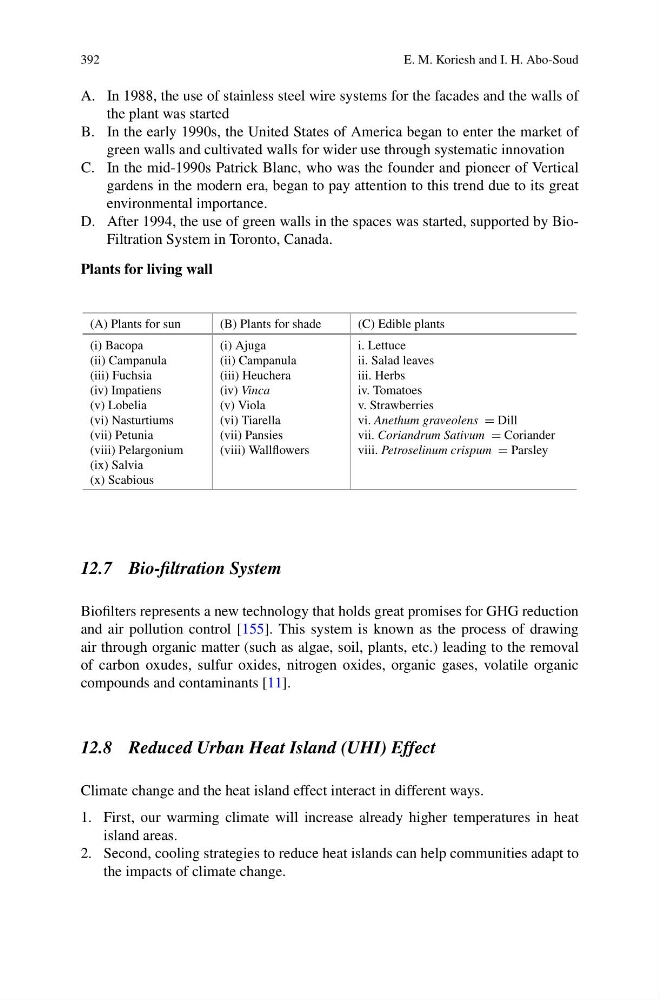
Plants for living wall
(A) Plants for sun
(B) Plants for shade
(C) Edible plants
(i) Bacopa
(ii) Campanula
(iii) Fuchsia
(iv) Impatiens
(v) Lobelia
(vi) Nasturtiums
(vii) Petunia
(viii) Pelargonium
(ix) Salvia
(x) Scabious
(i) Ajuga
(ii) Campanula
(iii) Heuchera
(iv) Vinca
(v) Viola
(vi) Tiarella
(vii) Pansies
(viii) Wallflowers
i. Lettuce
ii. Salad leaves
iii. Herbs
iv. Tomatoes
v. Strawberries
vi. Anethum graveolens = Dill
vii. Coriandrum Sativum = Coriander
viii. Petroselinum crispum = Parsley
12.7 Bio-filtration System
Biofilters represents a new technology that holds great promises for GHG reduction
and air pollution control [155]. This system is known as the process of drawing
air through organic matter (such as algae, soil, plants, etc.) leading to the removal
of carbon oxudes, sulfur oxides, nitrogen oxides, organic gases, volatile organic
compounds and contaminants [11].
12.8 Reduced Urban Heat Island (UHI) Effect
Climate change and the heat island effect interact in different ways.
1. First, our warming climate will increase already higher temperatures in heat
island areas.
2. Second, cooling strategies to reduce heat islands can help communities adapt to
the impacts of climate change.
E. M. Koriesh and I. H. Abo-Soud
A. In 1988, the use of stainless steel wire systems for the facades and the walls of
the plant was started
B. In the early 1990s, the United States of America began to enter the market of
green walls and cultivated walls for wider use through systematic innovation
C. In the mid-1990s Patrick Blanc, who was the founder and pioneer of Vertical
gardens in the modern era, began to pay attention to this trend due to its great
environmental importance.
D. After 1994, the use of green walls in the spaces was started, supported by BioFiltration System in Toronto, Canada.
Plants for living wall
(A) Plants for sun
(B) Plants for shade
(C) Edible plants
(i) Bacopa
(ii) Campanula
(iii) Fuchsia
(iv) Impatiens
(v) Lobelia
(vi) Nasturtiums
(vii) Petunia
(viii) Pelargonium
(ix) Salvia
(x) Scabious
(i) Ajuga
(ii) Campanula
(iii) Heuchera
(iv) Vinca
(v) Viola
(vi) Tiarella
(vii) Pansies
(viii) Wallflowers
i. Lettuce
ii. Salad leaves
iii. Herbs
iv. Tomatoes
v. Strawberries
vi. Anethum graveolens = Dill
vii. Coriandrum Sativum = Coriander
viii. Petroselinum crispum = Parsley
12.7 Bio-filtration System
Biofilters represents a new technology that holds great promises for GHG reduction
and air pollution control [155]. This system is known as the process of drawing
air through organic matter (such as algae, soil, plants, etc.) leading to the removal
of carbon oxudes, sulfur oxides, nitrogen oxides, organic gases, volatile organic
compounds and contaminants [11].
12.8 Reduced Urban Heat Island (UHI) Effect
Climate change and the heat island effect interact in different ways.
1. First, our warming climate will increase already higher temperatures in heat
island areas.
2. Second, cooling strategies to reduce heat islands can help communities adapt to
the impacts of climate change.