

Nano-technology for Real-Time Control of the Red Palm …
339
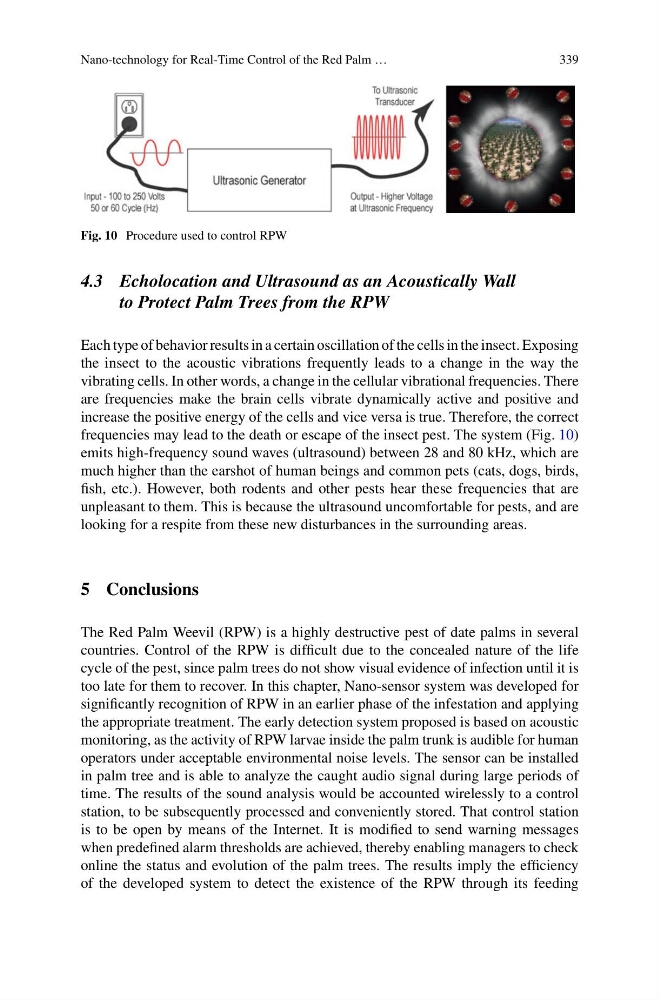
Fig. 10 Procedure used to control RPW
4.3 Echolocation and Ultrasound as an Acoustically Wall
to Protect Palm Trees from the RPW
Each type of behavior results in a certain oscillation of the cells in the insect. Exposing
the insect to the acoustic vibrations frequently leads to a change in the way the
vibrating cells. In other words, a change in the cellular vibrational frequencies. There
are frequencies make the brain cells vibrate dynamically active and positive and
increase the positive energy of the cells and vice versa is true. Therefore, the correct
frequencies may lead to the death or escape of the insect pest. The system (Fig. 10)
emits high-frequency sound waves (ultrasound) between 28 and 80 kHz, which are
much higher than the earshot of human beings and common pets (cats, dogs, birds,
fish, etc.). However, both rodents and other pests hear these frequencies that are
unpleasant to them. This is because the ultrasound uncomfortable for pests, and are
looking for a respite from these new disturbances in the surrounding areas.
5 Conclusions
The Red Palm Weevil (RPW) is a highly destructive pest of date palms in several
countries. Control of the RPW is difficult due to the concealed nature of the life
cycle of the pest, since palm trees do not show visual evidence of infection until it is
too late for them to recover. In this chapter, Nano-sensor system was developed for
significantly recognition of RPW in an earlier phase of the infestation and applying
the appropriate treatment. The early detection system proposed is based on acoustic
monitoring, as the activity of RPW larvae inside the palm trunk is audible for human
operators under acceptable environmental noise levels. The sensor can be installed
in palm tree and is able to analyze the caught audio signal during large periods of
time. The results of the sound analysis would be accounted wirelessly to a control
station, to be subsequently processed and conveniently stored. That control station
is to be open by means of the Internet. It is modified to send warning messages
when predefined alarm thresholds are achieved, thereby enabling managers to check
online the status and evolution of the palm trees. The results imply the efficiency
of the developed system to detect the existence of the RPW through its feeding
339
Fig. 10 Procedure used to control RPW
4.3 Echolocation and Ultrasound as an Acoustically Wall
to Protect Palm Trees from the RPW
Each type of behavior results in a certain oscillation of the cells in the insect. Exposing
the insect to the acoustic vibrations frequently leads to a change in the way the
vibrating cells. In other words, a change in the cellular vibrational frequencies. There
are frequencies make the brain cells vibrate dynamically active and positive and
increase the positive energy of the cells and vice versa is true. Therefore, the correct
frequencies may lead to the death or escape of the insect pest. The system (Fig. 10)
emits high-frequency sound waves (ultrasound) between 28 and 80 kHz, which are
much higher than the earshot of human beings and common pets (cats, dogs, birds,
fish, etc.). However, both rodents and other pests hear these frequencies that are
unpleasant to them. This is because the ultrasound uncomfortable for pests, and are
looking for a respite from these new disturbances in the surrounding areas.
5 Conclusions
The Red Palm Weevil (RPW) is a highly destructive pest of date palms in several
countries. Control of the RPW is difficult due to the concealed nature of the life
cycle of the pest, since palm trees do not show visual evidence of infection until it is
too late for them to recover. In this chapter, Nano-sensor system was developed for
significantly recognition of RPW in an earlier phase of the infestation and applying
the appropriate treatment. The early detection system proposed is based on acoustic
monitoring, as the activity of RPW larvae inside the palm trunk is audible for human
operators under acceptable environmental noise levels. The sensor can be installed
in palm tree and is able to analyze the caught audio signal during large periods of
time. The results of the sound analysis would be accounted wirelessly to a control
station, to be subsequently processed and conveniently stored. That control station
is to be open by means of the Internet. It is modified to send warning messages
when predefined alarm thresholds are achieved, thereby enabling managers to check
online the status and evolution of the palm trees. The results imply the efficiency
of the developed system to detect the existence of the RPW through its feeding