

332
E.-S. E. Omran
Rutile (Tetragonal System)
Anatase (Tetragonal System)
Brookite (Orthorhombic System)
SEM Nanotubes image
Spectral signature
SEM and TEM Nanofibers image
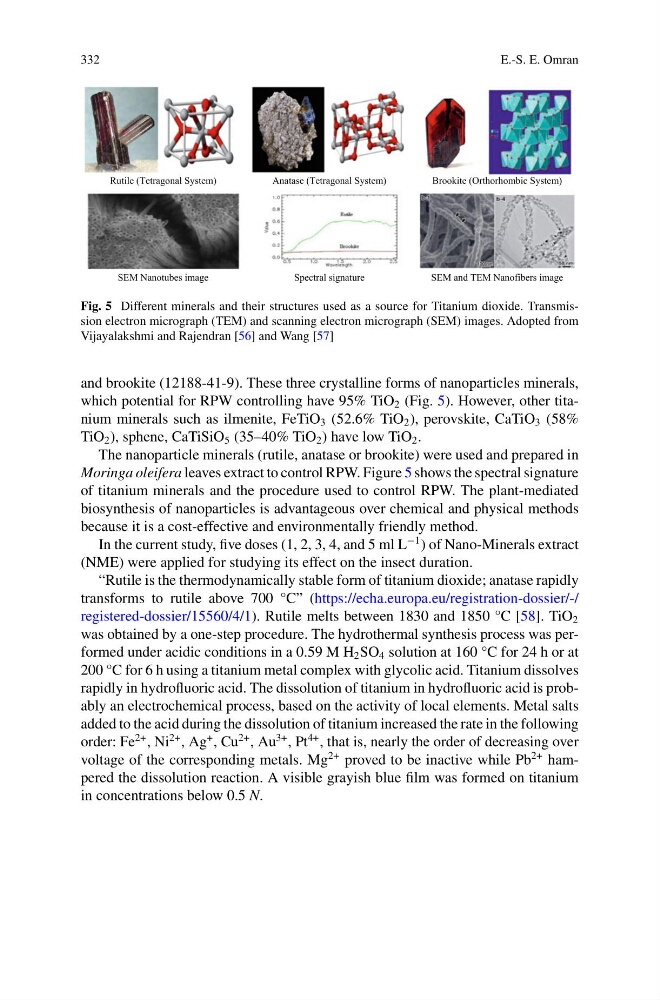
Fig. 5 Different minerals and their structures used as a source for Titanium dioxide. Transmission electron micrograph (TEM) and scanning electron micrograph (SEM) images. Adopted from
Vijayalakshmi and Rajendran [56] and Wang [57]
and brookite (12188-41-9). These three crystalline forms of nanoparticles minerals,
which potential for RPW controlling have 95% TiO 2 (Fig. 5). However, other titanium minerals such as ilmenite, FeTiO 3 (52.6% TiO 2 ), perovskite, CaTiO 3 (58%
TiO 2 ), sphene, CaTiSiO 5 (35–40% TiO 2 ) have low TiO 2 .
The nanoparticle minerals (rutile, anatase or brookite) were used and prepared in
Moringa oleifera leaves extract to control RPW. Figure 5 shows the spectral signature
of titanium minerals and the procedure used to control RPW. The plant-mediated
biosynthesis of nanoparticles is advantageous over chemical and physical methods
because it is a cost-effective and environmentally friendly method.
In the current study, five doses (1, 2, 3, 4, and 5 ml L
−1 ) of Nano-Minerals extract
(NME) were applied for studying its effect on the insect duration.
“Rutile is the thermodynamically stable form of titanium dioxide; anatase rapidly
transforms to rutile above 700 °C” (https://echa.europa.eu/registration-dossier/-/
registered-dossier/15560/4/1). Rutile melts between 1830 and 1850 °C [58]. TiO 2
was obtained by a one-step procedure. The hydrothermal synthesis process was performed under acidic conditions in a 0.59 M H 2 SO 4 solution at 160 °C for 24 h or at
200 °C for 6 h using a titanium metal complex with glycolic acid. Titanium dissolves
rapidly in hydrofluoric acid. The dissolution of titanium in hydrofluoric acid is probably an electrochemical process, based on the activity of local elements. Metal salts
added to the acid during the dissolution of titanium increased the rate in the following
order: Fe
2+ , Ni
2+ , Ag
+ , Cu
2+ , Au
3+ , Pt
4+ , that is, nearly the order of decreasing over
voltage of the corresponding metals. Mg
2+ proved to be inactive while Pb
2+ hampered the dissolution reaction. A visible grayish blue film was formed on titanium
in concentrations below 0.5 N.
E.-S. E. Omran
Rutile (Tetragonal System)
Anatase (Tetragonal System)
Brookite (Orthorhombic System)
SEM Nanotubes image
Spectral signature
SEM and TEM Nanofibers image
Fig. 5 Different minerals and their structures used as a source for Titanium dioxide. Transmission electron micrograph (TEM) and scanning electron micrograph (SEM) images. Adopted from
Vijayalakshmi and Rajendran [56] and Wang [57]
and brookite (12188-41-9). These three crystalline forms of nanoparticles minerals,
which potential for RPW controlling have 95% TiO 2 (Fig. 5). However, other titanium minerals such as ilmenite, FeTiO 3 (52.6% TiO 2 ), perovskite, CaTiO 3 (58%
TiO 2 ), sphene, CaTiSiO 5 (35–40% TiO 2 ) have low TiO 2 .
The nanoparticle minerals (rutile, anatase or brookite) were used and prepared in
Moringa oleifera leaves extract to control RPW. Figure 5 shows the spectral signature
of titanium minerals and the procedure used to control RPW. The plant-mediated
biosynthesis of nanoparticles is advantageous over chemical and physical methods
because it is a cost-effective and environmentally friendly method.
In the current study, five doses (1, 2, 3, 4, and 5 ml L
−1 ) of Nano-Minerals extract
(NME) were applied for studying its effect on the insect duration.
“Rutile is the thermodynamically stable form of titanium dioxide; anatase rapidly
transforms to rutile above 700 °C” (https://echa.europa.eu/registration-dossier/-/
registered-dossier/15560/4/1). Rutile melts between 1830 and 1850 °C [58]. TiO 2
was obtained by a one-step procedure. The hydrothermal synthesis process was performed under acidic conditions in a 0.59 M H 2 SO 4 solution at 160 °C for 24 h or at
200 °C for 6 h using a titanium metal complex with glycolic acid. Titanium dissolves
rapidly in hydrofluoric acid. The dissolution of titanium in hydrofluoric acid is probably an electrochemical process, based on the activity of local elements. Metal salts
added to the acid during the dissolution of titanium increased the rate in the following
order: Fe
2+ , Ni
2+ , Ag
+ , Cu
2+ , Au
3+ , Pt
4+ , that is, nearly the order of decreasing over
voltage of the corresponding metals. Mg
2+ proved to be inactive while Pb
2+ hampered the dissolution reaction. A visible grayish blue film was formed on titanium
in concentrations below 0.5 N.