

Agricultural Production in Egypt: Assessing Vulnerability …
213
4.1 Vulnerability of Water Resources to Climate Change
The vulnerability of Egypt’s water resources to climate change entails those affecting
Nile flows including sensitivity to precipitation on the Ethiopian highlands; sensitivity to a temperature increase in equatorial lakes and Bahr El Ghazal, and uncertainty
due to significant differences in the Global Circulation Models output of water flow
into the Nile. The sensitivity of the Nile River, as the main source of water in Egypt, to
climate change, has been well documented. The expected effects of climate change
on Egyptian water resources at the southern part of Aswan High Dam Reservoir,
Lake Nubia, were investigated by Elshemy [19].
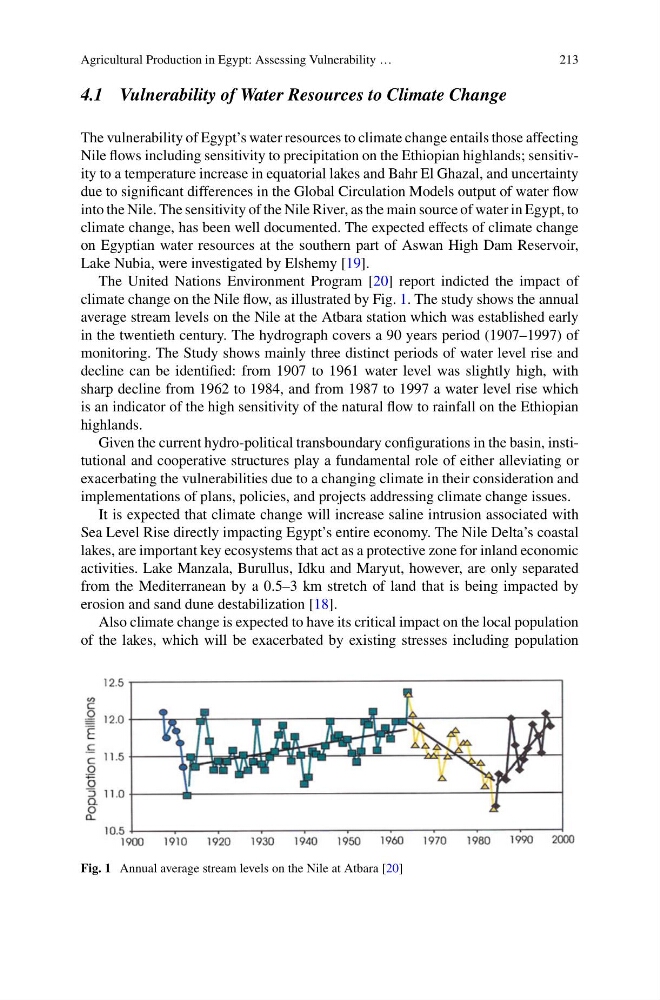
The United Nations Environment Program [20] report indicted the impact of
climate change on the Nile flow, as illustrated by Fig. 1. The study shows the annual
average stream levels on the Nile at the Atbara station which was established early
in the twentieth century. The hydrograph covers a 90 years period (1907–1997) of
monitoring. The Study shows mainly three distinct periods of water level rise and
decline can be identified: from 1907 to 1961 water level was slightly high, with
sharp decline from 1962 to 1984, and from 1987 to 1997 a water level rise which
is an indicator of the high sensitivity of the natural flow to rainfall on the Ethiopian
highlands.
Given the current hydro-political transboundary configurations in the basin, institutional and cooperative structures play a fundamental role of either alleviating or
exacerbating the vulnerabilities due to a changing climate in their consideration and
implementations of plans, policies, and projects addressing climate change issues.
It is expected that climate change will increase saline intrusion associated with
Sea Level Rise directly impacting Egypt’s entire economy. The Nile Delta’s coastal
lakes, are important key ecosystems that act as a protective zone for inland economic
activities. Lake Manzala, Burullus, Idku and Maryut, however, are only separated
from the Mediterranean by a 0.5–3 km stretch of land that is being impacted by
erosion and sand dune destabilization [18].
Also climate change is expected to have its critical impact on the local population
of the lakes, which will be exacerbated by existing stresses including population
Fig. 1 Annual average stream levels on the Nile at Atbara [20]
213
4.1 Vulnerability of Water Resources to Climate Change
The vulnerability of Egypt’s water resources to climate change entails those affecting
Nile flows including sensitivity to precipitation on the Ethiopian highlands; sensitivity to a temperature increase in equatorial lakes and Bahr El Ghazal, and uncertainty
due to significant differences in the Global Circulation Models output of water flow
into the Nile. The sensitivity of the Nile River, as the main source of water in Egypt, to
climate change, has been well documented. The expected effects of climate change
on Egyptian water resources at the southern part of Aswan High Dam Reservoir,
Lake Nubia, were investigated by Elshemy [19].
The United Nations Environment Program [20] report indicted the impact of
climate change on the Nile flow, as illustrated by Fig. 1. The study shows the annual
average stream levels on the Nile at the Atbara station which was established early
in the twentieth century. The hydrograph covers a 90 years period (1907–1997) of
monitoring. The Study shows mainly three distinct periods of water level rise and
decline can be identified: from 1907 to 1961 water level was slightly high, with
sharp decline from 1962 to 1984, and from 1987 to 1997 a water level rise which
is an indicator of the high sensitivity of the natural flow to rainfall on the Ethiopian
highlands.
Given the current hydro-political transboundary configurations in the basin, institutional and cooperative structures play a fundamental role of either alleviating or
exacerbating the vulnerabilities due to a changing climate in their consideration and
implementations of plans, policies, and projects addressing climate change issues.
It is expected that climate change will increase saline intrusion associated with
Sea Level Rise directly impacting Egypt’s entire economy. The Nile Delta’s coastal
lakes, are important key ecosystems that act as a protective zone for inland economic
activities. Lake Manzala, Burullus, Idku and Maryut, however, are only separated
from the Mediterranean by a 0.5–3 km stretch of land that is being impacted by
erosion and sand dune destabilization [18].
Also climate change is expected to have its critical impact on the local population
of the lakes, which will be exacerbated by existing stresses including population
Fig. 1 Annual average stream levels on the Nile at Atbara [20]