

174
H. Elbasiouny and F. Elbehiry
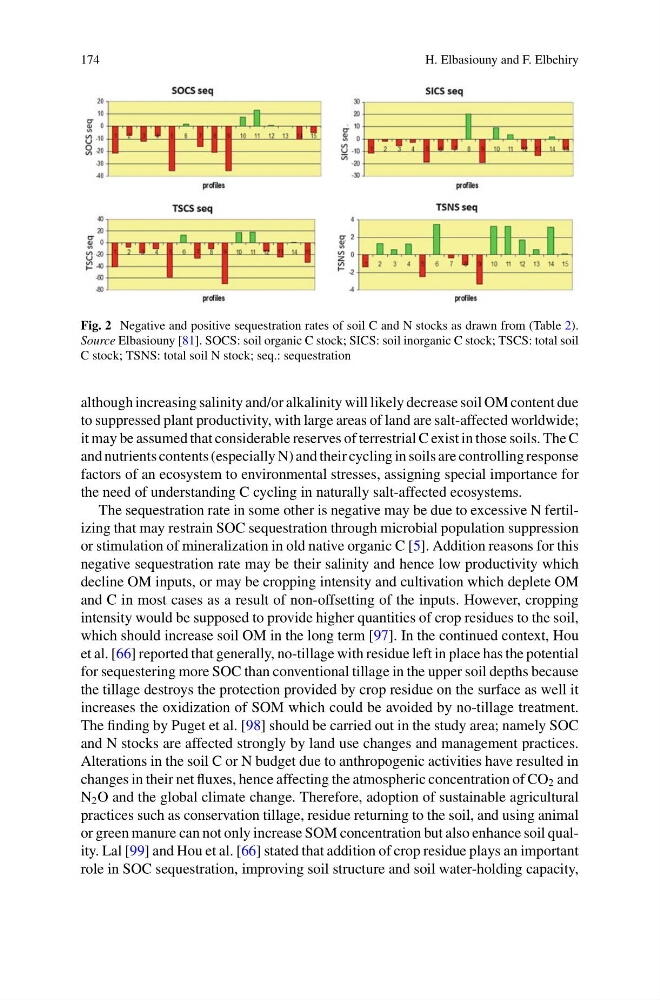
Fig. 2 Negative and positive sequestration rates of soil C and N stocks as drawn from (Table 2).
Source Elbasiouny [81]. SOCS: soil organic C stock; SICS: soil inorganic C stock; TSCS: total soil
C stock; TSNS: total soil N stock; seq.: sequestration
although increasing salinity and/or alkalinity will likely decrease soil OM content due
to suppressed plant productivity, with large areas of land are salt-affected worldwide;
it may be assumed that considerable reserves of terrestrial C exist in those soils. The C
and nutrients contents (especially N) and their cycling in soils are controlling response
factors of an ecosystem to environmental stresses, assigning special importance for
the need of understanding C cycling in naturally salt-affected ecosystems.
The sequestration rate in some other is negative may be due to excessive N fertilizing that may restrain SOC sequestration through microbial population suppression
or stimulation of mineralization in old native organic C [5]. Addition reasons for this
negative sequestration rate may be their salinity and hence low productivity which
decline OM inputs, or may be cropping intensity and cultivation which deplete OM
and C in most cases as a result of non-offsetting of the inputs. However, cropping
intensity would be supposed to provide higher quantities of crop residues to the soil,
which should increase soil OM in the long term [97]. In the continued context, Hou
et al. [66] reported that generally, no-tillage with residue left in place has the potential
for sequestering more SOC than conventional tillage in the upper soil depths because
the tillage destroys the protection provided by crop residue on the surface as well it
increases the oxidization of SOM which could be avoided by no-tillage treatment.
The finding by Puget et al. [98] should be carried out in the study area; namely SOC
and N stocks are affected strongly by land use changes and management practices.
Alterations in the soil C or N budget due to anthropogenic activities have resulted in
changes in their net fluxes, hence affecting the atmospheric concentration of CO 2 and
N 2 O and the global climate change. Therefore, adoption of sustainable agricultural
practices such as conservation tillage, residue returning to the soil, and using animal
or green manure can not only increase SOM concentration but also enhance soil quality. Lal [99] and Hou et al. [66] stated that addition of crop residue plays an important
role in SOC sequestration, improving soil structure and soil water-holding capacity,
H. Elbasiouny and F. Elbehiry
Fig. 2 Negative and positive sequestration rates of soil C and N stocks as drawn from (Table 2).
Source Elbasiouny [81]. SOCS: soil organic C stock; SICS: soil inorganic C stock; TSCS: total soil
C stock; TSNS: total soil N stock; seq.: sequestration
although increasing salinity and/or alkalinity will likely decrease soil OM content due
to suppressed plant productivity, with large areas of land are salt-affected worldwide;
it may be assumed that considerable reserves of terrestrial C exist in those soils. The C
and nutrients contents (especially N) and their cycling in soils are controlling response
factors of an ecosystem to environmental stresses, assigning special importance for
the need of understanding C cycling in naturally salt-affected ecosystems.
The sequestration rate in some other is negative may be due to excessive N fertilizing that may restrain SOC sequestration through microbial population suppression
or stimulation of mineralization in old native organic C [5]. Addition reasons for this
negative sequestration rate may be their salinity and hence low productivity which
decline OM inputs, or may be cropping intensity and cultivation which deplete OM
and C in most cases as a result of non-offsetting of the inputs. However, cropping
intensity would be supposed to provide higher quantities of crop residues to the soil,
which should increase soil OM in the long term [97]. In the continued context, Hou
et al. [66] reported that generally, no-tillage with residue left in place has the potential
for sequestering more SOC than conventional tillage in the upper soil depths because
the tillage destroys the protection provided by crop residue on the surface as well it
increases the oxidization of SOM which could be avoided by no-tillage treatment.
The finding by Puget et al. [98] should be carried out in the study area; namely SOC
and N stocks are affected strongly by land use changes and management practices.
Alterations in the soil C or N budget due to anthropogenic activities have resulted in
changes in their net fluxes, hence affecting the atmospheric concentration of CO 2 and
N 2 O and the global climate change. Therefore, adoption of sustainable agricultural
practices such as conservation tillage, residue returning to the soil, and using animal
or green manure can not only increase SOM concentration but also enhance soil quality. Lal [99] and Hou et al. [66] stated that addition of crop residue plays an important
role in SOC sequestration, improving soil structure and soil water-holding capacity,