

Soil Carbon Sequestration for Climate Change Mitigation …
173
Table 2 Sequestration rate of C and N stocks as calculated from 1987 and 2007 C and N stock
data (Mg ha −1 year −1 ) [81]
Profile no.
SOCSseq.
SICSseq.
TSCSSeq.
TSNSseq.
1
−21.30
−11.55
−40.50
−1.37
2
−7.19
−2.07
−7.84
1.26
3
−11.75
−5.26
−17.08
0.59
4
−7.80
−2.96
−10.82
1.23
5
−35.79
−18.93
−57.89
−2.51
6
1.73
−8.93
13.13
3.47
7
−16.18
−8.35
−26.47
−0.32
8
−20.85
20.34
−10.23
−1.15
9
−35.48
−19.33
−69.79
−3.35
10
7.33
9.18
17.30
3.22
11
13.11
3.64
18.19
3.25
12
0.98
−7.87
−14.42
1.66
13
−0.04
−13.68
−24.77
0.58
14
−10.38
2.15
0.46
3.11
15
−5.05
−8.26
−33.10
0.09
Average Mg/ha/year
−9.91
−4.79
−17.59
0.65
SOCS soil organic C stock; SICS soil inorganic C stock; TSCS total soil C stock; TSNS total soil
N stock; seq. sequestration
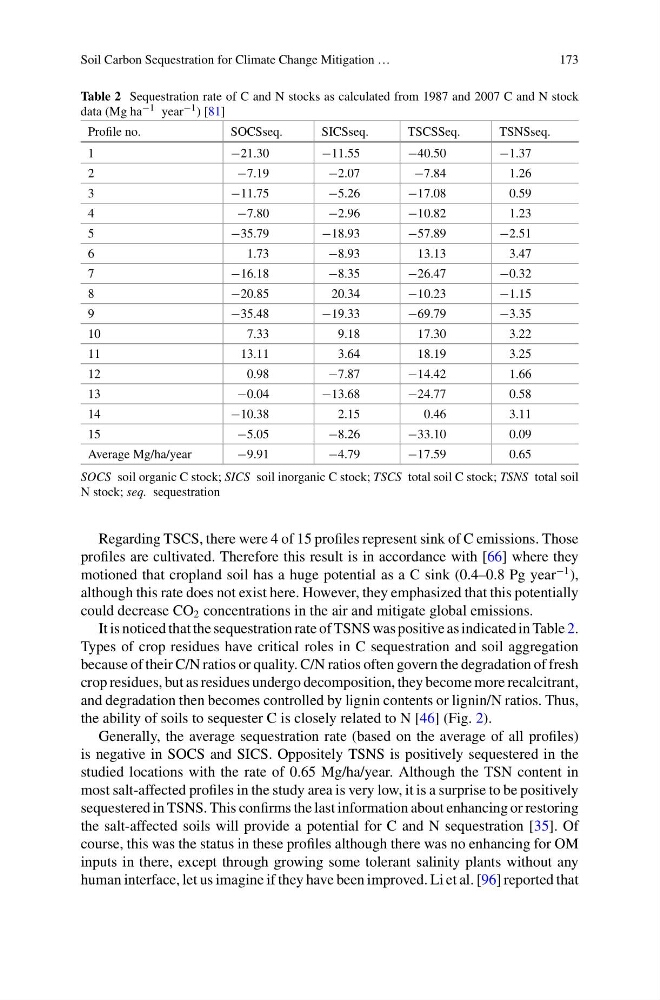
Regarding TSCS, there were 4 of 15 profiles represent sink of C emissions. Those
profiles are cultivated. Therefore this result is in accordance with [66] where they
motioned that cropland soil has a huge potential as a C sink (0.4–0.8 Pg year
−1 ),
although this rate does not exist here. However, they emphasized that this potentially
could decrease CO 2 concentrations in the air and mitigate global emissions.
It is noticed that the sequestration rate of TSNS was positive as indicated in Table 2.
Types of crop residues have critical roles in C sequestration and soil aggregation
because of their C/N ratios or quality. C/N ratios often govern the degradation of fresh
crop residues, but as residues undergo decomposition, they become more recalcitrant,
and degradation then becomes controlled by lignin contents or lignin/N ratios. Thus,
the ability of soils to sequester C is closely related to N [46] (Fig. 2).
Generally, the average sequestration rate (based on the average of all profiles)
is negative in SOCS and SICS. Oppositely TSNS is positively sequestered in the
studied locations with the rate of 0.65 Mg/ha/year. Although the TSN content in
most salt-affected profiles in the study area is very low, it is a surprise to be positively
sequestered in TSNS. This confirms the last information about enhancing or restoring
the salt-affected soils will provide a potential for C and N sequestration [35]. Of
course, this was the status in these profiles although there was no enhancing for OM
inputs in there, except through growing some tolerant salinity plants without any
human interface, let us imagine if they have been improved. Li et al. [96] reported that
173
Table 2 Sequestration rate of C and N stocks as calculated from 1987 and 2007 C and N stock
data (Mg ha −1 year −1 ) [81]
Profile no.
SOCSseq.
SICSseq.
TSCSSeq.
TSNSseq.
1
−21.30
−11.55
−40.50
−1.37
2
−7.19
−2.07
−7.84
1.26
3
−11.75
−5.26
−17.08
0.59
4
−7.80
−2.96
−10.82
1.23
5
−35.79
−18.93
−57.89
−2.51
6
1.73
−8.93
13.13
3.47
7
−16.18
−8.35
−26.47
−0.32
8
−20.85
20.34
−10.23
−1.15
9
−35.48
−19.33
−69.79
−3.35
10
7.33
9.18
17.30
3.22
11
13.11
3.64
18.19
3.25
12
0.98
−7.87
−14.42
1.66
13
−0.04
−13.68
−24.77
0.58
14
−10.38
2.15
0.46
3.11
15
−5.05
−8.26
−33.10
0.09
Average Mg/ha/year
−9.91
−4.79
−17.59
0.65
SOCS soil organic C stock; SICS soil inorganic C stock; TSCS total soil C stock; TSNS total soil
N stock; seq. sequestration
Regarding TSCS, there were 4 of 15 profiles represent sink of C emissions. Those
profiles are cultivated. Therefore this result is in accordance with [66] where they
motioned that cropland soil has a huge potential as a C sink (0.4–0.8 Pg year
−1 ),
although this rate does not exist here. However, they emphasized that this potentially
could decrease CO 2 concentrations in the air and mitigate global emissions.
It is noticed that the sequestration rate of TSNS was positive as indicated in Table 2.
Types of crop residues have critical roles in C sequestration and soil aggregation
because of their C/N ratios or quality. C/N ratios often govern the degradation of fresh
crop residues, but as residues undergo decomposition, they become more recalcitrant,
and degradation then becomes controlled by lignin contents or lignin/N ratios. Thus,
the ability of soils to sequester C is closely related to N [46] (Fig. 2).
Generally, the average sequestration rate (based on the average of all profiles)
is negative in SOCS and SICS. Oppositely TSNS is positively sequestered in the
studied locations with the rate of 0.65 Mg/ha/year. Although the TSN content in
most salt-affected profiles in the study area is very low, it is a surprise to be positively
sequestered in TSNS. This confirms the last information about enhancing or restoring
the salt-affected soils will provide a potential for C and N sequestration [35]. Of
course, this was the status in these profiles although there was no enhancing for OM
inputs in there, except through growing some tolerant salinity plants without any
human interface, let us imagine if they have been improved. Li et al. [96] reported that