

Soils as Driver and Victim of Climate Change in Egypt
129
The predicted climate warming is proposed to enhance SOC decomposition, which
may further increase soil N availability, leading to higher soil CO 2 efflux [101]. Each
Tone of carbon lost from the soil releases 3.7 Tones of CO 2 in the atmosphere [102]. A
recent study made detailed predictions of the future spatial evolution of topsoil SOC
driven by climate change and land use change for France up to the year 2100 [103].
The climate change will have a much bigger influence on future SOC losses in midlatitude mineral soils than land use change dynamics. High-resolution simulation of
land use and climate change impacts on SOC stocks indicated that France would
lose between 774 and 1221 Mt of SOC by 2100 (i.e. 20–30% of 1990 stock). The
future climate change will contribute approximately 10 times more to this total SOC
decrease than land use change [103].
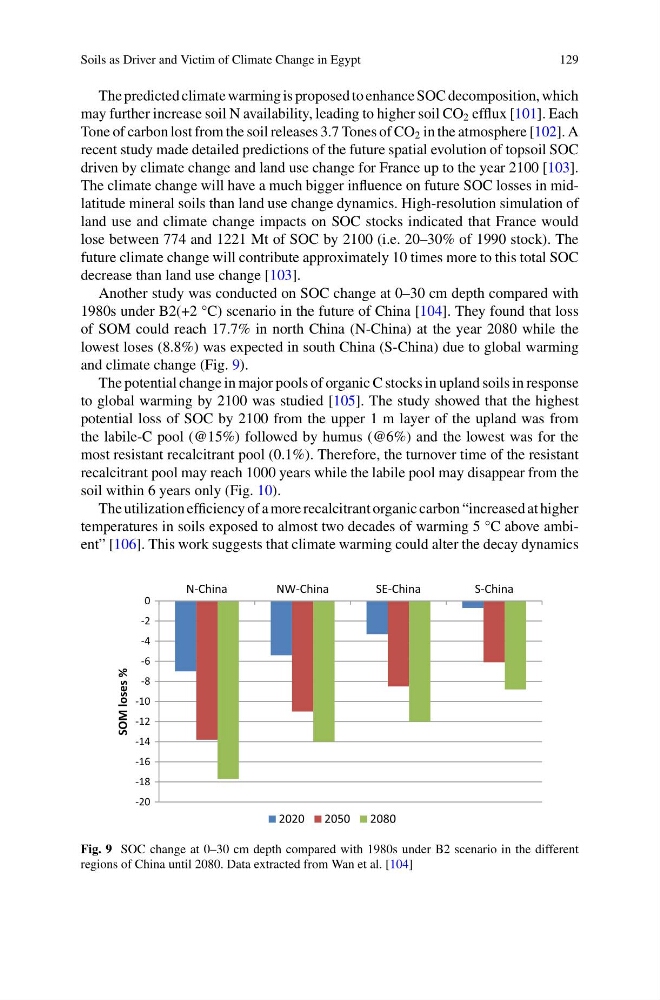
Another study was conducted on SOC change at 0–30 cm depth compared with
1980s under B2(+2 °C) scenario in the future of China [104]. They found that loss
of SOM could reach 17.7% in north China (N-China) at the year 2080 while the
lowest loses (8.8%) was expected in south China (S-China) due to global warming
and climate change (Fig. 9).
The potential change in major pools of organic C stocks in upland soils in response
to global warming by 2100 was studied [105]. The study showed that the highest
potential loss of SOC by 2100 from the upper 1 m layer of the upland was from
the labile-C pool (@15%) followed by humus (@6%) and the lowest was for the
most resistant recalcitrant pool (0.1%). Therefore, the turnover time of the resistant
recalcitrant pool may reach 1000 years while the labile pool may disappear from the
soil within 6 years only (Fig. 10).
The utilization efficiency of a more recalcitrant organic carbon “increased at higher
temperatures in soils exposed to almost two decades of warming 5 °C above ambient” [106]. This work suggests that climate warming could alter the decay dynamics
-20
-18
-16
-14
-12
-10
-8
-6
-4
-2
0
N-China
NW-China
SE-China
S-China
SOM loses %
2020
2050
2080
Fig. 9 SOC change at 0–30 cm depth compared with 1980s under B2 scenario in the different
regions of China until 2080. Data extracted from Wan et al. [104]
129
The predicted climate warming is proposed to enhance SOC decomposition, which
may further increase soil N availability, leading to higher soil CO 2 efflux [101]. Each
Tone of carbon lost from the soil releases 3.7 Tones of CO 2 in the atmosphere [102]. A
recent study made detailed predictions of the future spatial evolution of topsoil SOC
driven by climate change and land use change for France up to the year 2100 [103].
The climate change will have a much bigger influence on future SOC losses in midlatitude mineral soils than land use change dynamics. High-resolution simulation of
land use and climate change impacts on SOC stocks indicated that France would
lose between 774 and 1221 Mt of SOC by 2100 (i.e. 20–30% of 1990 stock). The
future climate change will contribute approximately 10 times more to this total SOC
decrease than land use change [103].
Another study was conducted on SOC change at 0–30 cm depth compared with
1980s under B2(+2 °C) scenario in the future of China [104]. They found that loss
of SOM could reach 17.7% in north China (N-China) at the year 2080 while the
lowest loses (8.8%) was expected in south China (S-China) due to global warming
and climate change (Fig. 9).
The potential change in major pools of organic C stocks in upland soils in response
to global warming by 2100 was studied [105]. The study showed that the highest
potential loss of SOC by 2100 from the upper 1 m layer of the upland was from
the labile-C pool (@15%) followed by humus (@6%) and the lowest was for the
most resistant recalcitrant pool (0.1%). Therefore, the turnover time of the resistant
recalcitrant pool may reach 1000 years while the labile pool may disappear from the
soil within 6 years only (Fig. 10).
The utilization efficiency of a more recalcitrant organic carbon “increased at higher
temperatures in soils exposed to almost two decades of warming 5 °C above ambient” [106]. This work suggests that climate warming could alter the decay dynamics
-20
-18
-16
-14
-12
-10
-8
-6
-4
-2
0
N-China
NW-China
SE-China
S-China
SOM loses %
2020
2050
2080
Fig. 9 SOC change at 0–30 cm depth compared with 1980s under B2 scenario in the different
regions of China until 2080. Data extracted from Wan et al. [104]