

128
R. R. Shahin
4 Impact of Climate Changes on Soil Functions
The impact of climate change on soils is a slow complex process as because soils
not only be strongly affected by climate change directly (for example effect of temperature on soil organic matter decomposition and indirectly, for example, changes
in soil moisture via changes in plant-related evapotranspiration) but also can act as a
source of greenhouse gases and thus contribute to the gases responsible for climate
change. Also changes in the functions and uses soils may be driven more by socioeconomic factors than environmental ones. However, the interaction of the various
soil forming processes, particularly biological ones, makes difficult to quantify the
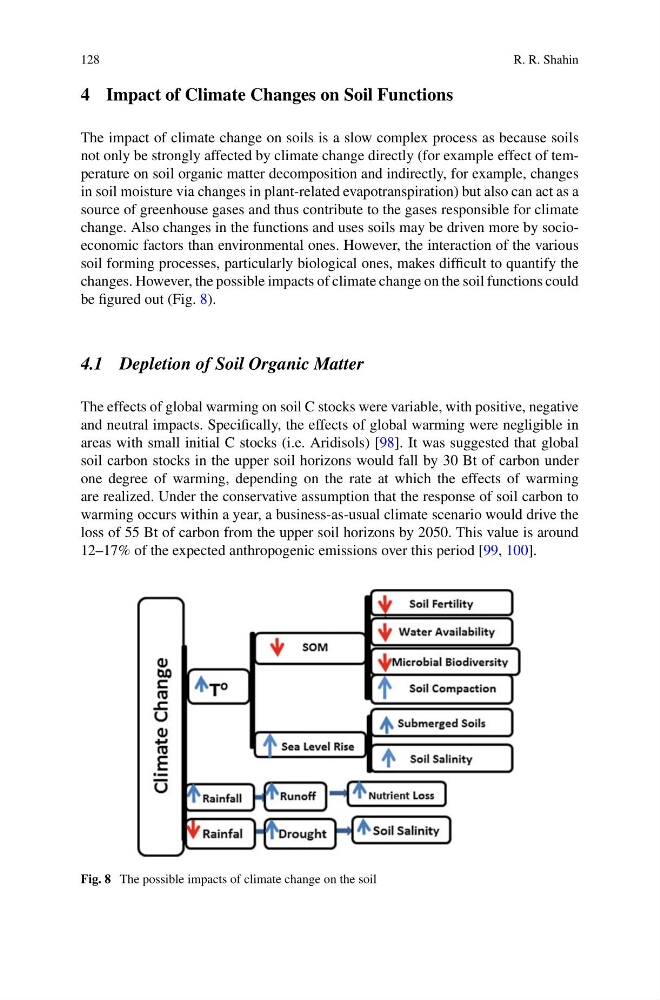
changes. However, the possible impacts of climate change on the soil functions could
be figured out (Fig. 8).
4.1 Depletion of Soil Organic Matter
The effects of global warming on soil C stocks were variable, with positive, negative
and neutral impacts. Specifically, the effects of global warming were negligible in
areas with small initial C stocks (i.e. Aridisols) [98]. It was suggested that global
soil carbon stocks in the upper soil horizons would fall by 30 Bt of carbon under
one degree of warming, depending on the rate at which the effects of warming
are realized. Under the conservative assumption that the response of soil carbon to
warming occurs within a year, a business-as-usual climate scenario would drive the
loss of 55 Bt of carbon from the upper soil horizons by 2050. This value is around
12–17% of the expected anthropogenic emissions over this period [99, 100].
Fig. 8 The possible impacts of climate change on the soil
R. R. Shahin
4 Impact of Climate Changes on Soil Functions
The impact of climate change on soils is a slow complex process as because soils
not only be strongly affected by climate change directly (for example effect of temperature on soil organic matter decomposition and indirectly, for example, changes
in soil moisture via changes in plant-related evapotranspiration) but also can act as a
source of greenhouse gases and thus contribute to the gases responsible for climate
change. Also changes in the functions and uses soils may be driven more by socioeconomic factors than environmental ones. However, the interaction of the various
soil forming processes, particularly biological ones, makes difficult to quantify the
changes. However, the possible impacts of climate change on the soil functions could
be figured out (Fig. 8).
4.1 Depletion of Soil Organic Matter
The effects of global warming on soil C stocks were variable, with positive, negative
and neutral impacts. Specifically, the effects of global warming were negligible in
areas with small initial C stocks (i.e. Aridisols) [98]. It was suggested that global
soil carbon stocks in the upper soil horizons would fall by 30 Bt of carbon under
one degree of warming, depending on the rate at which the effects of warming
are realized. Under the conservative assumption that the response of soil carbon to
warming occurs within a year, a business-as-usual climate scenario would drive the
loss of 55 Bt of carbon from the upper soil horizons by 2050. This value is around
12–17% of the expected anthropogenic emissions over this period [99, 100].
Fig. 8 The possible impacts of climate change on the soil