

126
R. R. Shahin
a greater impact on CO 2 fluxes than systems using scarification and/or sub-soiling
as the sole method of soil tillage [78, 72, 79].
3.5 Rice Cultivation
Rice farms in paddy soils have been a concern of scientists all over world because they
produce the most potent greenhouse gases (GHGs), carbon dioxide (CO 2 ), methane
(CH 4 ), and nitrous oxide (N 2 O) [80], because of their positive increases in radiative
forcing and their contribution to global warming [4].
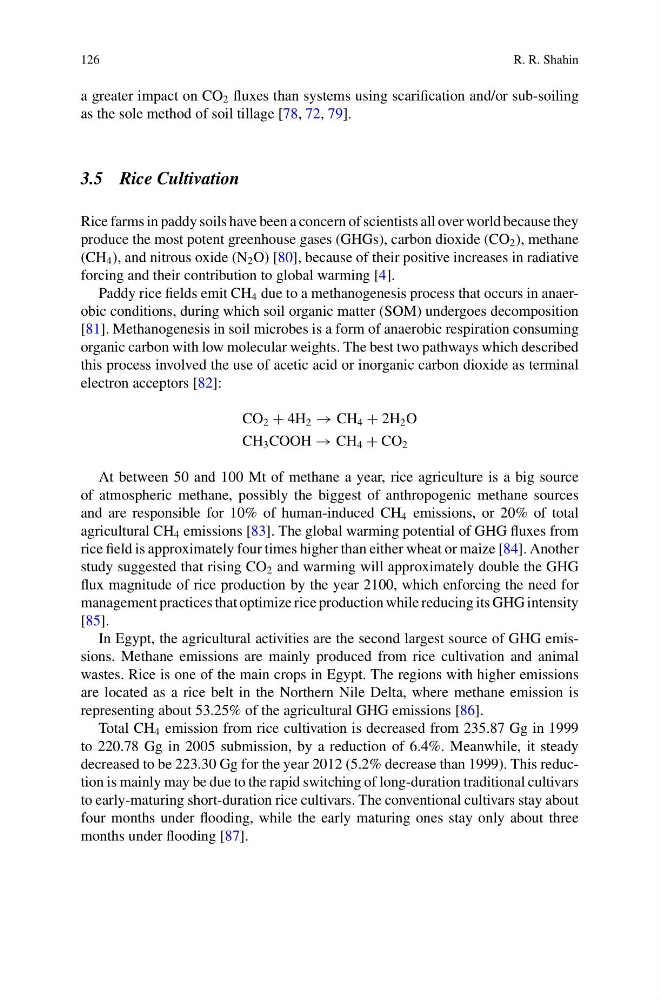
Paddy rice fields emit CH 4 due to a methanogenesis process that occurs in anaerobic conditions, during which soil organic matter (SOM) undergoes decomposition
[81]. Methanogenesis in soil microbes is a form of anaerobic respiration consuming
organic carbon with low molecular weights. The best two pathways which described
this process involved the use of acetic acid or inorganic carbon dioxide as terminal
electron acceptors [82]:
CO 2 + 4H 2 → CH 4 + 2H 2 O
CH 3 COOH → CH 4 + CO 2
At between 50 and 100 Mt of methane a year, rice agriculture is a big source
of atmospheric methane, possibly the biggest of anthropogenic methane sources
and are responsible for 10% of human-induced CH 4 emissions, or 20% of total
agricultural CH 4 emissions [83]. The global warming potential of GHG fluxes from
rice field is approximately four times higher than either wheat or maize [84]. Another
study suggested that rising CO 2 and warming will approximately double the GHG
flux magnitude of rice production by the year 2100, which enforcing the need for
management practices that optimize rice production while reducing its GHG intensity
[85].
In Egypt, the agricultural activities are the second largest source of GHG emissions. Methane emissions are mainly produced from rice cultivation and animal
wastes. Rice is one of the main crops in Egypt. The regions with higher emissions
are located as a rice belt in the Northern Nile Delta, where methane emission is
representing about 53.25% of the agricultural GHG emissions [86].
Total CH 4 emission from rice cultivation is decreased from 235.87 Gg in 1999
to 220.78 Gg in 2005 submission, by a reduction of 6.4%. Meanwhile, it steady
decreased to be 223.30 Gg for the year 2012 (5.2% decrease than 1999). This reduction is mainly may be due to the rapid switching of long-duration traditional cultivars
to early-maturing short-duration rice cultivars. The conventional cultivars stay about
four months under flooding, while the early maturing ones stay only about three
months under flooding [87].
R. R. Shahin
a greater impact on CO 2 fluxes than systems using scarification and/or sub-soiling
as the sole method of soil tillage [78, 72, 79].
3.5 Rice Cultivation
Rice farms in paddy soils have been a concern of scientists all over world because they
produce the most potent greenhouse gases (GHGs), carbon dioxide (CO 2 ), methane
(CH 4 ), and nitrous oxide (N 2 O) [80], because of their positive increases in radiative
forcing and their contribution to global warming [4].
Paddy rice fields emit CH 4 due to a methanogenesis process that occurs in anaerobic conditions, during which soil organic matter (SOM) undergoes decomposition
[81]. Methanogenesis in soil microbes is a form of anaerobic respiration consuming
organic carbon with low molecular weights. The best two pathways which described
this process involved the use of acetic acid or inorganic carbon dioxide as terminal
electron acceptors [82]:
CO 2 + 4H 2 → CH 4 + 2H 2 O
CH 3 COOH → CH 4 + CO 2
At between 50 and 100 Mt of methane a year, rice agriculture is a big source
of atmospheric methane, possibly the biggest of anthropogenic methane sources
and are responsible for 10% of human-induced CH 4 emissions, or 20% of total
agricultural CH 4 emissions [83]. The global warming potential of GHG fluxes from
rice field is approximately four times higher than either wheat or maize [84]. Another
study suggested that rising CO 2 and warming will approximately double the GHG
flux magnitude of rice production by the year 2100, which enforcing the need for
management practices that optimize rice production while reducing its GHG intensity
[85].
In Egypt, the agricultural activities are the second largest source of GHG emissions. Methane emissions are mainly produced from rice cultivation and animal
wastes. Rice is one of the main crops in Egypt. The regions with higher emissions
are located as a rice belt in the Northern Nile Delta, where methane emission is
representing about 53.25% of the agricultural GHG emissions [86].
Total CH 4 emission from rice cultivation is decreased from 235.87 Gg in 1999
to 220.78 Gg in 2005 submission, by a reduction of 6.4%. Meanwhile, it steady
decreased to be 223.30 Gg for the year 2012 (5.2% decrease than 1999). This reduction is mainly may be due to the rapid switching of long-duration traditional cultivars
to early-maturing short-duration rice cultivars. The conventional cultivars stay about
four months under flooding, while the early maturing ones stay only about three
months under flooding [87].