

with the Preferred Reporting Items for Systematic Reviews and Meta-Analyses
(PRISMA) guidelines [16].
Systematic search was performed for abstracts of all articles published up to
October 2019. We used MEDLINE/PubMed for the identification of studies. Four
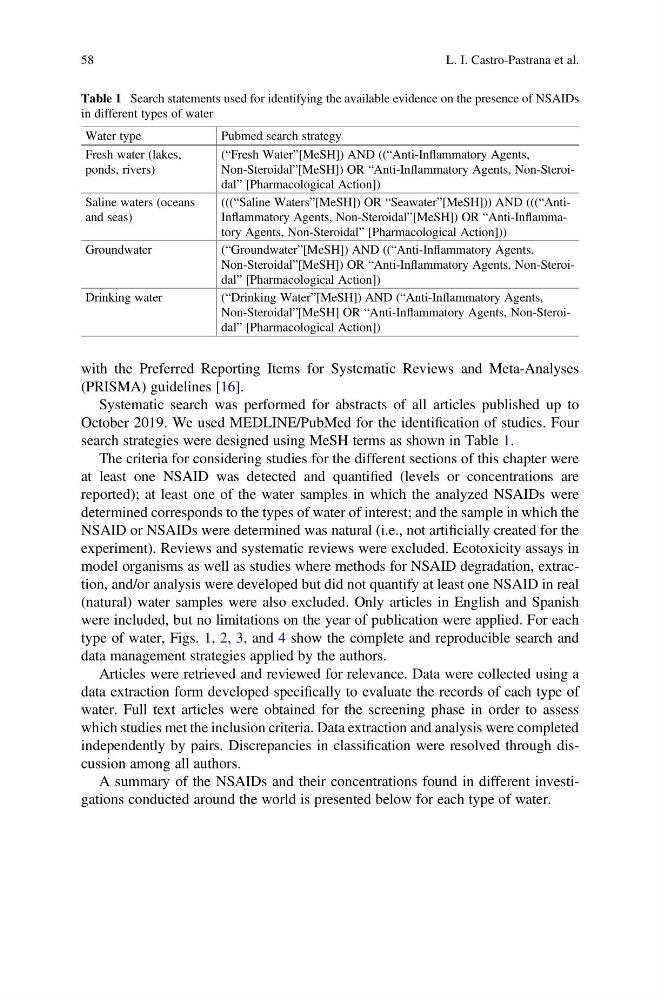
search strategies were designed using MeSH terms as shown in Table 1.
The criteria for considering studies for the different sections of this chapter were
at least one NSAID was detected and quantified (levels or concentrations are
reported); at least one of the water samples in which the analyzed NSAIDs were
determined corresponds to the types of water of interest; and the sample in which the
NSAID or NSAIDs were determined was natural (i.e., not artificially created for the
experiment). Reviews and systematic reviews were excluded. Ecotoxicity assays in
model organisms as well as studies where methods for NSAID degradation, extraction, and/or analysis were developed but did not quantify at least one NSAID in real
(natural) water samples were also excluded. Only articles in English and Spanish
were included, but no limitations on the year of publication were applied. For each
type of water, Figs. 1, 2, 3, and 4 show the complete and reproducible search and
data management strategies applied by the authors.
Articles were retrieved and reviewed for relevance. Data were collected using a
data extraction form developed specifically to evaluate the records of each type of
water. Full text articles were obtained for the screening phase in order to assess
which studies met the inclusion criteria. Data extraction and analysis were completed
independently by pairs. Discrepancies in classification were resolved through discussion among all authors.
A summary of the NSAIDs and their concentrations found in different investigations conducted around the world is presented below for each type of water.
Table 1 Search statements used for identifying the available evidence on the presence of NSAIDs
in different types of water
Water type
Pubmed search strategy
Fresh water (lakes,
ponds, rivers)
(“Fresh Water”[MeSH]) AND ((“Anti-Inflammatory Agents,
Non-Steroidal”[MeSH]) OR “Anti-Inflammatory Agents, Non-Steroidal” [Pharmacological Action])
Saline waters (oceans
and seas)
(((“Saline Waters”[MeSH]) OR “Seawater”[MeSH])) AND (((“AntiInflammatory Agents, Non-Steroidal”[MeSH]) OR “Anti-Inflammatory Agents, Non-Steroidal” [Pharmacological Action]))
Groundwater
(“Groundwater”[MeSH]) AND ((“Anti-Inflammatory Agents,
Non-Steroidal”[MeSH]) OR “Anti-Inflammatory Agents, Non-Steroidal” [Pharmacological Action])
Drinking water
(“Drinking Water”[MeSH]) AND (“Anti-Inflammatory Agents,
Non-Steroidal”[MeSH] OR “Anti-Inflammatory Agents, Non-Steroidal” [Pharmacological Action])
58
L. I. Castro-Pastrana et al.
(PRISMA) guidelines [16].
Systematic search was performed for abstracts of all articles published up to
October 2019. We used MEDLINE/PubMed for the identification of studies. Four
search strategies were designed using MeSH terms as shown in Table 1.
The criteria for considering studies for the different sections of this chapter were
at least one NSAID was detected and quantified (levels or concentrations are
reported); at least one of the water samples in which the analyzed NSAIDs were
determined corresponds to the types of water of interest; and the sample in which the
NSAID or NSAIDs were determined was natural (i.e., not artificially created for the
experiment). Reviews and systematic reviews were excluded. Ecotoxicity assays in
model organisms as well as studies where methods for NSAID degradation, extraction, and/or analysis were developed but did not quantify at least one NSAID in real
(natural) water samples were also excluded. Only articles in English and Spanish
were included, but no limitations on the year of publication were applied. For each
type of water, Figs. 1, 2, 3, and 4 show the complete and reproducible search and
data management strategies applied by the authors.
Articles were retrieved and reviewed for relevance. Data were collected using a
data extraction form developed specifically to evaluate the records of each type of
water. Full text articles were obtained for the screening phase in order to assess
which studies met the inclusion criteria. Data extraction and analysis were completed
independently by pairs. Discrepancies in classification were resolved through discussion among all authors.
A summary of the NSAIDs and their concentrations found in different investigations conducted around the world is presented below for each type of water.
Table 1 Search statements used for identifying the available evidence on the presence of NSAIDs
in different types of water
Water type
Pubmed search strategy
Fresh water (lakes,
ponds, rivers)
(“Fresh Water”[MeSH]) AND ((“Anti-Inflammatory Agents,
Non-Steroidal”[MeSH]) OR “Anti-Inflammatory Agents, Non-Steroidal” [Pharmacological Action])
Saline waters (oceans
and seas)
(((“Saline Waters”[MeSH]) OR “Seawater”[MeSH])) AND (((“AntiInflammatory Agents, Non-Steroidal”[MeSH]) OR “Anti-Inflammatory Agents, Non-Steroidal” [Pharmacological Action]))
Groundwater
(“Groundwater”[MeSH]) AND ((“Anti-Inflammatory Agents,
Non-Steroidal”[MeSH]) OR “Anti-Inflammatory Agents, Non-Steroidal” [Pharmacological Action])
Drinking water
(“Drinking Water”[MeSH]) AND (“Anti-Inflammatory Agents,
Non-Steroidal”[MeSH] OR “Anti-Inflammatory Agents, Non-Steroidal” [Pharmacological Action])
58
L. I. Castro-Pastrana et al.