

4 Nanomaterials for Electrocatalytic Degradation
of NSAIDs
As it has been pointed out, conventional treatment methods have shown a deficiency
to separate pharmaceuticals from wastewater effluents. For several reasons, these
methods are not effective enough to eliminate these pollutants from disposal waters.
For example, biological techniques can be very time-consuming [57]; adsorption
processes and filtrations require further treatments in order to remove them and do
not always show high efficiencies [58, 59]; and furthermore, some physicochemical
methods involve a low removal percentage, generation of toxic by-products, and
high operational costs [60].
Electrooxidation, as an AOP, offers several advantages that can overcome the
deficiencies of previously mentioned methods: they are cheap and environmentally
friendly and have a low energy demand and a high efficiency in wastewater
treatment, all of which make it possible for electrochemistry to be utilized in the
removal of NSAIDS and their intermediates [61, 62].
Furthermore, ever since the use of electrical techniques was proposed for water
remediation in 1889, several methods have been developed, but all of them rely on
the use of electrolysis for the removal of the compounds of interest. This can happen
in either of two ways: direct or indirect electrolysis, being understood by electrolysis
as the decomposition of a compound present in solution by applying an electrical
current or voltage [63].
Direct electrolysis applies when electrons are exchanged directly between the
compound of interest (pollutant) and the surface of an electrode at its interface [64],
whereas indirect electrolysis refers to an oxidation-reduction process at the bulk of
the solution by species that were generated at the electrode’s surface. This implies
that the pollutants’ degradation process does not necessarily occur at the surface of
an electrode, but it is initiated at it [65, 66]. For this reason, it is important to take into
account the diffusion of species from the bulk of the solution to the electrode, and
vice versa, to achieve the desired reaction [67].
It is known that when electrocatalysis of pollutants takes place by indirect
electrolysis, the efficiency of this process strongly relies on the generation of a
high concentration of oxygen reactive species at the electrode from water discharge,
which mainly implies the production of hydroxyl radicals. This reaction takes place
at the surface of the electrode as indicated in (1):
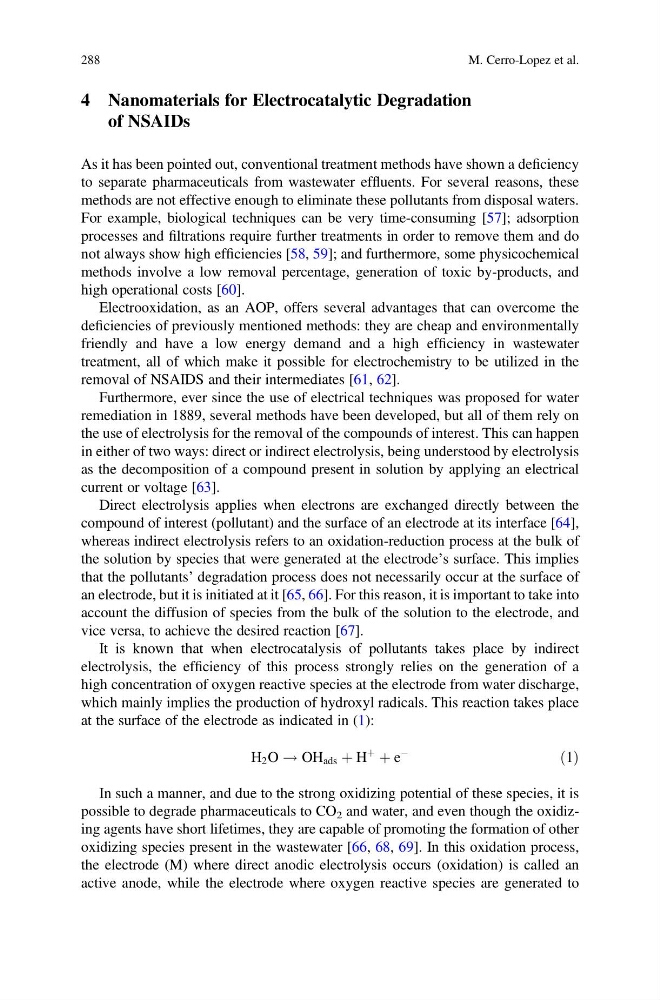
H 2 O ! OH ads þ H
þ
þ e
À
ð1Þ
In such a manner, and due to the strong oxidizing potential of these species, it is
possible to degrade pharmaceuticals to CO 2 and water, and even though the oxidizing agents have short lifetimes, they are capable of promoting the formation of other
oxidizing species present in the wastewater [66, 68, 69]. In this oxidation process,
the electrode (M) where direct anodic electrolysis occurs (oxidation) is called an
active anode, while the electrode where oxygen reactive species are generated to
288
M. Cerro-Lopez et al.
of NSAIDs
As it has been pointed out, conventional treatment methods have shown a deficiency
to separate pharmaceuticals from wastewater effluents. For several reasons, these
methods are not effective enough to eliminate these pollutants from disposal waters.
For example, biological techniques can be very time-consuming [57]; adsorption
processes and filtrations require further treatments in order to remove them and do
not always show high efficiencies [58, 59]; and furthermore, some physicochemical
methods involve a low removal percentage, generation of toxic by-products, and
high operational costs [60].
Electrooxidation, as an AOP, offers several advantages that can overcome the
deficiencies of previously mentioned methods: they are cheap and environmentally
friendly and have a low energy demand and a high efficiency in wastewater
treatment, all of which make it possible for electrochemistry to be utilized in the
removal of NSAIDS and their intermediates [61, 62].
Furthermore, ever since the use of electrical techniques was proposed for water
remediation in 1889, several methods have been developed, but all of them rely on
the use of electrolysis for the removal of the compounds of interest. This can happen
in either of two ways: direct or indirect electrolysis, being understood by electrolysis
as the decomposition of a compound present in solution by applying an electrical
current or voltage [63].
Direct electrolysis applies when electrons are exchanged directly between the
compound of interest (pollutant) and the surface of an electrode at its interface [64],
whereas indirect electrolysis refers to an oxidation-reduction process at the bulk of
the solution by species that were generated at the electrode’s surface. This implies
that the pollutants’ degradation process does not necessarily occur at the surface of
an electrode, but it is initiated at it [65, 66]. For this reason, it is important to take into
account the diffusion of species from the bulk of the solution to the electrode, and
vice versa, to achieve the desired reaction [67].
It is known that when electrocatalysis of pollutants takes place by indirect
electrolysis, the efficiency of this process strongly relies on the generation of a
high concentration of oxygen reactive species at the electrode from water discharge,
which mainly implies the production of hydroxyl radicals. This reaction takes place
at the surface of the electrode as indicated in (1):
H 2 O ! OH ads þ H
þ
þ e
À
ð1Þ
In such a manner, and due to the strong oxidizing potential of these species, it is
possible to degrade pharmaceuticals to CO 2 and water, and even though the oxidizing agents have short lifetimes, they are capable of promoting the formation of other
oxidizing species present in the wastewater [66, 68, 69]. In this oxidation process,
the electrode (M) where direct anodic electrolysis occurs (oxidation) is called an
active anode, while the electrode where oxygen reactive species are generated to
288
M. Cerro-Lopez et al.