

As we have seen different types of nanoadsorbents are now being tested to
remove NSAIDs. These adsorbents have shown to have a high and fast removal
percentage in most of the cases. We have classified, based on their composition, the
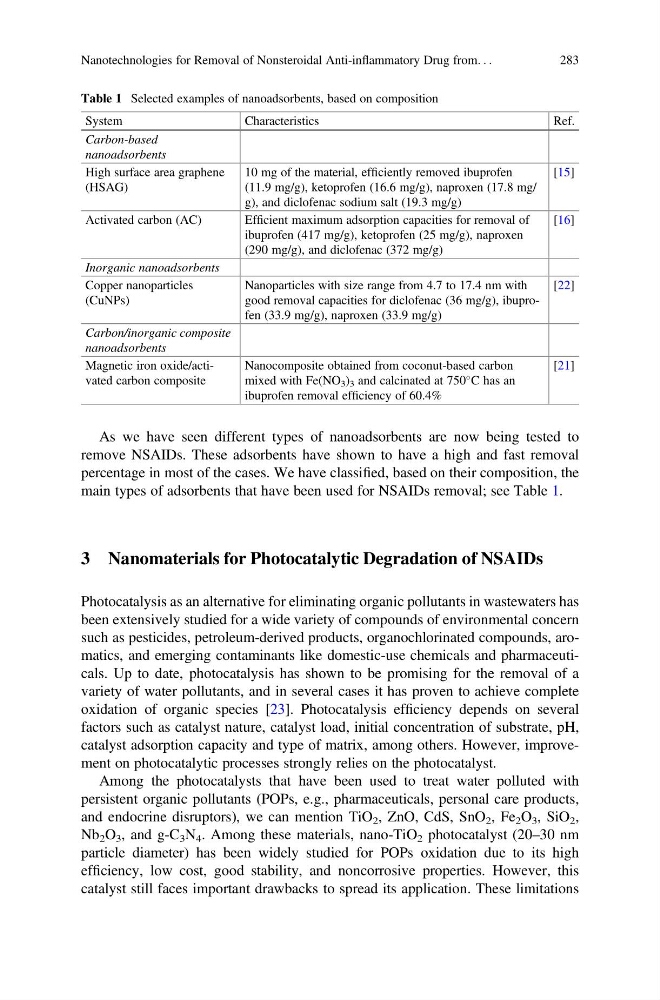
main types of adsorbents that have been used for NSAIDs removal; see Table 1.
3 Nanomaterials for Photocatalytic Degradation of NSAIDs
Photocatalysis as an alternative for eliminating organic pollutants in wastewaters has
been extensively studied for a wide variety of compounds of environmental concern
such as pesticides, petroleum-derived products, organochlorinated compounds, aromatics, and emerging contaminants like domestic-use chemicals and pharmaceuticals. Up to date, photocatalysis has shown to be promising for the removal of a
variety of water pollutants, and in several cases it has proven to achieve complete
oxidation of organic species [23]. Photocatalysis efficiency depends on several
factors such as catalyst nature, catalyst load, initial concentration of substrate, pH,
catalyst adsorption capacity and type of matrix, among others. However, improvement on photocatalytic processes strongly relies on the photocatalyst.
Among the photocatalysts that have been used to treat water polluted with
persistent organic pollutants (POPs, e.g., pharmaceuticals, personal care products,
and endocrine disruptors), we can mention TiO 2 , ZnO, CdS, SnO 2 , Fe 2 O 3 , SiO 2 ,
Nb 2 O 3 , and g-C 3 N 4 . Among these materials, nano-TiO 2 photocatalyst (20–30 nm
particle diameter) has been widely studied for POPs oxidation due to its high
efficiency, low cost, good stability, and noncorrosive properties. However, this
catalyst still faces important drawbacks to spread its application. These limitations
Table 1 Selected examples of nanoadsorbents, based on composition
System
Characteristics
Ref.
Carbon-based
nanoadsorbents
High surface area graphene
(HSAG)
10 mg of the material, efficiently removed ibuprofen
(11.9 mg/g), ketoprofen (16.6 mg/g), naproxen (17.8 mg/
g), and diclofenac sodium salt (19.3 mg/g)
[15]
Activated carbon (AC)
Efficient maximum adsorption capacities for removal of
ibuprofen (417 mg/g), ketoprofen (25 mg/g), naproxen
(290 mg/g), and diclofenac (372 mg/g)
[16]
Inorganic nanoadsorbents
Copper nanoparticles
(CuNPs)
Nanoparticles with size range from 4.7 to 17.4 nm with
good removal capacities for diclofenac (36 mg/g), ibuprofen (33.9 mg/g), naproxen (33.9 mg/g)
[22]
Carbon/inorganic composite
nanoadsorbents
Magnetic iron oxide/activated carbon composite
Nanocomposite obtained from coconut-based carbon
mixed with Fe(NO 3 ) 3 and calcinated at 750
C has an
ibuprofen removal efficiency of 60.4%
[21]
Nanotechnologies for Removal of Nonsteroidal Anti-inflammatory Drug from. . .
283
remove NSAIDs. These adsorbents have shown to have a high and fast removal
percentage in most of the cases. We have classified, based on their composition, the
main types of adsorbents that have been used for NSAIDs removal; see Table 1.
3 Nanomaterials for Photocatalytic Degradation of NSAIDs
Photocatalysis as an alternative for eliminating organic pollutants in wastewaters has
been extensively studied for a wide variety of compounds of environmental concern
such as pesticides, petroleum-derived products, organochlorinated compounds, aromatics, and emerging contaminants like domestic-use chemicals and pharmaceuticals. Up to date, photocatalysis has shown to be promising for the removal of a
variety of water pollutants, and in several cases it has proven to achieve complete
oxidation of organic species [23]. Photocatalysis efficiency depends on several
factors such as catalyst nature, catalyst load, initial concentration of substrate, pH,
catalyst adsorption capacity and type of matrix, among others. However, improvement on photocatalytic processes strongly relies on the photocatalyst.
Among the photocatalysts that have been used to treat water polluted with
persistent organic pollutants (POPs, e.g., pharmaceuticals, personal care products,
and endocrine disruptors), we can mention TiO 2 , ZnO, CdS, SnO 2 , Fe 2 O 3 , SiO 2 ,
Nb 2 O 3 , and g-C 3 N 4 . Among these materials, nano-TiO 2 photocatalyst (20–30 nm
particle diameter) has been widely studied for POPs oxidation due to its high
efficiency, low cost, good stability, and noncorrosive properties. However, this
catalyst still faces important drawbacks to spread its application. These limitations
Table 1 Selected examples of nanoadsorbents, based on composition
System
Characteristics
Ref.
Carbon-based
nanoadsorbents
High surface area graphene
(HSAG)
10 mg of the material, efficiently removed ibuprofen
(11.9 mg/g), ketoprofen (16.6 mg/g), naproxen (17.8 mg/
g), and diclofenac sodium salt (19.3 mg/g)
[15]
Activated carbon (AC)
Efficient maximum adsorption capacities for removal of
ibuprofen (417 mg/g), ketoprofen (25 mg/g), naproxen
(290 mg/g), and diclofenac (372 mg/g)
[16]
Inorganic nanoadsorbents
Copper nanoparticles
(CuNPs)
Nanoparticles with size range from 4.7 to 17.4 nm with
good removal capacities for diclofenac (36 mg/g), ibuprofen (33.9 mg/g), naproxen (33.9 mg/g)
[22]
Carbon/inorganic composite
nanoadsorbents
Magnetic iron oxide/activated carbon composite
Nanocomposite obtained from coconut-based carbon
mixed with Fe(NO 3 ) 3 and calcinated at 750
C has an
ibuprofen removal efficiency of 60.4%
[21]
Nanotechnologies for Removal of Nonsteroidal Anti-inflammatory Drug from. . .
283