

photoreactor was intermittently operated using a reaction volume of 30 mL of
effluent to be treated, and the experiments were performed using the following
methodology: Initially, the effluent was charged, and thereafter, the catalyst was
added and then stirred. After the pH was measured and adjusted as required (2.7,
5, or 8), the UV lamp was turned on and finally H 2 O 2 (30%) was added. The
temperature (T ) and stirring were kept constant at 30 Æ 2
C and 800 rpm. Samples
taken at different reaction times were subjected to a separation process in a centrifuge BOECO M-240 to remove the Fe-PILC. Sulfuric acid (96.9%) and hydrogen
peroxide (30%), both from Fermont, were used to conduct the photo-Fenton process.
The studied variables were (1) initial catalyst concentration, (2) pH, (3) initial
concentration of H 2 O 2 , and (4) initial concentration of total organic carbon of
effluent. Given the diversity of materials used for the cleaning of areas coupled
with those used in the manufacturing process, it was decided to use as primary
response variable the total organic carbon (TOC) content.
In order to make evident the effect of photo-Fenton, initially, the effluent was
separately treated with hydrogen peroxide (H 2 O 2 ), catalyst (Fe-PILCs), and UV
light. Experiments combining all of them (photo-Fenton) were also carried out. Total
organic carbon (TOC) was used as response variable. It is worth pointing out that
the H 2 O 2 stoichiometric amount used in all experiments was calculated based on the
TOC content of the effluent [36]. Figure 3 shows that in terms of mineralization, the
best treatment of the effluent is the photo-Fenton process, since it shows a significant
difference regarding TOC values with the other essayed treatments after 3 hours of
reaction. These results showed that the photo-Fenton process can be carried out
without changing pH effluent. At the same conditions, however, and only decreasing
pH to 2.7, a greater mineralization of 51.0% was attained. Therefore, the other
variables were studied under a pH 2.7, and further below the results of a systematic
study of pH are also presented.
The results shown in Fig. 4 allow to discard the adsorption of contaminants onto
the catalytic surface. Furthermore, from Fig. 4, it can also be inferred that the
hydroxyl radical generation by photolysis of hydrogen peroxide via reaction 7 [37]
is rather slow.
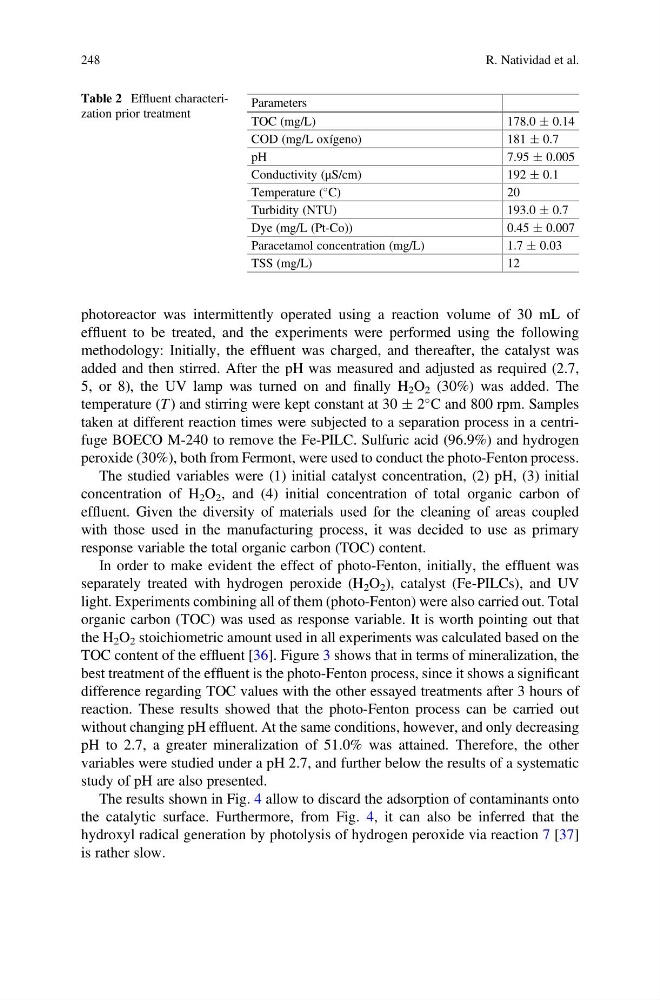
Table 2 Effluent characterization prior treatment
Parameters
TOC (mg/L)
178.0 Æ 0.14
COD (mg/L oxígeno)
181 Æ 0.7
pH
7.95 Æ 0.005
Conductivity (μS/cm)
192 Æ 0.1
Temperature (
C)
20
Turbidity (NTU)
193.0 Æ 0.7
Dye (mg/L (Pt-Co))
0.45 Æ 0.007
Paracetamol concentration (mg/L)
1.7 Æ 0.03
TSS (mg/L)
12
248
R. Natividad et al.
effluent to be treated, and the experiments were performed using the following
methodology: Initially, the effluent was charged, and thereafter, the catalyst was
added and then stirred. After the pH was measured and adjusted as required (2.7,
5, or 8), the UV lamp was turned on and finally H 2 O 2 (30%) was added. The
temperature (T ) and stirring were kept constant at 30 Æ 2
C and 800 rpm. Samples
taken at different reaction times were subjected to a separation process in a centrifuge BOECO M-240 to remove the Fe-PILC. Sulfuric acid (96.9%) and hydrogen
peroxide (30%), both from Fermont, were used to conduct the photo-Fenton process.
The studied variables were (1) initial catalyst concentration, (2) pH, (3) initial
concentration of H 2 O 2 , and (4) initial concentration of total organic carbon of
effluent. Given the diversity of materials used for the cleaning of areas coupled
with those used in the manufacturing process, it was decided to use as primary
response variable the total organic carbon (TOC) content.
In order to make evident the effect of photo-Fenton, initially, the effluent was
separately treated with hydrogen peroxide (H 2 O 2 ), catalyst (Fe-PILCs), and UV
light. Experiments combining all of them (photo-Fenton) were also carried out. Total
organic carbon (TOC) was used as response variable. It is worth pointing out that
the H 2 O 2 stoichiometric amount used in all experiments was calculated based on the
TOC content of the effluent [36]. Figure 3 shows that in terms of mineralization, the
best treatment of the effluent is the photo-Fenton process, since it shows a significant
difference regarding TOC values with the other essayed treatments after 3 hours of
reaction. These results showed that the photo-Fenton process can be carried out
without changing pH effluent. At the same conditions, however, and only decreasing
pH to 2.7, a greater mineralization of 51.0% was attained. Therefore, the other
variables were studied under a pH 2.7, and further below the results of a systematic
study of pH are also presented.
The results shown in Fig. 4 allow to discard the adsorption of contaminants onto
the catalytic surface. Furthermore, from Fig. 4, it can also be inferred that the
hydroxyl radical generation by photolysis of hydrogen peroxide via reaction 7 [37]
is rather slow.
Table 2 Effluent characterization prior treatment
Parameters
TOC (mg/L)
178.0 Æ 0.14
COD (mg/L oxígeno)
181 Æ 0.7
pH
7.95 Æ 0.005
Conductivity (μS/cm)
192 Æ 0.1
Temperature (
C)
20
Turbidity (NTU)
193.0 Æ 0.7
Dye (mg/L (Pt-Co))
0.45 Æ 0.007
Paracetamol concentration (mg/L)
1.7 Æ 0.03
TSS (mg/L)
12
248
R. Natividad et al.