

surface waters. Heath et al. [45] investigated and compared the influence of different
filter materials on the analysis of multiple NSAIDs samples from a Spain river water.
Although the main scope of this study was to determine possible sources of
variation, researchers reported IBF reached concentrations of up 11.89 μg/L in that
river.
Other NSAIDs, such as NPX and ASA, have been also found in concentrations of
environmental relevance. For instance, Selke et al. [5] quantified NPX in eight
different surface water samples of Pakistan. According to their results, NPX reached
maximum concentrations of 32 μg/L in one major river. Researchers explained this
was due to eight different pharmaceutical manufacturers which did not treat their
effluents before entering the river.
In Canada, Brun et al. [4] investigated the occurrence of multiple pharmaceuticals
in WWTP effluents and receiving waters of the four Atlantic Canadian Provinces.
Their results demonstrated ASA persisted in samples as far as 17 km downstream
from the WWTPs, with concentrations ranging from 0.057 to 17 μg/L.
3.3 Drinking Water and Groundwater
Groundwater constitutes 97% of the global freshwater and is the single most
important supply for the production of drinking water. Therefore, it is vital that the
quality of groundwater must be protected. However, compared with the thoroughly
research undertaken to assess the occurrence of NSAIDs in surface water, there is a
lack of interest in evaluating their presence in groundwater.
Spain, France, Iran, Germany, and Norway are the only countries that have
reported the occurrence of NSAIDs in drinking water. The highest concentrations
of these drugs in this vital resource were found in Spain, when Heath et al. [45]
demonstrated NPX, DCF, IBF, and ketoprofen (KTP) which were present in concentrations of over 0.500 μg/L.
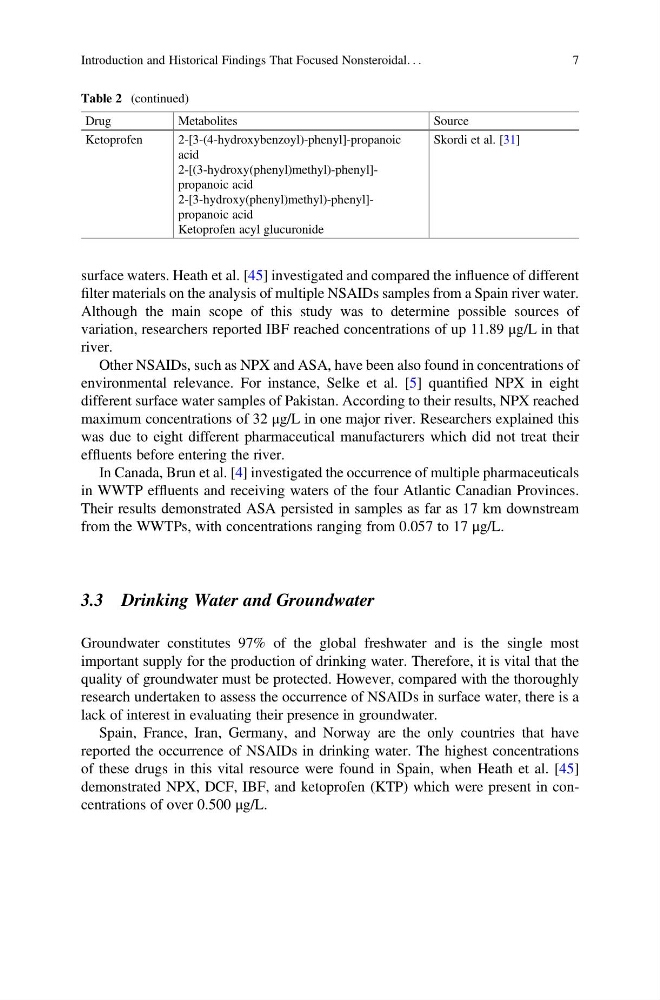
Table 2 (continued)
Drug
Metabolites
Source
Ketoprofen
2-[3-(4-hydroxybenzoyl)-phenyl]-propanoic
acid
2-[(3-hydroxy(phenyl)methyl)-phenyl]propanoic acid
2-[3-hydroxy(phenyl)methyl)-phenyl]propanoic acid
Ketoprofen acyl glucuronide
Skordi et al. [31]
Introduction and Historical Findings That Focused Nonsteroidal. . .
7
filter materials on the analysis of multiple NSAIDs samples from a Spain river water.
Although the main scope of this study was to determine possible sources of
variation, researchers reported IBF reached concentrations of up 11.89 μg/L in that
river.
Other NSAIDs, such as NPX and ASA, have been also found in concentrations of
environmental relevance. For instance, Selke et al. [5] quantified NPX in eight
different surface water samples of Pakistan. According to their results, NPX reached
maximum concentrations of 32 μg/L in one major river. Researchers explained this
was due to eight different pharmaceutical manufacturers which did not treat their
effluents before entering the river.
In Canada, Brun et al. [4] investigated the occurrence of multiple pharmaceuticals
in WWTP effluents and receiving waters of the four Atlantic Canadian Provinces.
Their results demonstrated ASA persisted in samples as far as 17 km downstream
from the WWTPs, with concentrations ranging from 0.057 to 17 μg/L.
3.3 Drinking Water and Groundwater
Groundwater constitutes 97% of the global freshwater and is the single most
important supply for the production of drinking water. Therefore, it is vital that the
quality of groundwater must be protected. However, compared with the thoroughly
research undertaken to assess the occurrence of NSAIDs in surface water, there is a
lack of interest in evaluating their presence in groundwater.
Spain, France, Iran, Germany, and Norway are the only countries that have
reported the occurrence of NSAIDs in drinking water. The highest concentrations
of these drugs in this vital resource were found in Spain, when Heath et al. [45]
demonstrated NPX, DCF, IBF, and ketoprofen (KTP) which were present in concentrations of over 0.500 μg/L.
Table 2 (continued)
Drug
Metabolites
Source
Ketoprofen
2-[3-(4-hydroxybenzoyl)-phenyl]-propanoic
acid
2-[(3-hydroxy(phenyl)methyl)-phenyl]propanoic acid
2-[3-hydroxy(phenyl)methyl)-phenyl]propanoic acid
Ketoprofen acyl glucuronide
Skordi et al. [31]
Introduction and Historical Findings That Focused Nonsteroidal. . .
7