

employed the measured environmental concentration reported by Ebele et al. [97]
where the current state of knowledge about global pharmaceutical levels has been
reviewed. Using a PEC proposed by Ebele et al. [97] of 57 ng g
À1 corresponding to
worst-case scenarios, the resulting RQ for DF was 0.19, indicating medium risk.
6 New Approaches: Mechanistic Risk Assessment
The currently widely employed assessment factor approach is increasingly criticized
for being not sufficiently ecologically relevant and uncertain but also little comprehensive and coherent, apart from being practically and economically impossible to
test all existing and new chemicals that are on the market in different test species and
developmental stages. In this context, the World Health Organization (WHO) works
to establish, through the International Programme on Chemical Safety (IPCS), the
scientific basis for the sound management of chemicals, proposing to integrate
weight mechanistic evidence in hazard and risk assessment. In a time where regulatory agents are facing legislative imperatives which require greater efficiency in
chemical assessment and management with progressively less reliance on animal
testing, recent developments in risk identification are now taking advantage on
evolving technologies able to provide high-throughput biological data at lower
levels of organization (e.g., transcriptomics, proteomics, and metabolomics) and
increasing computational capacity for data assimilation and prediction.
The adverse outcome pathway (AOP) conceptual framework [98] is a logical
sequence of events or processes within biological systems which can be used to
understand adverse effects and refine current risk assessment practices with the
purpose to develop predictive methods for human and environmental toxicology.
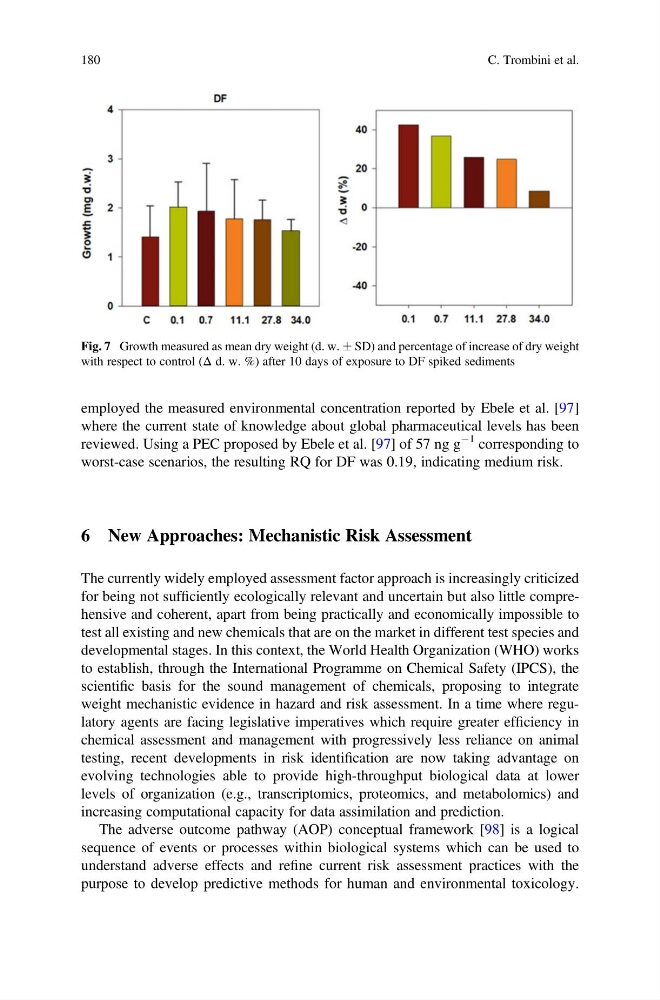
Fig. 7 Growth measured as mean dry weight (d. w. Æ SD) and percentage of increase of dry weight
with respect to control (Δ d. w. %) after 10 days of exposure to DF spiked sediments
180
C. Trombini et al.
where the current state of knowledge about global pharmaceutical levels has been
reviewed. Using a PEC proposed by Ebele et al. [97] of 57 ng g
À1 corresponding to
worst-case scenarios, the resulting RQ for DF was 0.19, indicating medium risk.
6 New Approaches: Mechanistic Risk Assessment
The currently widely employed assessment factor approach is increasingly criticized
for being not sufficiently ecologically relevant and uncertain but also little comprehensive and coherent, apart from being practically and economically impossible to
test all existing and new chemicals that are on the market in different test species and
developmental stages. In this context, the World Health Organization (WHO) works
to establish, through the International Programme on Chemical Safety (IPCS), the
scientific basis for the sound management of chemicals, proposing to integrate
weight mechanistic evidence in hazard and risk assessment. In a time where regulatory agents are facing legislative imperatives which require greater efficiency in
chemical assessment and management with progressively less reliance on animal
testing, recent developments in risk identification are now taking advantage on
evolving technologies able to provide high-throughput biological data at lower
levels of organization (e.g., transcriptomics, proteomics, and metabolomics) and
increasing computational capacity for data assimilation and prediction.
The adverse outcome pathway (AOP) conceptual framework [98] is a logical
sequence of events or processes within biological systems which can be used to
understand adverse effects and refine current risk assessment practices with the
purpose to develop predictive methods for human and environmental toxicology.
Fig. 7 Growth measured as mean dry weight (d. w. Æ SD) and percentage of increase of dry weight
with respect to control (Δ d. w. %) after 10 days of exposure to DF spiked sediments
180
C. Trombini et al.