

development happening typically in the sediment. In the past years, the number of
studies that have reported the negative effects of pharmaceutical compounds on
benthic macroinvertebrates from contaminated sediments employing midges has
increased significantly [90–95]. Among the analyzed responses in these studies,
the authors observed decrease of emergence, reduced growth, increase of the
biomass, and increase of the female/male ratio in spiked sediment exposure experiments at low concentrations with different pharmaceuticals. Nieto et al. [96] carried
out chronic toxicity experiments (21 days) with DF spiked sediments analyzing the
endpoints survival, growth (biomass) and developmental stage (day 10), emergence
rate, cumulative emergence, and sex ratio (male/female) (days 15–21) in low-level
dose-response exposures comprised between 0.1 and 34.04 μg g
À1 .
At these concentrations, no significant mortality was observed nor was development having reached all organisms the fourth instar [96] at the end of the experiment.
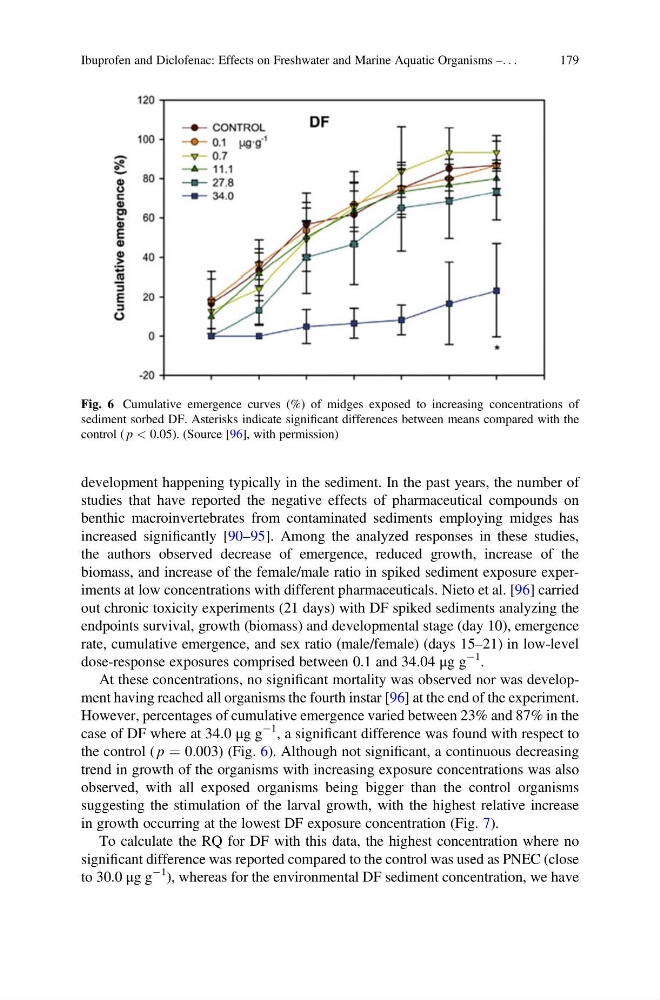
However, percentages of cumulative emergence varied between 23% and 87% in the
case of DF where at 34.0 μg g
À1 , a significant difference was found with respect to
the control ( p ¼ 0.003) (Fig. 6). Although not significant, a continuous decreasing
trend in growth of the organisms with increasing exposure concentrations was also
observed, with all exposed organisms being bigger than the control organisms
suggesting the stimulation of the larval growth, with the highest relative increase
in growth occurring at the lowest DF exposure concentration (Fig. 7).
To calculate the RQ for DF with this data, the highest concentration where no
significant difference was reported compared to the control was used as PNEC (close
to 30.0 μg g
À1 ), whereas for the environmental DF sediment concentration, we have
Fig. 6 Cumulative emergence curves (%) of midges exposed to increasing concentrations of
sediment sorbed DF. Asterisks indicate significant differences between means compared with the
control ( p < 0.05). (Source [96], with permission)
Ibuprofen and Diclofenac: Effects on Freshwater and Marine Aquatic Organisms –. . .
179
studies that have reported the negative effects of pharmaceutical compounds on
benthic macroinvertebrates from contaminated sediments employing midges has
increased significantly [90–95]. Among the analyzed responses in these studies,
the authors observed decrease of emergence, reduced growth, increase of the
biomass, and increase of the female/male ratio in spiked sediment exposure experiments at low concentrations with different pharmaceuticals. Nieto et al. [96] carried
out chronic toxicity experiments (21 days) with DF spiked sediments analyzing the
endpoints survival, growth (biomass) and developmental stage (day 10), emergence
rate, cumulative emergence, and sex ratio (male/female) (days 15–21) in low-level
dose-response exposures comprised between 0.1 and 34.04 μg g
À1 .
At these concentrations, no significant mortality was observed nor was development having reached all organisms the fourth instar [96] at the end of the experiment.
However, percentages of cumulative emergence varied between 23% and 87% in the
case of DF where at 34.0 μg g
À1 , a significant difference was found with respect to
the control ( p ¼ 0.003) (Fig. 6). Although not significant, a continuous decreasing
trend in growth of the organisms with increasing exposure concentrations was also
observed, with all exposed organisms being bigger than the control organisms
suggesting the stimulation of the larval growth, with the highest relative increase
in growth occurring at the lowest DF exposure concentration (Fig. 7).
To calculate the RQ for DF with this data, the highest concentration where no
significant difference was reported compared to the control was used as PNEC (close
to 30.0 μg g
À1 ), whereas for the environmental DF sediment concentration, we have
Fig. 6 Cumulative emergence curves (%) of midges exposed to increasing concentrations of
sediment sorbed DF. Asterisks indicate significant differences between means compared with the
control ( p < 0.05). (Source [96], with permission)
Ibuprofen and Diclofenac: Effects on Freshwater and Marine Aquatic Organisms –. . .
179